What is the angiography error when defining myocardial ischemia during percutaneous coronary interventions?
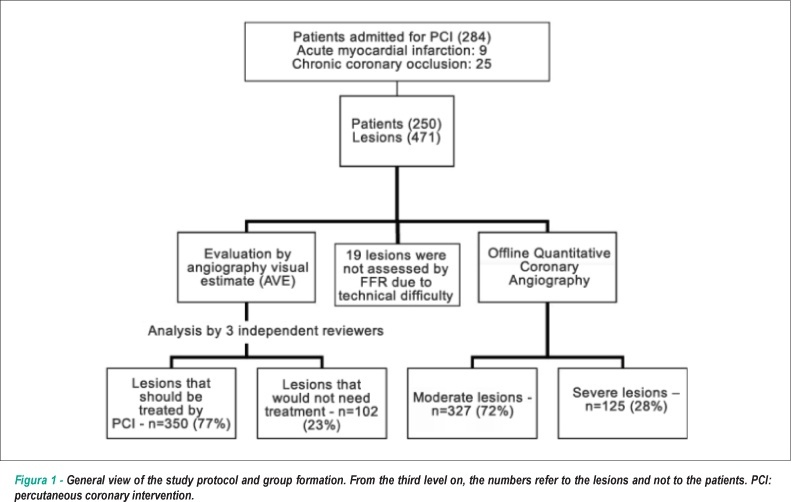
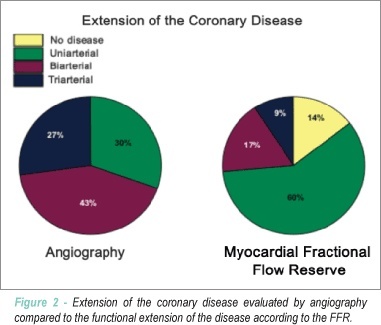
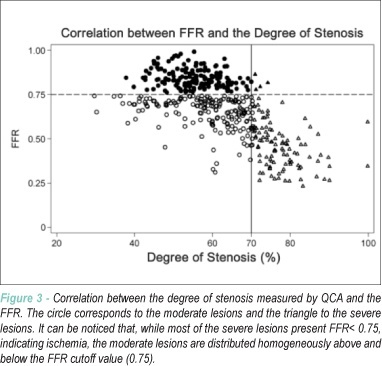
BACKGROUND: The angiography has been used as a reference standard to define coronary artery disease (CAD), although its limitations are well-known. The significance of the myocardial fractional flow reserve (FFR) in the assessment of CAD is well established. OBJECTIVE: The aim of this study was to evaluate the accuracy of angiography when defining ischemic lesions and its correlation with FFR. METHODS: Two hundred and fifty consecutive patients (471 arteries) were included in this study. All stenoses > 50% at the angiography visual estimate (AVE) were assessed by FFR measurements. When FFR was 0.75, no interventional treatment was carried out. Offline quantitative coronary angiography (QCA) was performed in all stenoses, which were divided in intermediate (< 70% – 327) and severe (125). The correlation coefficients between the diameter of the stenosis (%DS) and FFR and the accuracy of VA of the angiography when assessing ischemia were determined. RESULTS: FFR could be obtained in 452 lesions (96%). Mean %DS and FFR were 56 ± 8% and 0.74 and 76 ± 6% and 0.48 for moderate and severe stenoses, respectively. Concordance between QCA and FFR was poor, especially in intermediate stenoses (Spearman's rho = – 0.33, p<0.0001). Visual assessment resulted in an accuracy of 57% and 96% in intermediate and severe lesions, respectively. CONCLUSION: Neither the visual assessment of an angiogram nor QCA can accurately predict the significance of most intermediate coronary stenoses, which emphasizes the importance of associating it to a functional evaluation of the coronary circulation, resulting in an adequate treatment of these stenoses.
Images
Image gallery fullscreen viewer
Comments are moderated by the editorial team before publication. Discussions should be evidence-based and use scientific language. Conflicts of interest should be declared.