Acute effect of resistance exercise intensity in cardiac autonomic modulation after exercise
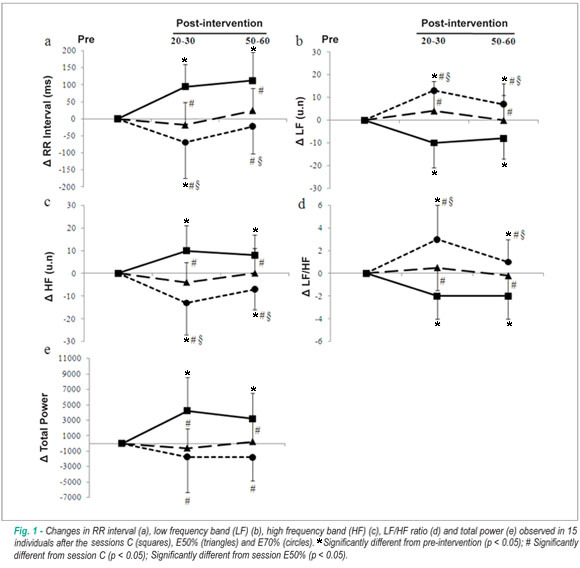
BACKGROUND: Cardiac sympathovagal balance is altered after resistance exercise. However, the impact of the characteristics of resistance training in this response remains unclear. OBJECTIVE: Analyze the acute effect of resistance exercise intensity for trunk and upper limbs in cardiac autonomic modulation after exercise. METHODS: Fifteen young men performed three experimental sessions in random order: control (C), resistance exercise with 50% of 1-RM (E50%) and resistance exercise with 70% of 1-RM (E70%). The sessions included 05 exercises for the trunk and upper limbs performed in three sets of 12, 9 and 6 repetitions, respectively. Before and at 20 and 50 minutes after the interventions, the heart rate was measured for spectral analysis of variability. RESULTS: In comparison to the values before the intervention, the RR interval and the band of high frequency (HF) increased (major changes: + 112 ± 83 ms; +10 ± 11 un, respectively, p < 0.01), while the low frequency band (LF) and LF/HF ratio decreased (major changes: -10 ± 11 pc; -2 ± 2, respectively, p 0.05). Compared to pre-exercise values, the RR interval and the HF band decreased (major changes: -69 ± 105 ms; -13 ± 14 un, respectively, p <0.01), while the LF band and the LF/HF ratio increased (major changes: -13 ± 14 un, 13 ± 3 14 ± 3 and un, respectively, p <0.01) after E70%. CONCLUSION: The higher intensity of resistance exercise for trunk and upper limbs promoted, in an acute manner, greater increase in cardiac sympathovagal balance after exercise.
Images
Image gallery fullscreen viewer
Comments are moderated by the editorial team before publication. Discussions should be evidence-based and use scientific language. Conflicts of interest should be declared.