Duke Activity Status Index for Cardiovascular Diseases: Validation of the Portuguese Translation
Background:
The Duke Activity Status Index (DASI) assesses the functional capacity of patients with cardiovascular disease (CVD), but there is no Portuguese version validated for CVD.
Objectives:
To translate and adapt cross-culturally the DASI for the Portuguese-Brazil language, and to verify its psychometric properties in the assessment of functional capacity of patients with CVD.
Methods:
The DASI was translated into Portuguese, then checked by back-translation into English and evaluated by an expert committee. The pre-test version was first evaluated in 30 subjects. The psychometric properties and correlation with exercise testing was performed in a second group of 67 subjects. An exploratory factor analyses was performed in all 97 subjects to verify the construct validity of the DASI.
Results:
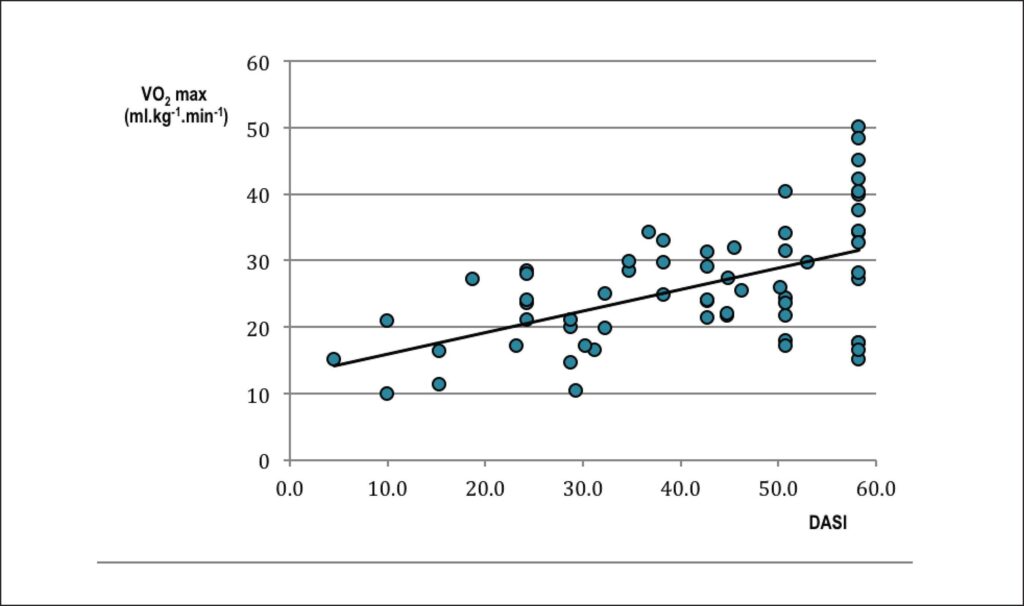
The intraclass correlation coefficient for test-retest reliability was 0.87 and for the inter-rater reliability was 0.84. Cronbach’s α for internal consistency was 0.93. The concurrent validity was verified by significant positive correlations of DASI scores with the VO2max (r = 0.51, p < 0.001). The factor analysis yielded two factors, which explained 54% of the total variance, with factor 1 accounting for 40% of the variance. Application of the DASI required between one and three and a half minutes per patient.
Conclusions:
The Brazilian version of the DASI appears to be a valid, reliable, fast and easy to administer tool to assess functional capacity among patients with CVD.
Images
Image gallery fullscreen viewer
Comments are moderated by the editorial team before publication. Discussions should be evidence-based and use scientific language. Conflicts of interest should be declared.