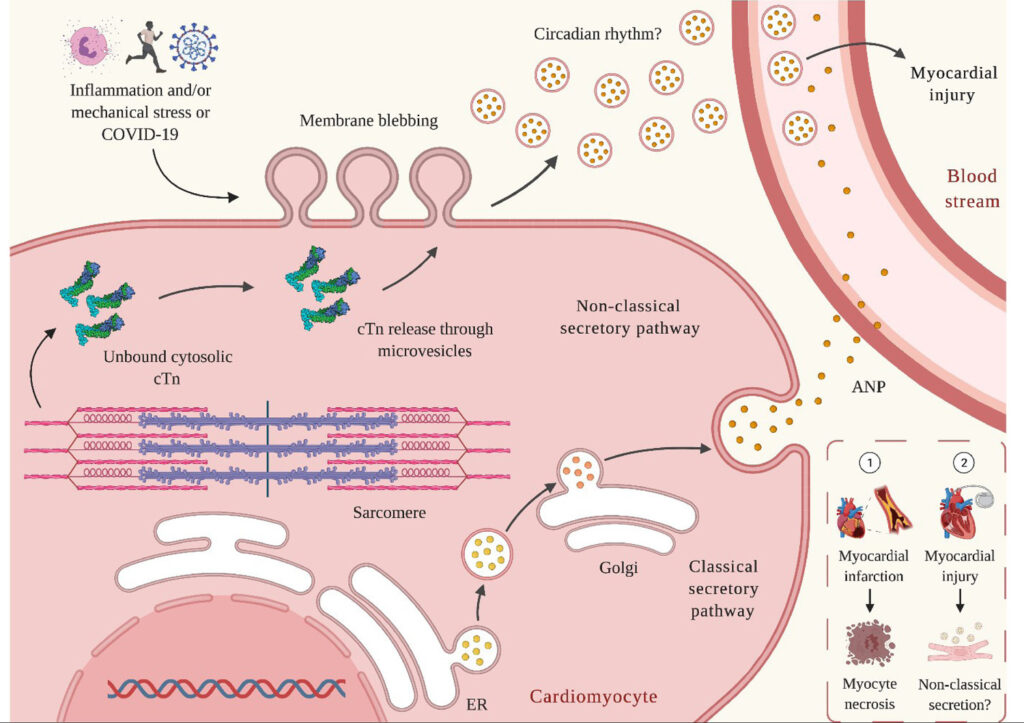
Non-Classical Secretion: A Possible Mechanism to Explain Cardiac Troponin Elevations in the Absence of Acute Myocardial Infarction
Introduction
Nowadays, high-sensitivity cardiac troponin (hs-cTn) assays are available for clinical use and are part of the definition of acute myocardial infarction (AMI). , However, troponin elevation is not limited to AMI, since other conditions related to oxygen demand mismatch, direct myocardial damage, increased myocardial strain, systemic processes (i.e. sepsis), neurological disease and renal failure can also result in its increase.Troponin can now also be detected in atypical scenarios, such as in strenuous endurance exercise, rapid atrial pacing, and dobutamine stress echocardiography, as well as in 50% to 100% of healthy subjects. ,
From a physiological point of view, troponin is a protein complex that regulates myofibrillar function, consisting of three subunits: I, T and C. In the case of troponin I and troponin T, there are three different tissue-specific isoforms: fast-twitch skeletal, slow-twitch skeletal and cardiac specific (fsTn, ssTn and cTn).Conversely, TnC has two isoforms, one present in fast-twitch skeletal muscle (fsTnC) and one that expresses in both slow-twitch skeletal and cardiac muscle (ssTnC/cTnC).
[…]
Images
Image gallery fullscreen viewer
Comments are moderated by the editorial team before publication. Discussions should be evidence-based and use scientific language. Conflicts of interest should be declared.