Catheter-Directed Therapy for the Management of Intermediate-High-Risk and High-Risk Pulmonary Embolism: Experience from a Single-Centre in Portugal
Abstract
Background:
Acute pulmonary embolism (PE) is a significant cause of morbimortality. Epidemiological data in Portugal are limited, potentially leading to underdiagnosis. Catheter-directed therapy (CDT) is a promising alternative treatment, particularly for high-risk patients.
Objectives:
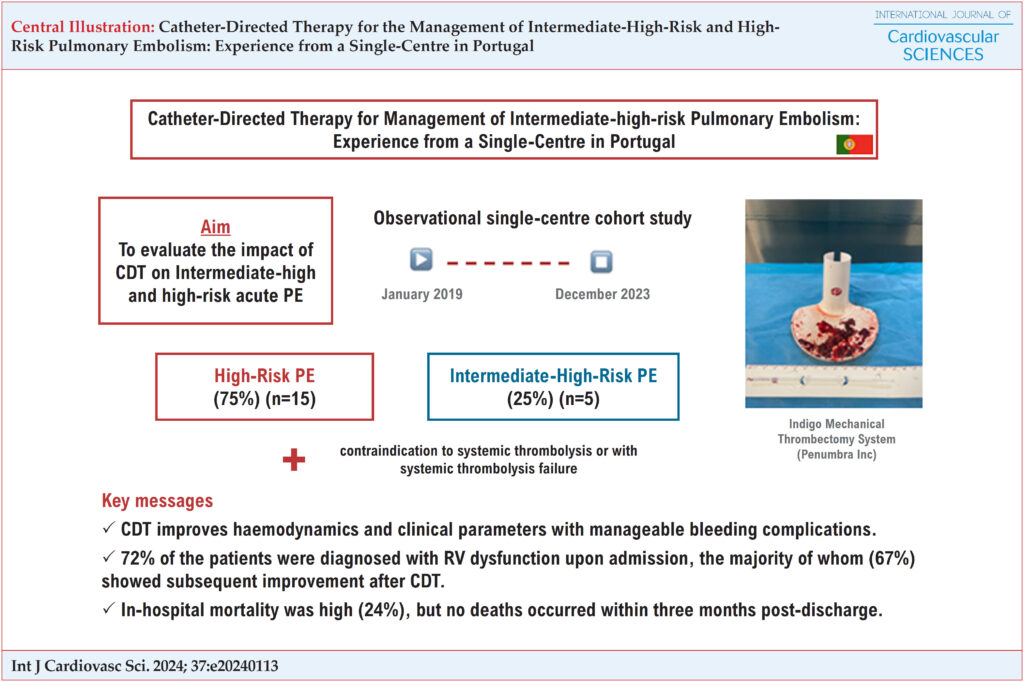
To evaluate the impact of CDT on intermediate-high-risk and high-risk acute PE.
Methods:
This is a retrospective single-centre study conducted from 2019 to 2023 in Portugal. Data included patient demographics, clinical presentation, procedural characteristics, and outcomes. Comparisons before and after the procedure were carried out, using two-sided paired Student´s T-test or McNemar´s test. P-value < 0.05 was considered statistically significant.
Results:
Among the 21 patients included in this study, the mean age was 62.5 (±16.8) years and 57% (n = 12) were female. Bilateral PE was predominant (n=18, 86%), with fifteen patients (75%) classified as high-risk PE and five (25%) as intermediate-high-risk PE. Overweight (n = 12, 57%), hypertension (n = 9, 45%), dyslipidaemia (n = 8, 40%), immobility (n = 4, 20%), and active cancer (n=3, 14%) were prevalent comorbidities. The median Charlson Comorbidity Index score was 3.5 (IQR 1.2–4.0). Two-thirds (n = 10, 67%) of the patients with high-risk PE exhibited contraindications to systemic fibrinolysis, while one-third (n = 5, 33%) had previously undergone failed thrombolysis. CDT improved hemodynamic parameters, significantly reducing the right ventricular (RV) dysfunction after the procedure (72.2% vs 23.5%, p=0.008). There was a low incidence of bleeding complications, with only one patient (5%) experiencing life-threatening haemorrhage. Despite these improvements, in-hospital mortality remained high (n = 5, 24%). No deaths occurred within three months post-discharge.
Conclusions:
Despite being in its early stages, CDT showed encouraging results in improving hemodynamic and clinical parameters in intermediate-high-risk and high-risk acute PE patients. Larger trials are warranted to further evaluate its efficacy and establish its role in treatment protocols.
Images
Image gallery fullscreen viewer
Comments are moderated by the editorial team before publication. Discussions should be evidence-based and use scientific language. Conflicts of interest should be declared.