ABC Family Arquivos Brasileiros de Cardiologia International Journal of Cardiovascular Sciences ABC Heart Failure & Cardiomyopathy ABC Imagem Cardiovascular
Português English
ABC Family
Português English
  • About
    • About ABC Family
    • Internal Regulation
    • Editorial Board
    • Brazilian Society of Cardiology (SBC)
  • Issues
  • SBC Guidelines
  • Content
    • Videos
    • Podcasts
    • News
  • About
    • About ABC Family
    • Internal Regulation
    • Editorial Board
    • Brazilian Society of Cardiology (SBC)
  • Issues
  • SBC Guidelines
  • Content
    • Videos
    • Podcasts
    • News

ABC Family

  • ABC Family
  • Arquivos Brasileiros de Cardiologia
  • International Journal of Cardiovascular Sciences
  • ABC Heart Failure & Cardiomyopathy
  • ABC Imagem Cardiovascular
Search in

No content found.

Journals
Ordering
Article types
Others

  1. Home
  2. Keyword: Percutaneous Occlusion
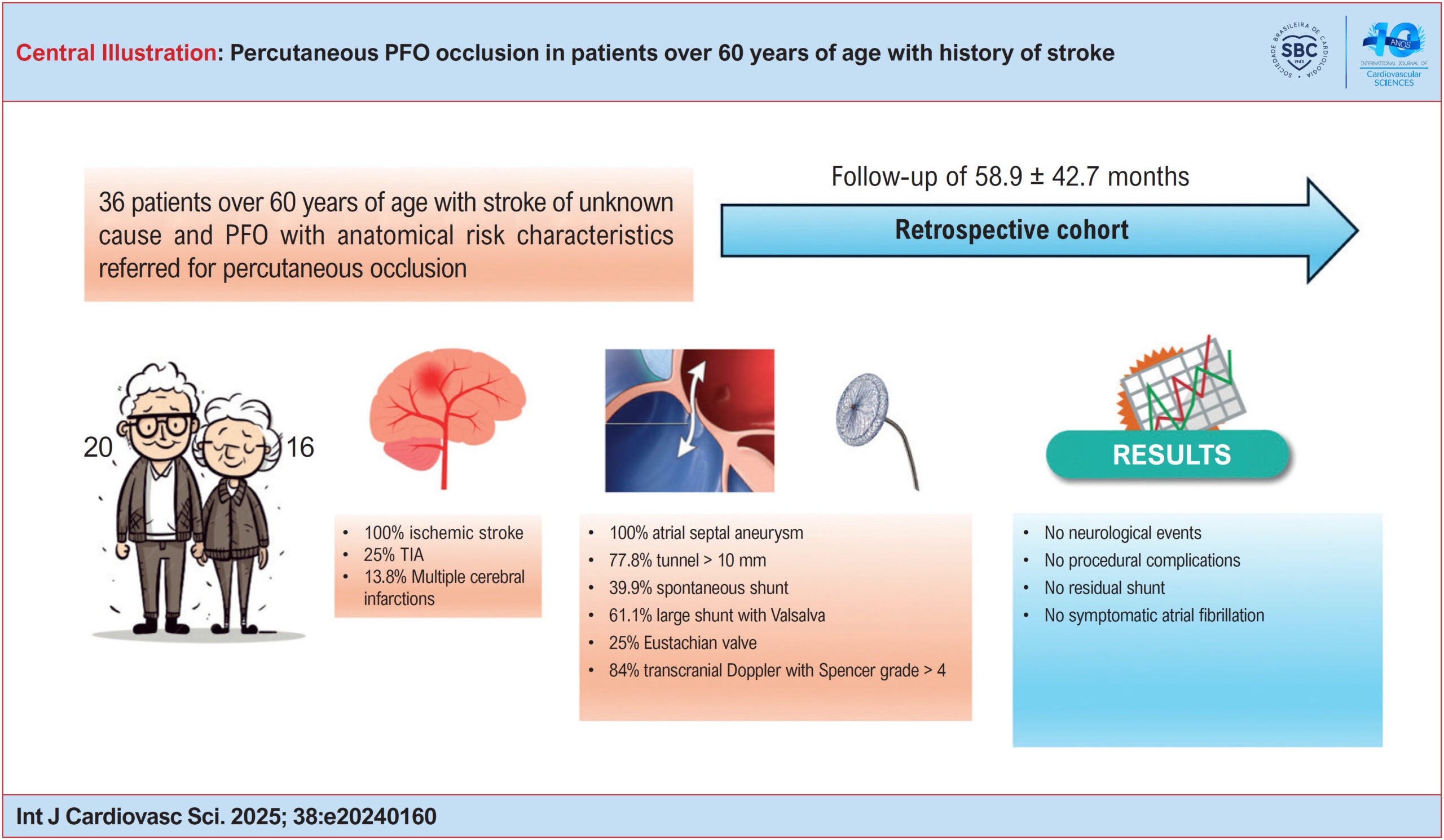
Central Illustration
IJCS
Original Article

Percutaneous Patent Foramen Ovale Occlusion in Patients Over 60 Years of Age with History of Stroke

Marcelo Sabedotti et al. Luciano da Silva Selistre Agda Mezzomo Fabio Eduardo Camazzola … Ramiro Caldas Degrazia Bibiana Guimarães Maggi Sara Voltolini

Abstract

Background:

The prevalence of patent foramen ovale (PFO) is 27%. PFO is related to paradoxical embolism, which can cause ischemic stroke. Ischemic stroke without an identifiable cause is common, accounting for up to 40% of cases, and PFO is frequently found in these patients. The prevalence of PFO is almost 3 times higher in elderly patients with ischemic stroke without identified etiology, suggesting that these patients may also benefit from PFO closure.

Objectives:

The primary objective was to assess the recurrence of ischemic stroke or transient ischemic attack during clinical follow-up. The secondary objective was to assess the occurrence of procedural complications, onset of atrial fibrillation, and reduced anticoagulant use.

Methods:

This retrospective cohort study included 36 patients over 60 years of age with prior ischemic stroke who underwent PFO closure. Survival analysis was performed using the Kaplan-Meier model. Independence tests between categorical variables were performed using the chi-square test and Fisher’s exact test, adopting a significance level of 0.05.

Results:

The patients’ mean age was 69.6 ± 6.5 years, and 55.5% were men. No complications occurred during the procedures. Echocardiography was performed 30 days after the intervention, showing no residual shunts. During the follow-up of 58.9 ± 42.7 months, there were no cases of ischemic stroke, transient ischemic attack, or atrial fibrillation related to the procedure. The use of anticoagulants decreased from 41.7% to 5.6% (p = 0.03).

Conclusions:

Percutaneous PFO occlusion for the prevention of cerebrovascular events in individuals over 60 years of age with prior ischemic stroke is effective and safe, with a low risk of complications, and it can reduce the risk of bleeding by reducing the use of anticoagulants.
  • Aged
  • Ischemic Stroke
  • Patent Foramen Ovale
  • Percutaneous Occlusion
  • Stroke
Read Full Article
Creative Commons Attribution (CC BY) Creative Commons license
11/04/2025 DOI: 10.36660/ijcs.20240160
Interventricular septal defects percutaneous occlusion: initial experiment
ABC
Artigo Original

Interventricular septal defects percutaneous occlusion: initial experiment

Francisco José Araújo Chamié de Queiróz et al. Raul Ivo Rossi Filho Sérgio Ramos César Esteves … Daniel Silva Chamié de Queiróz Paulo Renato Machado João Carlos Tress Stella Suzana Horowitz Helder Paupério Rosaura Victer

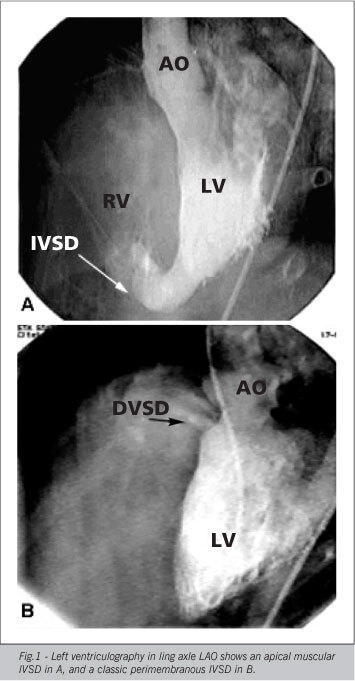
OBJECTIVE: To assess the initial experiment with percutaneous closure of interventricular septal defects (IVSD), especially perimembranous IVSD (PMIVSD) with the new Amplatzer prosthesis. METHODS: Eleven patients were submitted to the procedure. Six of them had perimembranous IVSD (PMIVSD) and five with muscular IVSD (MIVSD). Two showed repeated respiratory tract infections and had low ponderal gain. One of them showed a previous history of infectious endocarditis. The others were asymptomatic and were selected through transthoracic echocardiography (TTE). RESULTS: In MIVSD group (n=5), a patient had apical IVSD, two had medioseptal defects and two patients showed multiple defects. In this group, an interatrial septal defects (IASD) (Amplatzer Septal Occluder®) and five prostheses for MIVSD (Amplatzer VSD-MUSC Occluder®), and one patient received two devices. All implants were well-succeeded and went by without complications. In PMIVSD group (n=6), two patients had membranous septal aneurysms. In five, we identified two orifices with selective angiography. We used arterial canal Amplatzer prostheses (ACP) (Amplatzer Duct Occluder®) in 1 patient and specific prostheses for PMIVSD in the others (Amplatzer VSD-MEMB Occluder®). A perimembranous occluder migrated immediately after released, being removed from the descending aorta. Another patient showed total atrioventricular block (TAVB), which reversed after corticotherapy. CONCLUSION: The procedure is technically complex and must be performed only in specialized centers. Despite of that, it showed safe and efficient in the selected cases, and it can be provided as an alternative to traditional surgical treatment.

  • Amplatzer
  • congenital cardiopathy
  • interventricular septal defects
  • Percutaneous Occlusion
Read Full Article
Creative Commons Attribution (CC BY) Creative Commons license
10/10/2005 DOI: 10.1590/S0066-782X2005001600005 Views 1
Initial experience in Brazil with the Helex septal occluder for percutaneous occlusion of atrial septal defects
ABC
Original Article

Initial experience in Brazil with the Helex septal occluder for percutaneous occlusion of atrial septal defects

Carlos A.C. Pedra et al. Simone F. Pedra César A. Esteves Francisco Chamiê … Sérgio Ramos Sérgio C. Pontes Jr João Carlos Tress Sérgio L. N. Braga Larry A. Latson Valmir F. Fontes

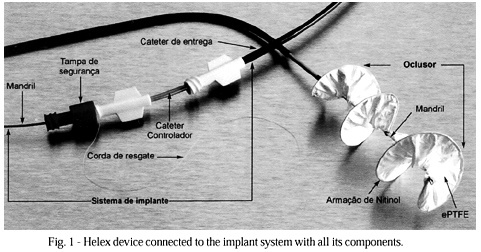
OBJECTIVE: To evaluate the initial clinical experience with the Helex septal occluder for percutaneous closure of atrial septal defects. METHODS: Ten patients underwent the procedure, 7 patients with ostium secundum atrial septal defects (ASD) with hemodynamic repercussions and 3 patients with pervious foramen ovale (PFO) and a history of stroke. Mean age was 33.8 years and mean weight was 55.4 kg. Mean diameter by transesophageal echocardiography and mean stretched ASD diameter were 11.33 ± 3.3mm, and 15.2 ± 3.8mm, respectively. The Qp/Qs ratio was 1.9 ± 0.3 in patients with ASD. RESULTS: Eleven occluders were placed because a patient with 2 holes needed 2 devices. It was necessary to retrieve and replace 4 devices in 3 patients. We observed immediate residual shunt (< 2mm) in 4 patients with ASD, and in those with patent foramen ovale total occlusion of the defect occurred. No complications were noted, and all patients were discharged on the following day. After 1 month, 2 patients with ASD experienced trivial residual shunts (1mm). In 1 patient, we observed mild prolapse in the proximal disk in the right atrium, without consequences. CONCLUSION: The Helex septal occluder was safe and effective for occluding small to moderate atrial septal defects. Because the implantation technique is demanding, it requires specific training of the operator. Even so, small technical failures may occur in the beginning of the learning curve, but they do not involve patient safety.

  • atrial septal defect
  • Helex septal occluder
  • Percutaneous Occlusion
Read Full Article
Creative Commons Attribution (CC BY) Creative Commons license
01/12/2003 DOI: 10.1590/S0066-782X2003001300001 Views 1
Percutaneous closure of ductus arteriosus with the amplatzer prosthesis. The Brazilian experience
ABC
Original Article

Percutaneous closure of ductus arteriosus with the amplatzer prosthesis. The Brazilian experience

Luiz Carlos Simões et al. Carlos A. C. Pedra César A. Esteves Ronaldo Camargo … Sérgio L.N. Braga Pedro Loureiro Marco Aurélio Santos Valmir Fernandes Fontes

OBJECTIVE – To report the results of percutaneous occlusion of persistent ductus arteriosus with the Amplatzer prosthesis in 2 Brazilian cardiological centers. METHODS – From May 1998 to July 2000, 33 patients with clinical and laboratory diagnosis of persistent ductus arteriosus underwent attempts at percutaneous implantation of the Amplatzer prosthesis. The median age was 36 months (from 6 months to 38 years), and the median weight was 14kg (from 6 to 92kg). Sixteen patients (48.5%) were under 2 years of age at the time of the procedure. All patients were followed up with periodical clinical and echocardiographic evaluations to assess the presence and degree of residual shunt and possible complications, such as pseudocoarctation of the aorta and left pulmonary artery stenosis. RESULTS – The minimum diameter of the arterial ducts ranged from 2.5 to 7.0mm (mean of 4.0±1.0, median of 3.9). The rate of success for implantation of the prosthesis was 100%. Femoral pulse was lost in 1 patient. The echocardiogram revealed total closure prior to hospital discharge in 30 patients, and in the follow-up visit 3 months later in the 3 remaining patients. The mean follow-up duration was 6.4±3.4 months. All patients were clinically well, asymptomatic, and did not need medication. No patient had narrowing of the left pulmonary artery or of the aorta. No early or late embolic events occurred, nor did infectious endarteritis. A new hospital admission was not required for any patient. CONCLUSION – The Amplatzer prosthesis for persistent ductus arteriosus is safe and highly effective for occlusion of ductus arteriosus of varied diameters, including large ones in small symptomatic infants.

  • Amplatzer prosthesis
  • Percutaneous Occlusion
  • persistent ductus arteriosus
Read Full Article
Creative Commons Attribution (CC BY) Creative Commons license
14/01/2002 DOI: 10.1590/S0066-782X2001001200003

How to cite this article

EndNote RIS

Electronic Document Format (Vancouver)

Sabedotti M, Selistre LS, Mezzomo A, Camazzola FE, Degrazia RC, Maggi BG, Voltolini S, et al. Percutaneous Patent Foramen Ovale Occlusion in Patients Over 60 Years of Age with History of Stroke. International Journal of Cardiovascular Sciences 2025;38:e20240160.

Electronic Document Format (ABNT)

Sabedotti, Marcelo; Selistre, Luciano da Silva; Mezzomo, Agda; Camazzola, Fabio Eduardo; Degrazia, Ramiro Caldas; Maggi, Bibiana Guimarães; Voltolini, Sara. Percutaneous Patent Foramen Ovale Occlusion in Patients Over 60 Years of Age with History of Stroke. International Journal of Cardiovascular Sciences, v. 38, e20240160, Apr. 2025.

Electronic Document Format (APA)

Sabedotti, M., Selistre, L. S., Mezzomo, A., Camazzola, F. E., Degrazia, R. C., Maggi, B. G., & Voltolini, S. (2025). Percutaneous Patent Foramen Ovale Occlusion in Patients Over 60 Years of Age with History of Stroke. International Journal of Cardiovascular Sciences, 38, e20240160.

Electronic Document Format (ISO)

Sabedotti, Marcelo and Selistre, Luciano da Silva and Mezzomo, Agda and Camazzola, Fabio Eduardo and Degrazia, Ramiro Caldas and Maggi, Bibiana Guimarães and Voltolini, Sara. Percutaneous Patent Foramen Ovale Occlusion in Patients Over 60 Years of Age with History of Stroke. International Journal of Cardiovascular Sciences [online]. 2025, vol. 38, [cited 2026-10-14], e20240160. Available from: <https://journals.cardiol.br/en/article/percutaneous-patent-foramen-ovale-occlusion-in-patients-over-60-years-of-age-with-history-of-stroke/>. ISSN 2359-4802

EndNote RIS

Electronic Document Format (Vancouver)

Queiróz FJAC, Rossi Filho RI, Ramos S, Esteves C, Queiróz DSC, Machado PR, Tress JC, et al. Interventricular septal defects percutaneous occlusion: initial experiment. Arquivos Brasileiros de Cardiologia 2005;85(3):174-9.

Electronic Document Format (ABNT)

Queiróz, Francisco José Araújo Chamié de; Rossi Filho, Raul Ivo; Ramos, Sérgio; Esteves, César; Queiróz, Daniel Silva Chamié de; Machado, Paulo Renato; Tress, João Carlos; Horowitz, Stella Suzana; Paupério, Helder; Victer, Rosaura. Interventricular septal defects percutaneous occlusion: initial experiment. Arquivos Brasileiros de Cardiologia, v. 85, n. 3, p. 174-179, Oct. 2005.

Electronic Document Format (APA)

Queiróz, F. J. A. C. , Rossi Filho, R. I., Ramos, S., Esteves, C., Queiróz, D. S. C. , Machado, P. R., Tress, J. C., Horowitz, S. S., Paupério, H., & Victer, R. (2005). Interventricular septal defects percutaneous occlusion: initial experiment. Arquivos Brasileiros de Cardiologia, 85(3), 174-179.

Electronic Document Format (ISO)

Queiróz, Francisco José Araújo Chamié de and Rossi Filho, Raul Ivo and Ramos, Sérgio and Esteves, César and Queiróz, Daniel Silva Chamié de and Machado, Paulo Renato and Tress, João Carlos and Horowitz, Stella Suzana and Paupério, Helder and Victer, Rosaura. Interventricular septal defects percutaneous occlusion: initial experiment. Arquivos Brasileiros de Cardiologia [online]. 2005, vol. 85, n. 3, [cited 2026-10-14], pp. 174-179. Available from: <https://journals.cardiol.br/article/interventricular-septal-defects-percutaneous-occlusion-initial-experiment/>. ISSN 0066-782X

EndNote RIS

Electronic Document Format (Vancouver)

Pedra CA, Pedra SF, Esteves CA, Chamiê F, Ramos S, Pontes Jr SC, Tress JC, et al. Initial experience in Brazil with the Helex septal occluder for percutaneous occlusion of atrial septal defects. Arquivos Brasileiros de Cardiologia 2003;81(5):444-52.

Electronic Document Format (ABNT)

Pedra, Carlos A.C.; Pedra, Simone F.; Esteves, César A.; Chamiê, Francisco; Ramos, Sérgio; Pontes Jr, Sérgio C.; Tress, João Carlos; Braga, Sérgio L. N.; Latson, Larry A.; Fontes, Valmir F.. Initial experience in Brazil with the Helex septal occluder for percutaneous occlusion of atrial septal defects. Arquivos Brasileiros de Cardiologia, v. 81, n. 5, p. 444-452, Nov. 2003.

Electronic Document Format (APA)

Pedra, C. A., Pedra, S. F., Esteves, C. A., Chamiê, F., Ramos, S., Pontes Jr, S. C., Tress, J. C., Braga, S. L. N., Latson, L. A., & Fontes, V. F. (2003). Initial experience in Brazil with the Helex septal occluder for percutaneous occlusion of atrial septal defects. Arquivos Brasileiros de Cardiologia, 81(5), 444-452.

Electronic Document Format (ISO)

Pedra, Carlos A.C. and Pedra, Simone F. and Esteves, César A. and Chamiê, Francisco and Ramos, Sérgio and Pontes Jr, Sérgio C. and Tress, João Carlos and Braga, Sérgio L. N. and Latson, Larry A. and Fontes, Valmir F.. Initial experience in Brazil with the Helex septal occluder for percutaneous occlusion of atrial septal defects. Arquivos Brasileiros de Cardiologia [online]. 2003, vol. 81, n. 5, [cited 2026-10-14], pp. 444-452. Available from: <https://journals.cardiol.br/en/article/initial-experience-in-brazil-with-the-helex-septal-occluder-for-percutaneous-occlusion-of-atrial-septal-defects/>. ISSN 0066-782X

EndNote RIS

Electronic Document Format (Vancouver)

Simões LC, Pedra CAC, Esteves CA, Camargo R, Braga SL, Loureiro P, Santos MA, et al. Percutaneous closure of ductus arteriosus with the amplatzer prosthesis. The Brazilian experience. Arquivos Brasileiros de Cardiologia 2002;77(6):526-31.

Electronic Document Format (ABNT)

Simões, Luiz Carlos; Pedra, Carlos A. C.; Esteves, César A.; Camargo, Ronaldo; Braga, Sérgio L.N.; Loureiro, Pedro; Santos, Marco Aurélio; Fontes, Valmir Fernandes. Percutaneous closure of ductus arteriosus with the amplatzer prosthesis. The Brazilian experience. Arquivos Brasileiros de Cardiologia, v. 77, n. 6, p. 526-531, Jan. 2002.

Electronic Document Format (APA)

Simões, L. C., Pedra, C. A. C., Esteves, C. A., Camargo, R., Braga, S. L., Loureiro, P., Santos, M. A., & Fontes, V. F. (2002). Percutaneous closure of ductus arteriosus with the amplatzer prosthesis. The Brazilian experience. Arquivos Brasileiros de Cardiologia, 77(6), 526-531.

Electronic Document Format (ISO)

Simões, Luiz Carlos and Pedra, Carlos A. C. and Esteves, César A. and Camargo, Ronaldo and Braga, Sérgio L.N. and Loureiro, Pedro and Santos, Marco Aurélio and Fontes, Valmir Fernandes. Percutaneous closure of ductus arteriosus with the amplatzer prosthesis. The Brazilian experience. Arquivos Brasileiros de Cardiologia [online]. 2002, vol. 77, n. 6, [cited 2026-10-14], pp. 526-531. Available from: <https://journals.cardiol.br/en/article/percutaneous-closure-of-ductus-arteriosus-with-the-amplatzer-prosthesis-the-brazilian-experience/>. ISSN 0066-782X

  • About ABC Family
  • Internal Regulation
  • Editorial Board
  • Brazilian Society of Cardiology (SBC)

Issues

SBC Guidelines

  • Videos
  • Podcasts
  • News