Suzana Alves Silva et al. Keila Amaral Sabrina Bernardez-Pereira Marcelo Franken … Daisa Mesquita Escobosa Carolina Ivo Leandro Menezes Alves da Costa Fabio Gomes da Conceição Laine Lisboa Thays Naomy Rizzi Bárbara Reis Tamburim Luciana Alves Lopes Siomara Tavares Fernandes Yamaguti Luiz Antonio Nasi Juçara Maccari Arthur Pille Jonas Michel Wolf Andre Volschan Marcelo Westerlund Montera Silvia Moreira Ayub Ferreira Luiz Francisco Cardoso Roberta Saretta Teresa Cristina D. C. Nascimento Olívia Margarido Camila Oliveira Evelyn Tiburzio Ary Ribeiro
Abstract
Background
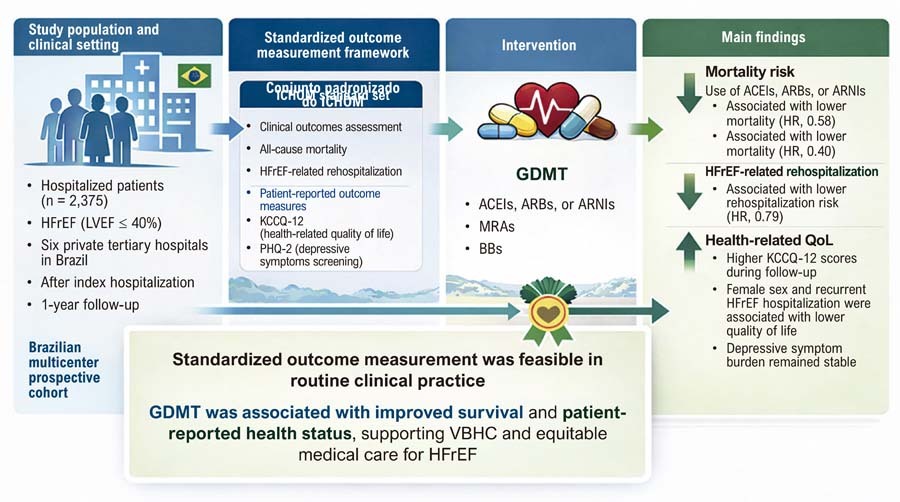
Real-world evidence integrating clinical outcomes and patient-reported measures in heart failure with reduced ejection fraction (HFrEF) remains scarce in middle-income countries. Standardized outcome measurement frameworks may enable more consistent evaluation of care quality and treatment effectiveness.
Objective
To assess the association of guideline-directed medical therapy (GDMT) with clinical outcomes and patient-reported quality of life (QoL) in patients with HFrEF within 1 year after index hospitalization, using the International Consortium for Health Outcomes Measurement standard set in a multicenter Brazilian cohort.
Methods
This prospective cohort study included adults hospitalized for decompensated HFrEF (ejection fraction ≤ 40%) across six private tertiary hospitals in Brazil. Clinical and patient-reported outcomes were collected using standardized instruments, including the Kansas City Cardiomyopathy Questionnaire-12 (KCCQ-12) and the Patient Health Questionnaire-2 (PHQ-2).
Results
A total of 2,375 patients were included (mean age, 75.9 ± 13.6 years; 69% male). During a median follow-up of 369 days, 26.1% died and 34.6% experienced heart failure-related rehospitalization. Older age was associated with higher risks of mortality and rehospitalization (p ≤ 0.003). Use of angiotensin-converting enzyme inhibitors, angiotensin receptor blockers, or angiotensin receptor-neprilysin inhibitors was associated with lower mortality (hazard ratio [HR], 0.58; p = 0.001), whereas beta-blockers showed a strong protective effect (HR, 0.40; p < 0.001). Mineralocorticoid receptor antagonists were associated with lower rehospitalization rates (HR, 0.79; p = 0.032). GDMT was associated with higher KCCQ-12 scores throughout follow-up (p < 0.05). Women and patients with recurrent rehospitalizations reported lower QoL (p < 0.02). PHQ-2 scores remained low and stable over time.
Conclusion
Standardized outcome measurement is feasible in real-world HFrEF care. GDMT was associated with improved survival and QoL, supporting more equitable and value-based management of HFrEF.