Maria E. R. Coste et al. Carolina N. França Maria Cristina Izar Daniela Teixeira … Mayari E. Ishimura Ieda Longo-Maugeri Amanda S. Bacchin Henrique Tria Bianco Flavio T. Moreira Ibraim Masciarelli Pinto Gilberto Szarf Adriano Mendes Caixeta Otavio Berwanger Iran Gonçalves Jr Francisco A. H. Fonseca
Abstract
Background
Patients with acute myocardial infarction may have a large infarcted area and ventricular dysfunction despite early thrombolysis and revascularization.
Objective
To investigate the behavior of circulating cytokines in patients with ST-segment elevation myocardial infarction (STEMI) and their relationship with ventricular function.
Methods
In the BATTLE-AMI (B and T Types of Lymphocytes Evaluation in Acute Myocardial Infarction) trial, patients with STEMI were treated with a pharmacoinvasive strategy. The plasma levels of cytokines (IL-1 β , IL-4, IL-6, IL-10, and IL-18) were tested using enzyme-linked immunosorbent assay (ELISA) at baseline and after 30 days. Infarcted mass and left ventricular ejection fraction (LVEF) were examined by 3-T cardiac magnetic resonance imaging. All p-values < 0.05 were considered statistically significant.
Results
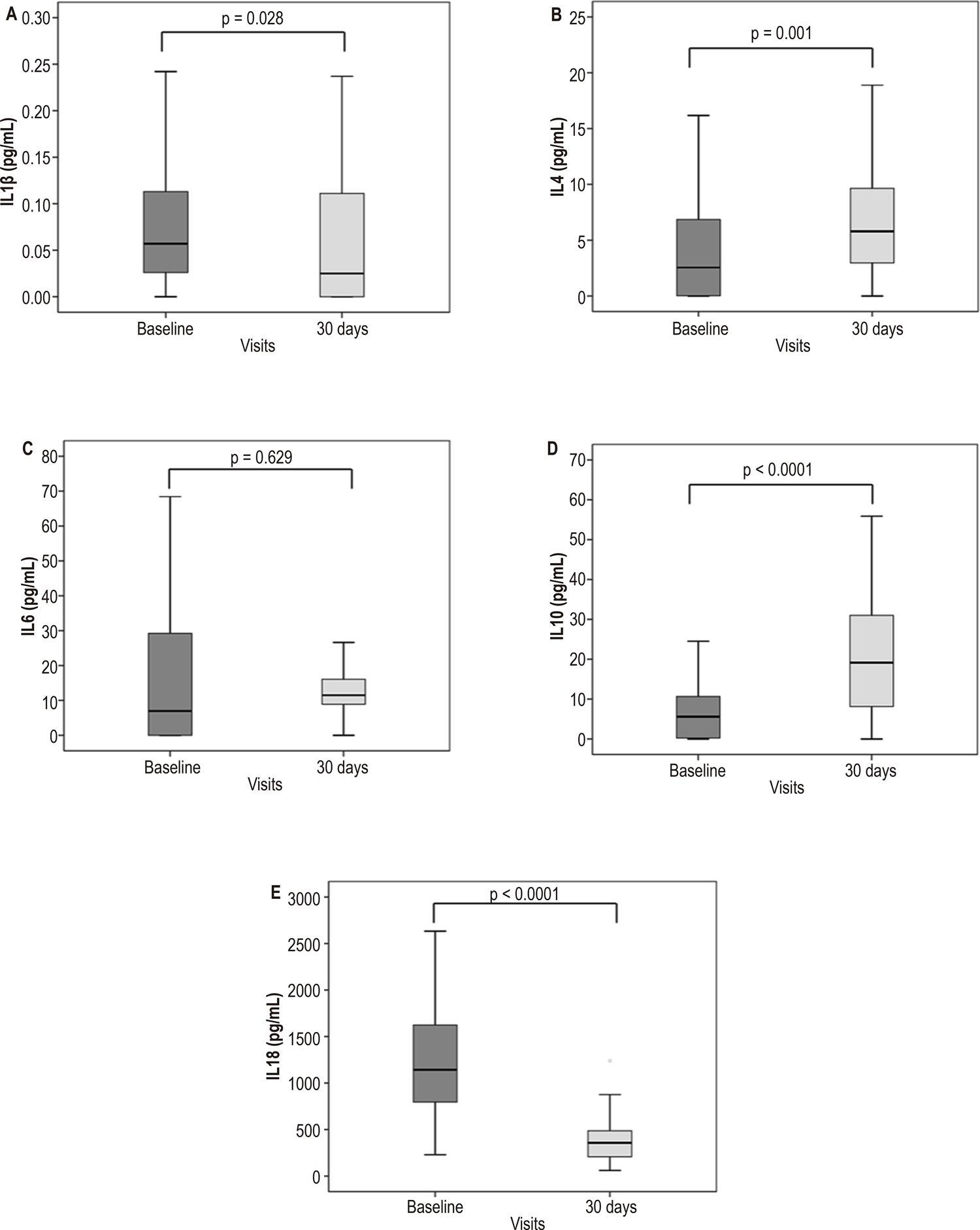
Compared to baseline, lower levels were detected for IL-1 β (p = 0.028) and IL-18 (p < 0.0001) 30 days after STEMI, whereas higher levels were observed for IL-4 (p = 0.001) and IL-10 (p < 0.0001) at that time point. Conversely, no changes were detected for IL-6 levels (p = 0.63). The levels of high-sensitivity C-reactive protein and IL-6 correlated at baseline (rho = 0.45, p < 0.0001) and 30 days after STEMI (rho = 0.29, p = 0.009). At baseline, correlation between IL-6 levels and LVEF was also observed (rho = -0.50, p = 0.004).
Conclusions
During the first month post-MI, we observed a marked improvement in the balance of pro- and anti-inflammatory cytokines, except for IL-6. These findings suggest residual inflammatory risk. (Arq Bras Cardiol. 2020; [online].ahead print, PP.0-0)