ABC Family Arquivos Brasileiros de Cardiologia International Journal of Cardiovascular Sciences ABC Heart Failure & Cardiomyopathy ABC Imagem Cardiovascular
Português English
ABC Family
Português English
  • About
    • About ABC Family
    • Internal Regulation
    • Editorial Board
    • Brazilian Society of Cardiology (SBC)
  • Issues
  • SBC Guidelines
  • Content
    • Videos
    • Podcasts
    • News
  • About
    • About ABC Family
    • Internal Regulation
    • Editorial Board
    • Brazilian Society of Cardiology (SBC)
  • Issues
  • SBC Guidelines
  • Content
    • Videos
    • Podcasts
    • News

ABC Family

  • ABC Family
  • Arquivos Brasileiros de Cardiologia
  • International Journal of Cardiovascular Sciences
  • ABC Heart Failure & Cardiomyopathy
  • ABC Imagem Cardiovascular
Search in

No content found.

Journals
Ordering
Article types
Others

  1. Home
  2. Keyword: continuous positive airway pressure
ABC
Letter to the Editor

Acute Effects of Continuous Positive Airway Pressure on Pulse Pressure in CHF

Jacobo Bacariza Blanco et al. Antonio M. Esquinas

Today’s reality on non-invasive ventilation (NIV) use has nothing but four key A level indications supported by evidence-based medicine. These, which would be chronic obstructive pulmonary disease (COPD) exacerbation, cardiogenic pulmonary edema, pulmonary infiltrates in immunocompromised patients, and the weaning of already extubated COPD patients, are the so called “the fabulous four”. But is this the maximum therapeutic potential of NIV? Probably not. If so, which would be the next one on this selected “fabulous four” group? Maybe it is stable chronic heart failure (CHF). If so, we would be facing a new frontier, yet unexplored, of those chronically stable not respiratory but cardiac patients, opening new applications, none existent up to today.

Quintão et al. move on into the next step to conquer this new frontier, the NIV application on stable CHF. They do so, analyzing the NIV (Continuous Positive Airway Pressure – CPAP) effects on pulse pressure (PP), as a risk factor with independent negative predictive value for adverse cardiovascular events, followed by left ventricular dysfunction, especially type II, caused by acute myocardial ischemia. They prove not only to affect PP reduction, but also heart rate (HR), mean arterial pressure (MAP), systolic blood pressure (SBP) and respiratory rate (RR).

[…]

  • continuous positive airway pressure
  • Heart Failure
  • Pulse
Read Full Article
Creative Commons Attribution (CC BY) Creative Commons license
01/02/2015 DOI: 10.5935/abc.20140217 Views 1
Effects of the continuous positive airway pressure on the airways of patients with chronic heart failure
ABC
Artigo Original

Effects of the continuous positive airway pressure on the airways of patients with chronic heart failure

João Carlos Moreno de Azevedo et al. Edison Ramos Migowisk de Carvalho Luis Augusto Feijó Fátima Palha de Oliveira … Sara Lúcia Silveira de Menezes Henrique Murad

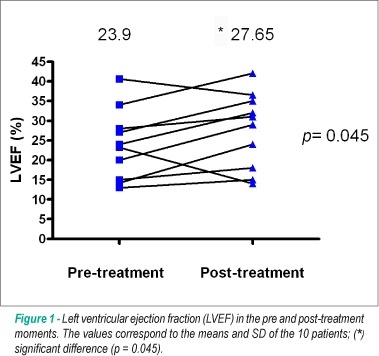
BACKGROUND: Heart failure can present with asymptomatic dysfunction at decompensation, with limitations and decrease in the productive capacity. The Continuous Positive Airway Pressure (CPAP) is a non-pharmacological means to decrease afterload. OBJECTIVE: To analyze the effects of CPAP (10 cmH2O), for 30 days in patients with chronic heart failure. METHODS: We assessed 10 patients with heart failure (6 males, 4 females) of several etiologies, with a mean age of 54 ± 14 years, with a BMI of 21 ± 0.04 kg/m². The therapy was applied for 60 min., 5 times a week for 30 days, during the daytime. The echocardiogram and the ergospirometry were analyzed, before and 30 days after the therapy. RESULTS: There was a 19.59% increase in the left ventricular ejection fraction (LVEF): 23.9 ± 8.91 vs 27.65 ± 9.56%; p = 0.045. At the ergospirometry, the exercise time (ET) showed a significant increase from 547 ± 151.319 vs 700 ± 293.990 sec., p = 0.02; oxygen consumption (VO2) was 9.59 ± 6.1 vs 4.51 ± 2.67 ml.kg-1.min.-1, p = 0.01, whereas the carbon dioxide production (VCO2) at rest (9.85 ± 4.38 vs 6.44 ± 2.88 ml.kg-1.min.-1, p = 0.03) decreased. CONCLUSION: The CPAP resulted in an increase in the LVEF and ET, decreased the oxygen consumption and the carbon dioxide production at rest.

  • continuous positive airway pressure
  • Echocardiography
  • Heart Failure
  • Oxygen Consumption
Read Full Article
Creative Commons Attribution (CC BY) Creative Commons license
11/06/2010 DOI: 10.1590/S0066-782X2010005000068 Views 1
ABC
Artigo Original

Comparative study between intermittent (Müller Reanimator) and continuous positive airway pressure in the postoperative period of coronary artery bypass grafting

Andréa Pires Müller et al. Márcia Olandoski Rafael Macedo Constantino Costantini Luiz César Guarita-Souza

OBJECTIVE: To compare the effect of the use of intermittent and continuous positive airway pressure in postoperative patients undergoing coronary artery bypass grafting. METHODS: This study included forty patients divided into two groups: one undergoing continuous positive airway pressure (CPAP Group), and the other undergoing intermittent pressure (Müller Resuscitator Group). The patients were evaluated in relation to the several study variables at the following time points: preoperative, 3rd, 24th, and 48th hours. RESULTS: The patient groups were homogeneous in relation to the several demographic and clinical variables. The values of pO2, pCO2 and sO2 were within normal limits and no significant differences were found between the groups. Regarding respirometry, the groups showed significant differences in the tidal volume and respiratory rate at the 48th postoperative hour. Dyspnea and use of accessory muscle in postoperative assessments were found with a significantly higher frequency in patients undergoing CPAP. Patients undergoing Müller Resuscitator had a normal chest radiograph more frequently than did patients undergoing CPAP. CONCLUSION: Both devices were shown to be able to keep pO2, pCO2, and sO2 values within normal limits. However, when the objective was pulmonary reexpansion with less imposed workload, the Müller Resuscitator was more effective because of its prompter action and consequently lower levels of dyspnea, respiratory rate (RR) and use of accessory muscle were observed.

  • continuous positive airway pressure
  • IPPB
  • physical therapy
Read Full Article
Creative Commons Attribution (CC BY) Creative Commons license
30/03/2006 DOI: 10.1590/S0066-782X2006000300012 Views 2

How to cite this article

EndNote RIS

Electronic Document Format (Vancouver)

Blanco JB, Esquinas AM. Acute Effects of Continuous Positive Airway Pressure on Pulse Pressure in CHF. Arquivos Brasileiros de Cardiologia 2015;104(2):175-6.

Electronic Document Format (ABNT)

Blanco, Jacobo Bacariza; Esquinas, Antonio M.. Acute Effects of Continuous Positive Airway Pressure on Pulse Pressure in CHF. Arquivos Brasileiros de Cardiologia, v. 104, n. 2, p. 175-176, Jan. 2015.

Electronic Document Format (APA)

Blanco, J. B., & Esquinas, A. M. (2015). Acute Effects of Continuous Positive Airway Pressure on Pulse Pressure in CHF. Arquivos Brasileiros de Cardiologia, 104(2), 175-176.

Electronic Document Format (ISO)

Blanco, Jacobo Bacariza and Esquinas, Antonio M.. Acute Effects of Continuous Positive Airway Pressure on Pulse Pressure in CHF. Arquivos Brasileiros de Cardiologia [online]. 2015, vol. 104, n. 2, [cited 2026-10-14], pp. 175-176. Available from: <https://journals.cardiol.br/en/article/acute-effects-of-continuous-positive-airway-pressure-on-pulse-pressure-in-chf/>. ISSN 0066-782X

EndNote RIS

Electronic Document Format (Vancouver)

Azevedo JCM, Carvalho ERM, Feijó LA, Oliveira FP, Menezes SLS, Murad H. Effects of the continuous positive airway pressure on the airways of patients with chronic heart failure. Arquivos Brasileiros de Cardiologia 2010;95(1):115-21.

Electronic Document Format (ABNT)

Azevedo, João Carlos Moreno de; Carvalho, Edison Ramos Migowisk de; Feijó, Luis Augusto; Oliveira, Fátima Palha de; Menezes, Sara Lúcia Silveira de; Murad, Henrique. Effects of the continuous positive airway pressure on the airways of patients with chronic heart failure. Arquivos Brasileiros de Cardiologia, v. 95, n. 1, p. 115-121, Jun. 2010.

Electronic Document Format (APA)

Azevedo, J. C. M. , Carvalho, E. R. M. , Feijó, L. A., Oliveira, F. P. , Menezes, S. L. S. , & Murad, H. (2010). Effects of the continuous positive airway pressure on the airways of patients with chronic heart failure. Arquivos Brasileiros de Cardiologia, 95(1), 115-121.

Electronic Document Format (ISO)

Azevedo, João Carlos Moreno de and Carvalho, Edison Ramos Migowisk de and Feijó, Luis Augusto and Oliveira, Fátima Palha de and Menezes, Sara Lúcia Silveira de and Murad, Henrique. Effects of the continuous positive airway pressure on the airways of patients with chronic heart failure. Arquivos Brasileiros de Cardiologia [online]. 2010, vol. 95, n. 1, [cited 2026-10-14], pp. 115-121. Available from: <https://journals.cardiol.br/en/article/effects-of-the-continuous-positive-airway-pressure-on-the-airways-of-patients-with-chronic-heart-failure/>. ISSN 0066-782X

EndNote RIS

Electronic Document Format (Vancouver)

Müller AP, Olandoski M, Macedo R, Costantini C, Guarita-Souza LC. Comparative study between intermittent (Müller Reanimator) and continuous positive airway pressure in the postoperative period of coronary artery bypass grafting. Arquivos Brasileiros de Cardiologia 2006;86(3):232-9.

Electronic Document Format (ABNT)

Müller, Andréa Pires; Olandoski, Márcia; Macedo, Rafael; Costantini, Constantino; Guarita-Souza, Luiz César. Comparative study between intermittent (Müller Reanimator) and continuous positive airway pressure in the postoperative period of coronary artery bypass grafting. Arquivos Brasileiros de Cardiologia, v. 86, n. 3, p. 232-239, Mar. 2006.

Electronic Document Format (APA)

Müller, A. P., Olandoski, M., Macedo, R., Costantini, C., & Guarita-Souza, L. C. (2006). Comparative study between intermittent (Müller Reanimator) and continuous positive airway pressure in the postoperative period of coronary artery bypass grafting. Arquivos Brasileiros de Cardiologia, 86(3), 232-239.

Electronic Document Format (ISO)

Müller, Andréa Pires and Olandoski, Márcia and Macedo, Rafael and Costantini, Constantino and Guarita-Souza, Luiz César. Comparative study between intermittent (Müller Reanimator) and continuous positive airway pressure in the postoperative period of coronary artery bypass grafting. Arquivos Brasileiros de Cardiologia [online]. 2006, vol. 86, n. 3, [cited 2026-10-14], pp. 232-239. Available from: <https://journals.cardiol.br/en/article/comparative-study-between-intermittent-muller-reanimator-and-continuous-positive-airway-pressure-in-the-postoperative-period-of-coronary-artery-bypass-grafting/>. ISSN 0066-782X

  • About ABC Family
  • Internal Regulation
  • Editorial Board
  • Brazilian Society of Cardiology (SBC)

Issues

SBC Guidelines

  • Videos
  • Podcasts
  • News