ABC Family Arquivos Brasileiros de Cardiologia International Journal of Cardiovascular Sciences ABC Heart Failure & Cardiomyopathy ABC Imagem Cardiovascular
Português English
ABC Family
Português English
  • About
    • About ABC Family
    • Internal Regulation
    • Editorial Board
    • Brazilian Society of Cardiology (SBC)
  • Issues
  • SBC Guidelines
  • Content
    • Videos
    • Podcasts
    • News
  • About
    • About ABC Family
    • Internal Regulation
    • Editorial Board
    • Brazilian Society of Cardiology (SBC)
  • Issues
  • SBC Guidelines
  • Content
    • Videos
    • Podcasts
    • News

ABC Family

  • ABC Family
  • Arquivos Brasileiros de Cardiologia
  • International Journal of Cardiovascular Sciences
  • ABC Heart Failure & Cardiomyopathy
  • ABC Imagem Cardiovascular
Search in

No content found.

Journals
Ordering
Article types
Others

  1. Home
  2. Keyword: congenital heart defect
Figure 1
IJCS
Original Article

Congenital Heart Disesase: A Retrospective Analysis from a Tertiary Referral Centre in Portugal

Diogo Faim et al. Joaquim Tiago Rui Castelo Andreia Francisco … Rosa Alves António Pires

Abstract

Background:

Congenital heart disease is the leading cause of mortality among all congenital malformations.

Objectives:

To evaluate the incidence of congenital heart diseases in a central maternity hospital in Portugal from January 2003 to December 2018 and to determine survival in the first year of life.

Methods:

Retrospective analysis of newborns diagnosed with congenital heart diseases within 72 hours after birth. Malformations were divided according to pathophysiology. Cumulative survival analysis was performed by the Kaplan-Meier test. Stastical significance was set at p <0.05.

Results:

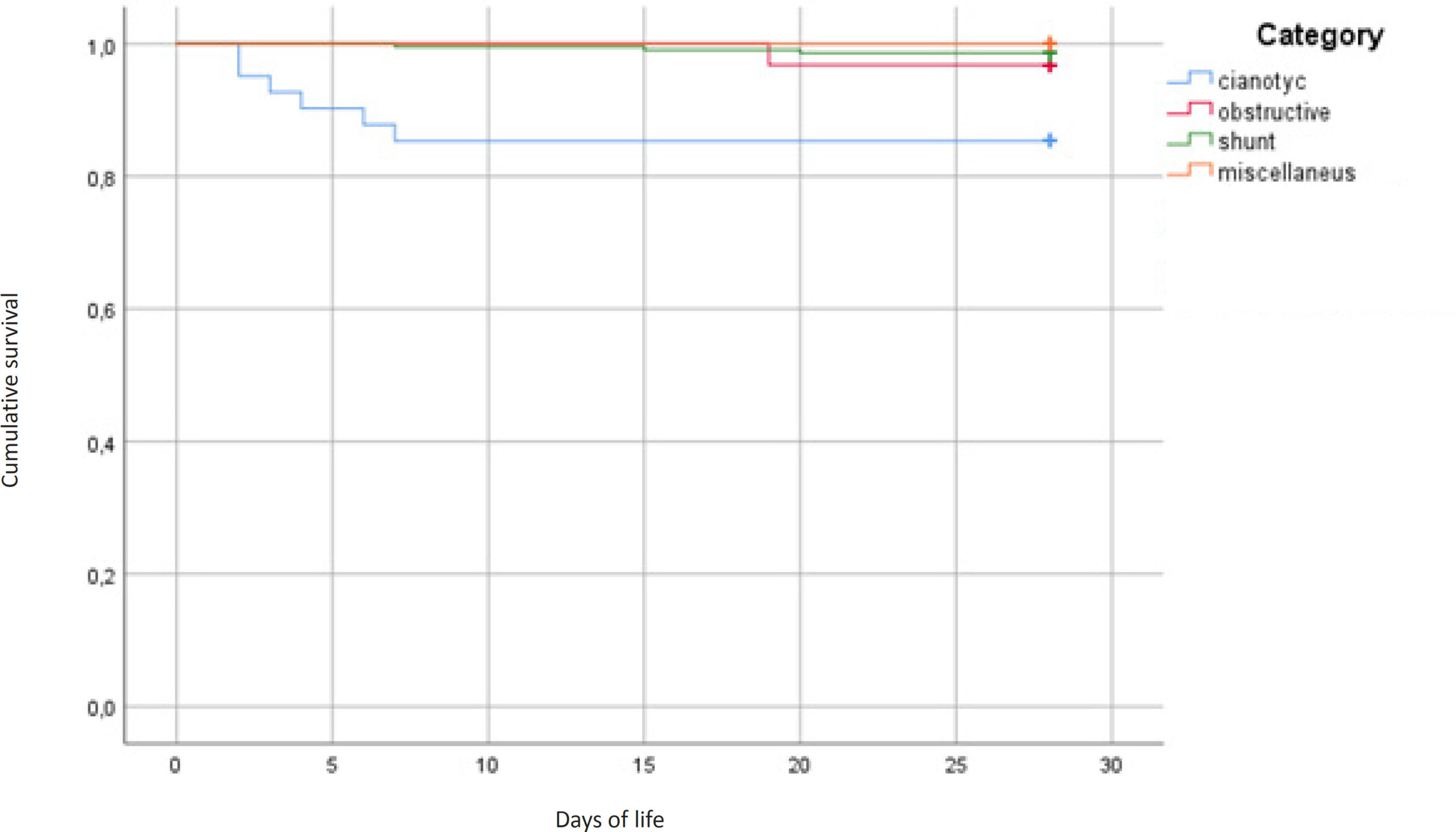
A total of 297 newborns with cardiac malformation was recorded among 47,198 live births (incidence of 6:1000), 16% associated with extra-cardiac disease. The most frequent congenital heart diseases were left-to-right shunt lesions (n = 216), followed by cyanotic (n = 41), acyanotic obstructive (n = 31) and miscellaneous (n = 9). Seventy (24%) patients had prenatal diagnosis, 88% of them cyanotic defects, and a positive association was found between prenatal diagnosis and mortality (p <0.001). Coarctation of the aorta was associated with gestational diabetes (p = 0.014). Atrial septal defect was more common in females (p = 0.02). Mortality rate due to heart disease was 3.4%. Patients with cyanotic disease, 99%, 97%, 97%, respectively, for patients with left-to-right shunt lesions, and 97%, 97%,97% for those with obstructive lesion cases.

Conclusion:

The incidence of congenital heart disease was 6:1000, mostly left-to-right shunt lesions. Heart disease accounted for only half of deaths, and cyanotic diseases have a high nonspecific mortality rate.
  • congenital heart defect
  • Neonatology
  • Newborn Infant
  • Survival
Read Full Article
Creative Commons Attribution (CC BY) Creative Commons license
28/07/2021 DOI: 10.36660/ijcs.20200238 Views 1
The role of nuchal translucency in the screening for congenital heart defects
ABC
Artigo Original

The role of nuchal translucency in the screening for congenital heart defects

Rafael Frederico Bruns et al. Antonio Fernandes Moron Carlos Geraldo Viana Murta Luís Flávio de Andrade Gonçalves Marina Maccagnano Zamith

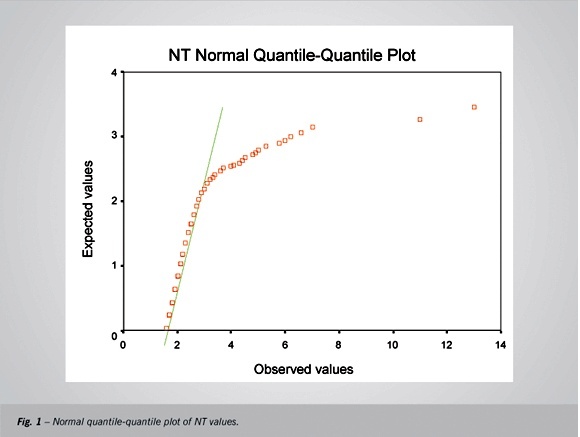
OBJECTIVE: Assess the accuracy of the nuchal translucency (NT) measurement between 11 and 13 weeks and 6 days of gestation as a sonographic marker to screen for congenital heart defects (CHD). METHODS: Multicentric retrospective study, analyzing single pregnancies from euploid fetuses. NT measurement was performed in the first trimester, when fetuses had from 45 to 84 mm of crown-rump length (CRL), according to the criteria established by the Fetal Medicine Foundation. Cases were followed until 1 month after delivery to verify the presence of CHD. RESULTS: 3,664 pregnancies were analyzed and 20 newborns had CHD diagnosed until the first month of life (prevalence of 0.55%). The median NT of the fetuses with CHD was 1.70 mm and 1.60 mm for fetuses without CHD, however no significant difference was found (Mann-Whitney test, p > 0.05). The sensitivity of NT in detection of CHD varied from 15% to 20%, with a range of false positive probability from 86.4% to 97.9%, depending on the cut-off point used. However, the odds ratio was high, compared to the classic indications of echocardiography, ranging from 4.7 to 33.7 according to the cutt-off point. CONCLUSION: In spite of the low sensitivity of the test, enlarged NT is an important risk factor for CHD and should be used in prenatal screening for CHD.

  • congenital heart defect
  • Nuchal translucency
  • ulrasound
Read Full Article
Creative Commons Attribution (CC BY) Creative Commons license
16/10/2006 DOI: 10.1590/S0066-782X2006001600013 Views 1

How to cite this article

EndNote RIS

Electronic Document Format (Vancouver)

Faim D, Tiago J, Castelo R, Francisco A, Alves R, Pires A. Congenital Heart Disesase: A Retrospective Analysis from a Tertiary Referral Centre in Portugal. International Journal of Cardiovascular Sciences 2021;34(5 Supl 1):105-13.

Electronic Document Format (ABNT)

Faim, Diogo; Tiago, Joaquim; Castelo, Rui; Francisco, Andreia; Alves, Rosa; Pires, António. Congenital Heart Disesase: A Retrospective Analysis from a Tertiary Referral Centre in Portugal. International Journal of Cardiovascular Sciences, v. 34, n. 5 Supl 1, p. 105-113, Jul. 2021.

Electronic Document Format (APA)

Faim, D., Tiago, J., Castelo, R., Francisco, A., Alves, R., & Pires, A. (2021). Congenital Heart Disesase: A Retrospective Analysis from a Tertiary Referral Centre in Portugal. International Journal of Cardiovascular Sciences, 34(5 Supl 1), 105-113.

Electronic Document Format (ISO)

Faim, Diogo and Tiago, Joaquim and Castelo, Rui and Francisco, Andreia and Alves, Rosa and Pires, António. Congenital Heart Disesase: A Retrospective Analysis from a Tertiary Referral Centre in Portugal. International Journal of Cardiovascular Sciences [online]. 2021, vol. 34, n. 5 Supl 1, [cited 2026-10-14], pp. 105-113. Available from: <https://journals.cardiol.br/en/article/congenital-heart-disesase-a-retrospective-analysis-from-a-tertiary-referral-centre-in-portugal/>. ISSN 2359-4802

EndNote RIS

Electronic Document Format (Vancouver)

Bruns RF, Moron AF, Murta CGV, Gonçalves LFA, Zamith MM. The role of nuchal translucency in the screening for congenital heart defects. Arquivos Brasileiros de Cardiologia 2006;87(3):307-14.

Electronic Document Format (ABNT)

Bruns, Rafael Frederico; Moron, Antonio Fernandes; Murta, Carlos Geraldo Viana; Gonçalves, Luís Flávio de Andrade; Zamith, Marina Maccagnano. The role of nuchal translucency in the screening for congenital heart defects. Arquivos Brasileiros de Cardiologia, v. 87, n. 3, p. 307-314, Oct. 2006.

Electronic Document Format (APA)

Bruns, R. F., Moron, A. F., Murta, C. G. V., Gonçalves, L. F. A., & Zamith, M. M. (2006). The role of nuchal translucency in the screening for congenital heart defects. Arquivos Brasileiros de Cardiologia, 87(3), 307-314.

Electronic Document Format (ISO)

Bruns, Rafael Frederico and Moron, Antonio Fernandes and Murta, Carlos Geraldo Viana and Gonçalves, Luís Flávio de Andrade and Zamith, Marina Maccagnano. The role of nuchal translucency in the screening for congenital heart defects. Arquivos Brasileiros de Cardiologia [online]. 2006, vol. 87, n. 3, [cited 2026-10-14], pp. 307-314. Available from: <https://journals.cardiol.br/en/article/the-role-of-nuchal-translucency-in-the-screening-for-congenital-heart-defects/>. ISSN 0066-782X

  • About ABC Family
  • Internal Regulation
  • Editorial Board
  • Brazilian Society of Cardiology (SBC)

Issues

SBC Guidelines

  • Videos
  • Podcasts
  • News