ABC Family Arquivos Brasileiros de Cardiologia International Journal of Cardiovascular Sciences ABC Heart Failure & Cardiomyopathy ABC Imagem Cardiovascular
Português English
ABC Family
Português English
  • About
    • About ABC Family
    • Internal Regulation
    • Editorial Board
    • Brazilian Society of Cardiology (SBC)
  • Issues
  • SBC Guidelines
  • Content
    • Videos
    • Podcasts
    • News
  • About
    • About ABC Family
    • Internal Regulation
    • Editorial Board
    • Brazilian Society of Cardiology (SBC)
  • Issues
  • SBC Guidelines
  • Content
    • Videos
    • Podcasts
    • News

ABC Family

  • ABC Family
  • Arquivos Brasileiros de Cardiologia
  • International Journal of Cardiovascular Sciences
  • ABC Heart Failure & Cardiomyopathy
  • ABC Imagem Cardiovascular
Search in

No content found.

Journals
Ordering
Article types
Others

  1. Home
  2. Keyword: Computer Simulation
Figure 1
ABC
Original Article

Learning: New Strategy for Humanized Digital Medical Education and Training in Cardiology

Manoel Fernandes Canesin et al. Fabrício Nogueira Furtado Rodrigo Marques Gonçalves Diogo Cesar Carraro … Thaísa Mariela Nascimento de Oliveira Ricardo Rodrigues Cláudio José Fuganti Cézar Eumann Mesas Laércio Uemura

Abstract

Background

The consolidation of new educational paradigms requires the implementation of innovative strategies to transform students into competent professionals.

Objectives

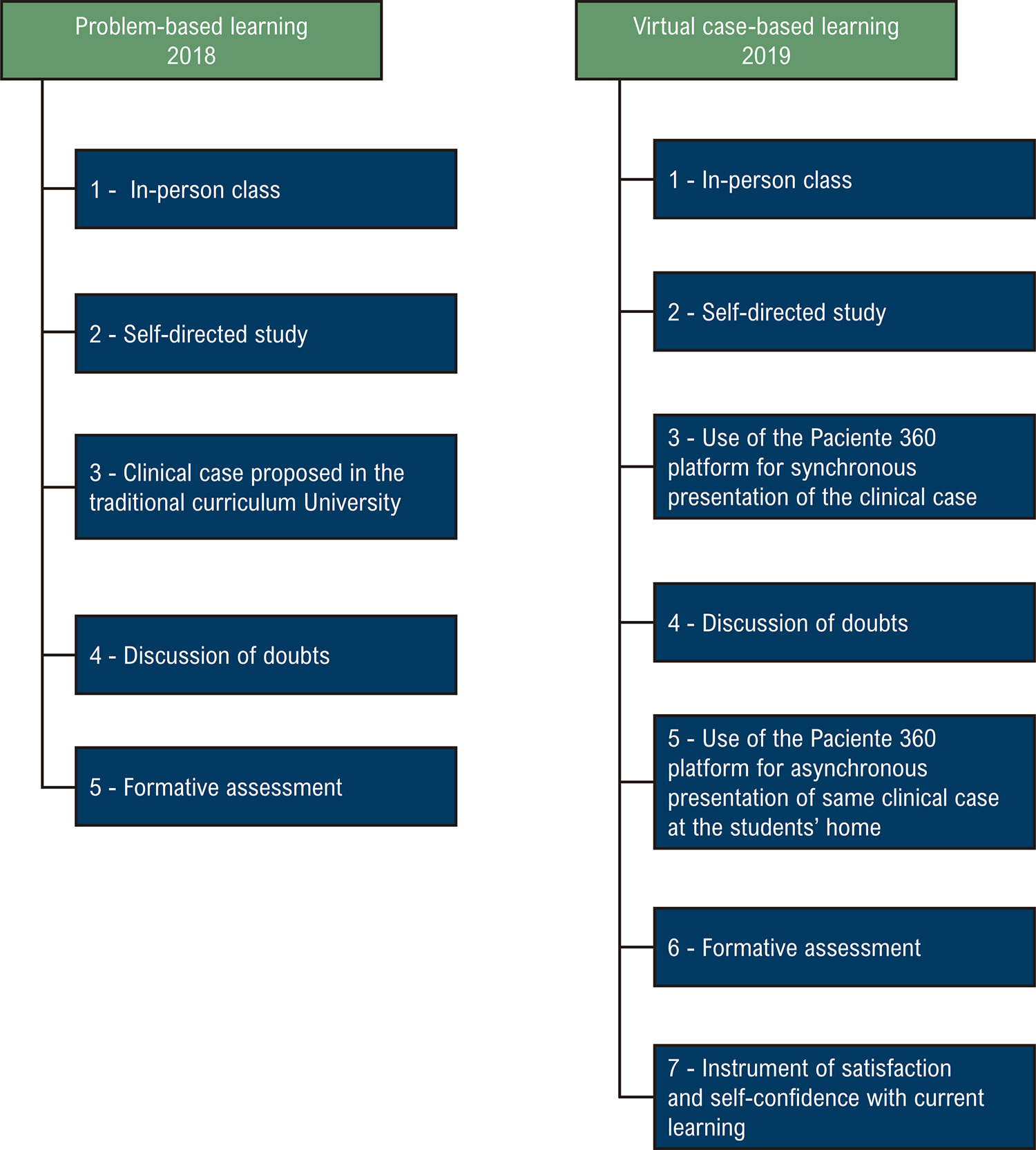
To assess knowledge and satisfaction of medical students before and after the use of a new humanized digital model of active learning, called virtual case-based learning (VCBL).

Methods

This was a descriptive, documentary analysis of the teaching-learning process of medical students. Data obtained from theoretical knowledge assessment and satisfaction evaluation questionnaires applied in 2018 and 2019 were analyzed, and the new VCBL was compared with the traditional active methodology PBL (problem-based learning). Descriptive and association analyses were made using the Statistical Package for the Social Sciences.

Results

A total of 167 evaluation forms administered to medical students were analyzed. In the evaluation of theoretical knowledge, the 2018 and the 2019 student groups had a mean of 41.7% and 73.3%, respectively (p<0.001). Among the students who responded to the satisfaction evaluation form, 76.0% gave the highest rating to question one, and 83.0% to question two. Nearly 70.0% of students positively evaluated knowledge acquisition with the Paciente 360 platform; 78.0% reported to feel prepared for working in outpatient care; and 94.0% positively evaluated the new method.

Conclusion

In this initial study, the results indicate that the new active method for humanized digital medical education, the VCBL, can help in the betterment of the teaching-learning process, promoting knowledge and satisfaction by the students.

  • Aprendizagem
  • Computer Simulation
  • Education, Medical
  • Humanization of Assistance
  • Students, Medical
Read Full Article
Creative Commons Attribution (CC BY) Creative Commons license
25/11/2022 DOI: 10.36660/abc.20220423 Views 2
ABC
Editorial

Computational Fluid Dynamics (CFD) For Predicting Pathological Changes In The Aorta: Is It Ready For Clinical Use?

Dominik Obrist et al. Hendrik von Tengg-Kobligk

Patient-specific modelling

Patient-specific models have been successfully deployed by many researchers. Nevertheless, the translation of high-resolution radiological data into geometrical vascular models for CFD remains a time-intensive task which is often cumbersome and requires trained specialists. There is a lack of automated segmentation and meshing tools for biomedical tasks. Recent developments based on deep neural networks may provide acceptable solutions for clinical use.

The setting of boundary conditions (e.g., velocity profiles at inflow/outflow) requires great care, because boundary conditions have a strong effect on the quality of the results. Therefore, it is useful to include flow measurements at well-defined locations (e.g., 2D+time or 3D+time blood flow MRI) into radiologic protocols. Next to the adequate choice of the modality and body location, this requires appropriate temporal and spatial resolution of the scans.

[…]

  • Biomedical Engineering
  • Cardiovascular Diseases/diagnosis
  • Cardiovascular Diseases/phyiopathology
  • Computer Assisted
  • Computer Simulation
  • Image Processing
  • Prosthesis Design
  • Prosthesis Implantation
Read Full Article
Creative Commons Attribution (CC BY) Creative Commons license
07/03/2022 DOI: 10.36660/abc.20220040 Views 1

How to cite this article

EndNote RIS

Electronic Document Format (Vancouver)

Canesin MF, Furtado FN, Gonçalves RM, Carraro DC, Oliveira TMN, Rodrigues R, Fuganti CJ, et al. Learning: New Strategy for Humanized Digital Medical Education and Training in Cardiology. Arquivos Brasileiros de Cardiologia 2022;119(5 suppl 1):35-42.

Electronic Document Format (ABNT)

Canesin, Manoel Fernandes; Furtado, Fabrício Nogueira; Gonçalves, Rodrigo Marques; Carraro, Diogo Cesar; Oliveira, Thaísa Mariela Nascimento de; Rodrigues, Ricardo; Fuganti, Cláudio José; Mesas, Cézar Eumann; Uemura, Laércio. Learning: New Strategy for Humanized Digital Medical Education and Training in Cardiology. Arquivos Brasileiros de Cardiologia, v. 119, n. 5 suppl 1, p. 35-42, Nov. 2022.

Electronic Document Format (APA)

Canesin, M. F., Furtado, F. N., Gonçalves, R. M., Carraro, D. C., Oliveira, T. M. N. , Rodrigues, R., Fuganti, C. J., Mesas, C. E., & Uemura, L. (2022). Learning: New Strategy for Humanized Digital Medical Education and Training in Cardiology. Arquivos Brasileiros de Cardiologia, 119(5 suppl 1), 35-42.

Electronic Document Format (ISO)

Canesin, Manoel Fernandes and Furtado, Fabrício Nogueira and Gonçalves, Rodrigo Marques and Carraro, Diogo Cesar and Oliveira, Thaísa Mariela Nascimento de and Rodrigues, Ricardo and Fuganti, Cláudio José and Mesas, Cézar Eumann and Uemura, Laércio. Learning: New Strategy for Humanized Digital Medical Education and Training in Cardiology. Arquivos Brasileiros de Cardiologia [online]. 2022, vol. 119, n. 5 suppl 1, [cited 2026-10-14], pp. 35-42. Available from: <https://journals.cardiol.br/en/article/learning-new-strategy-for-humanized-digital-medical-education-and-training-in-cardiology/>. ISSN 0066-782X

EndNote RIS

Electronic Document Format (Vancouver)

Obrist D, Tengg-Kobligk H. Computational Fluid Dynamics (CFD) For Predicting Pathological Changes In The Aorta: Is It Ready For Clinical Use?. Arquivos Brasileiros de Cardiologia 2022;118(2):461-2.

Electronic Document Format (ABNT)

Obrist, Dominik; Tengg-Kobligk, Hendrik von. Computational Fluid Dynamics (CFD) For Predicting Pathological Changes In The Aorta: Is It Ready For Clinical Use?. Arquivos Brasileiros de Cardiologia, v. 118, n. 2, p. 461-462, Mar. 2022.

Electronic Document Format (APA)

Obrist, D., & Tengg-Kobligk, H. (2022). Computational Fluid Dynamics (CFD) For Predicting Pathological Changes In The Aorta: Is It Ready For Clinical Use?. Arquivos Brasileiros de Cardiologia, 118(2), 461-462.

Electronic Document Format (ISO)

Obrist, Dominik and Tengg-Kobligk, Hendrik von. Computational Fluid Dynamics (CFD) For Predicting Pathological Changes In The Aorta: Is It Ready For Clinical Use?. Arquivos Brasileiros de Cardiologia [online]. 2022, vol. 118, n. 2, [cited 2026-10-14], pp. 461-462. Available from: <https://journals.cardiol.br/en/article/computational-fluid-dynamics-cfd-for-predicting-pathological-changes-in-the-aorta-is-it-ready-for-clinical-use/>. ISSN 0066-782X

  • About ABC Family
  • Internal Regulation
  • Editorial Board
  • Brazilian Society of Cardiology (SBC)

Issues

SBC Guidelines

  • Videos
  • Podcasts
  • News