ABC Family Arquivos Brasileiros de Cardiologia International Journal of Cardiovascular Sciences ABC Heart Failure & Cardiomyopathy ABC Imagem Cardiovascular
Português English
ABC Family
Português English
  • About
    • About ABC Family
    • Internal Regulation
    • Editorial Board
    • Brazilian Society of Cardiology (SBC)
  • Issues
  • SBC Guidelines
  • Content
    • Videos
    • Podcasts
    • News
  • About
    • About ABC Family
    • Internal Regulation
    • Editorial Board
    • Brazilian Society of Cardiology (SBC)
  • Issues
  • SBC Guidelines
  • Content
    • Videos
    • Podcasts
    • News

ABC Family

  • ABC Family
  • Arquivos Brasileiros de Cardiologia
  • International Journal of Cardiovascular Sciences
  • ABC Heart Failure & Cardiomyopathy
  • ABC Imagem Cardiovascular
Search in

No content found.

Journals
Ordering
Article types
Others

  1. Home
  2. Keyword: caffeine
ABC
Original Article

Study on Urinary Caffeine and Caffeine Metabolite Levels in American Adults with Coronary Heart Disease: A Cross-Sectional NHANES Study (2009-2014)

Qianqian Li et al. Gan Ke Mengdie Liu Yanjun Chen … Ye Luo Liangxian Qiu

Abstract

Background:

In recent years, the impact of diet and lifestyle on coronary heart disease (CHD) has garnered significant attention. Caffeine, a common dietary component, and its metabolites may influence cardiovascular health.

Objective:

This study aimed to investigate the association between urinary levels of caffeine and its metabolites and the incidence of CHD as well as to assess how these associations vary across different population groups.

Methods:

Data from the NHANES database (2009-2014) were analyzed using multivariable logistic regression models and smooth curve fitting techniques. Participants were categorized into a control group (n = 5,005) and a CHD group (n = 222) based on CHD status. Urinary levels of caffeine and its metabolites were measured and recorded. Multivariable logistic regression was used to evaluate the association between urinary caffeine/metabolite levels and CHD incidence, while smooth curve fitting was employed to explore potential nonlinear relationships. A significance level of 5% was used to determine statistical significance.

Results:

Higher urinary paraxanthine levels were associated with a lower risk of CHD. In contrast, elevated urinary caffeine levels were positively associated with CHD incidence among Mexican Americans, an association not observed in other racial/ethnic groups.

Conclusion:

Lower urinary paraxanthine levels may reflect a reduced risk of CHD, while higher urinary caffeine levels could indicate an increased CHD risk in specific populations.
  • caffeine
  • Cardiovascular disease
  • Coffee Metabolites
  • Race
Read Full Article
Creative Commons Attribution (CC BY) Creative Commons license
01/12/2025 DOI: 10.36660/abc.20240425i Views 2
Influence of caffeine on blood pressure and platelet aggregation
ABC
Original Article

Influence of caffeine on blood pressure and platelet aggregation

José Wilson S. Cavalcante et al. Paulo Roberto M. Santos Jr. Marcus G. F. de Menezes Hedylamar Oliveira Marques … Leonardo Pessoa Cavalcante Walewska S. Pacheco

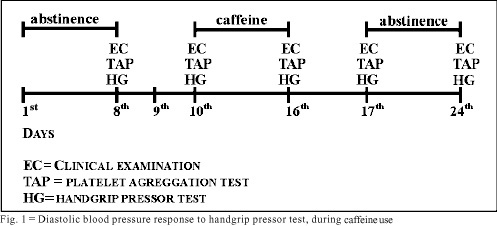
OBJECTIVE: Studies have demonstrated that methylxanthines, such as caffeine, are A1 and A2 adenosine receptor antagonists found in the brain, heart, lungs, peripheral vessels, and platelets. Considering the high consumption of products with caffeine in their composition, in Brazil and throughout the rest of the world, the authors proposed to observe the effects of this substance on blood pressure and platelet aggregation. METHODS: Thirteen young adults, ranging from 21 to 27 years of age, participated in this study. Each individual took 750mg/day of caffeine (250mg tid), over a period of seven days. The effects on blood pressure were analyzed through the pressor test with handgrip, and platelet aggregation was analyzed using adenosine diphosphate, collagen, and adrenaline. RESULTS: Diastolic pressure showed a significant increase 24 hours after the first intake (p<0.05). This effect, however, disappeared in the subsequent days. The platelet aggregation tests did not reveal statistically significant alterations, at any time during the study. CONCLUSION: The data suggest that caffeine increases diastolic blood pressure at the beginning of caffeine intake. This hypertensive effect disappears with chronic use. The absence of alterations in platelet aggregation indicates the need for larger randomized studies.

  • Adenosine
  • Blood Pressure
  • caffeine
Read Full Article
Creative Commons Attribution (CC BY) Creative Commons license
08/01/2002 DOI: 10.1590/S0066-782X2000000800002

How to cite this article

EndNote RIS

Electronic Document Format (Vancouver)

Li Q, Ke G, Liu M, Chen Y, Luo Y, Qiu L. Study on Urinary Caffeine and Caffeine Metabolite Levels in American Adults with Coronary Heart Disease: A Cross-Sectional NHANES Study (2009-2014). Arquivos Brasileiros de Cardiologia 2025;122(9):e20240425.

Electronic Document Format (ABNT)

Li, Qianqian; Ke, Gan; Liu, Mengdie; Chen, Yanjun; Luo, Ye; Qiu, Liangxian. Study on Urinary Caffeine and Caffeine Metabolite Levels in American Adults with Coronary Heart Disease: A Cross-Sectional NHANES Study (2009-2014). Arquivos Brasileiros de Cardiologia, v. 122, n. 9, e20240425, Nov. 2025.

Electronic Document Format (APA)

Li, Q., Ke, G., Liu, M., Chen, Y., Luo, Y., & Qiu, L. (2025). Study on Urinary Caffeine and Caffeine Metabolite Levels in American Adults with Coronary Heart Disease: A Cross-Sectional NHANES Study (2009-2014). Arquivos Brasileiros de Cardiologia, 122(9), e20240425.

Electronic Document Format (ISO)

Li, Qianqian and Ke, Gan and Liu, Mengdie and Chen, Yanjun and Luo, Ye and Qiu, Liangxian. Study on Urinary Caffeine and Caffeine Metabolite Levels in American Adults with Coronary Heart Disease: A Cross-Sectional NHANES Study (2009-2014). Arquivos Brasileiros de Cardiologia [online]. 2025, vol. 122, n. 9, [cited 2026-10-14], e20240425. Available from: <https://journals.cardiol.br/en/article/study-on-urinary-caffeine-and-caffeine-metabolite-levels-in-american-adults-with-coronary-heart-disease-a-cross-sectional-nhanes-study-2009-2014/>. ISSN 0066-782X

EndNote RIS

Electronic Document Format (Vancouver)

Cavalcante JWS, Santos Jr. PRM, Menezes MGF, Marques HO, Cavalcante LP, Pacheco WS. Influence of caffeine on blood pressure and platelet aggregation. Arquivos Brasileiros de Cardiologia 2002;75(2):102-5.

Electronic Document Format (ABNT)

Cavalcante, José Wilson S.; Santos Jr., Paulo Roberto M.; Menezes, Marcus G. F. de; Marques, Hedylamar Oliveira; Cavalcante, Leonardo Pessoa; Pacheco, Walewska S.. Influence of caffeine on blood pressure and platelet aggregation. Arquivos Brasileiros de Cardiologia, v. 75, n. 2, p. 102-105, Jan. 2002.

Electronic Document Format (APA)

Cavalcante, J. W. S., Santos Jr., P. R. M., Menezes, M. G. F. , Marques, H. O., Cavalcante, L. P., & Pacheco, W. S. (2002). Influence of caffeine on blood pressure and platelet aggregation. Arquivos Brasileiros de Cardiologia, 75(2), 102-105.

Electronic Document Format (ISO)

Cavalcante, José Wilson S. and Santos Jr., Paulo Roberto M. and Menezes, Marcus G. F. de and Marques, Hedylamar Oliveira and Cavalcante, Leonardo Pessoa and Pacheco, Walewska S.. Influence of caffeine on blood pressure and platelet aggregation. Arquivos Brasileiros de Cardiologia [online]. 2002, vol. 75, n. 2, [cited 2026-10-14], pp. 102-105. Available from: <https://journals.cardiol.br/en/article/influence-of-caffeine-on-blood-pressure-and-platelet-aggregation/>. ISSN 0066-782X

  • About ABC Family
  • Internal Regulation
  • Editorial Board
  • Brazilian Society of Cardiology (SBC)

Issues

SBC Guidelines

  • Videos
  • Podcasts
  • News