ABC Family Arquivos Brasileiros de Cardiologia International Journal of Cardiovascular Sciences ABC Heart Failure & Cardiomyopathy ABC Imagem Cardiovascular
Português English
ABC Family
Português English
  • About
    • About ABC Family
    • Internal Regulation
    • Editorial Board
    • Brazilian Society of Cardiology (SBC)
  • Issues
  • SBC Guidelines
  • Content
    • Videos
    • Podcasts
    • News
  • About
    • About ABC Family
    • Internal Regulation
    • Editorial Board
    • Brazilian Society of Cardiology (SBC)
  • Issues
  • SBC Guidelines
  • Content
    • Videos
    • Podcasts
    • News

ABC Family

  • ABC Family
  • Arquivos Brasileiros de Cardiologia
  • International Journal of Cardiovascular Sciences
  • ABC Heart Failure & Cardiomyopathy
  • ABC Imagem Cardiovascular
Search in

No content found.

Journals
Ordering
Article types
Others

  1. Home
  2. Keyword: acute ischemic syndrome
Inflammatory, lipid, and metabolic profile in acute ischemic syndrome: correlation with hospital and posthospital events
ABC
Artigo Original

Inflammatory, lipid, and metabolic profile in acute ischemic syndrome: correlation with hospital and posthospital events

Elizabeth da Rosa Duarte et al. Lucia Campos Pellanda Vera Lúcia Portal

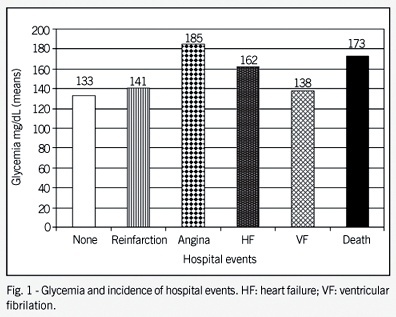
OBJECTIVE: To associate the markers lipid profile, inflammatory profile (high-sensitivity C-reactive protein HSCRP and fibrinogen), and metabolic profile (glucose determination) with hospital and posthospital events in patients with acute ischemic syndrome (AIS) and to describe the predictors of mortality in this population. METHODS: A cohort study with 199 patients with AIS (unstable angina, acute myocardial infarction (AMI) with or without ST segment elevation) admitted to the intensive care unit (ICU) of a university cardiology Hospital, from March to November 2002. The previous diseases, the medication in use, and the coronary risk factors were recorded. The clinical events considered in the hospital were reinfarction, angina, heart failure (HF), ventricular fibrillation, and death; the posthospital events considered (30 days after hospital discharge) were reinfarction, angina, HF, death, and admittance for percutaneous procedures (PTCA) or for revascularization (MRS). RESULTS: HSCRP and altered glycemia were significantly associated with hospital events (P = 0.03 and P < 0.01, respectively); however, they were not associated with posthospital events (P = 0.19 and P = 0.61, respectively). Lipid profile and fibrinogen did not have a statistically significant association in any of the times assessed. Using multiple logistic regression, age (P = 0.04), previous AMI (P = 0.04), myocardial infarction with ST segment elevation (P = 0.008) or without ST segment elevation (P = 0.048), and altered glycemia (P = 0.002) were predictors of hospital mortality. CONCLUSION: Increased HSCRP and altered glycemia were associated with a greater number of hospital events, whereas age, previous AMI, AMI with or without ST segment elevation, and altered glycemia were predictors of hospital mortality.

  • acute ischemic syndrome
  • inflammatory markers
  • Lipid profile
Read Full Article
Creative Commons Attribution (CC BY) Creative Commons license
08/03/2005 DOI: 10.1590/S0066-782X2005000200006 Views 2
Analysis of Plasma Homocysteine Levels in Patients with Unstable Angina
ABC
Original Article

Analysis of Plasma Homocysteine Levels in Patients with Unstable Angina

José Roberto Tavares et al. Vânia D'Almeida Daniela C. Diniz Carolina A. Terzi … Edison N. Cruz Edson Stefanini Adagmar Andriollo Angelo A.V. de Paola Antonio C. Carvalho

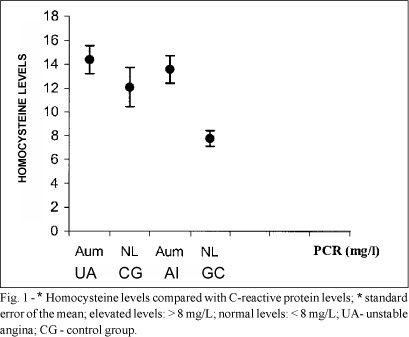
OBJECTIVE – To determine the prevalence of hyperhomocystinemia in patients with acute ischemic syndrome of the unstable angina type. METHODS – We prospectively studied 46 patients (24 females) with unstable angina and 46 control patients (19 males), paired by sex and age, blinded to the laboratory data. Details of diets, smoking habits, medication used, body mass index, and the presence of hypertension and diabetes were recorded, as were plasma lipid and glucose levels, C-reactive protein, and lipoperoxidation in all participants. Patients with renal disease were excluded. Plasma homocysteine was estimated using high-pressure liquid chromatography. RESULTS – Plasma homocysteine levels were significantly higher in the group of patients with unstable angina (12.7±6.7 µmol/L) than in the control group (8.7±4.4 µmol/L) (p<0.05). Among males, homocystinemia was higher in the group with unstable angina than in the control group, but this difference was not statistically significant (14.1±5.9 µmol/L versus 11.9±4.2 µmol/L). Among females, however, a statistically significant difference was observed between the 2 groups: 11.0±7.4 µmol/L versus 6.4±2.9 µmol/L (p<0.05) in the unstable angina and control groups, respectively. Approximately 24% of the patients had unstable angina at homocysteine levels above 15 µmol/L. CONCLUSION – High homocysteine levels seem to be a relevant prevalent factor in the population with unstable angina, particularly among females.

  • acute ischemic syndrome
  • homocysteine
  • Unstable Angina
Read Full Article
Creative Commons Attribution (CC BY) Creative Commons license
10/09/2002 DOI: 10.1590/S0066-782X2002001100008 Views 1

How to cite this article

EndNote RIS

Electronic Document Format (Vancouver)

Duarte ER, Pellanda LC, Portal VL. Inflammatory, lipid, and metabolic profile in acute ischemic syndrome: correlation with hospital and posthospital events. Arquivos Brasileiros de Cardiologia 2005;84(2):122-9.

Electronic Document Format (ABNT)

Duarte, Elizabeth da Rosa; Pellanda, Lucia Campos; Portal, Vera Lúcia. Inflammatory, lipid, and metabolic profile in acute ischemic syndrome: correlation with hospital and posthospital events. Arquivos Brasileiros de Cardiologia, v. 84, n. 2, p. 122-129, Mar. 2005.

Electronic Document Format (APA)

Duarte, E. R., Pellanda, L. C., & Portal, V. L. (2005). Inflammatory, lipid, and metabolic profile in acute ischemic syndrome: correlation with hospital and posthospital events. Arquivos Brasileiros de Cardiologia, 84(2), 122-129.

Electronic Document Format (ISO)

Duarte, Elizabeth da Rosa and Pellanda, Lucia Campos and Portal, Vera Lúcia. Inflammatory, lipid, and metabolic profile in acute ischemic syndrome: correlation with hospital and posthospital events. Arquivos Brasileiros de Cardiologia [online]. 2005, vol. 84, n. 2, [cited 2026-10-14], pp. 122-129. Available from: <https://journals.cardiol.br/en/article/inflammatory-lipid-and-metabolic-profile-in-acute-ischemic-syndrome-correlation-with-hospital-and-posthospital-events/>. ISSN 0066-782X

EndNote RIS

Electronic Document Format (Vancouver)

Tavares JR, D’Almeida V, Diniz DC, Terzi CA, Cruz EN, Stefanini E, Andriollo A, et al. Analysis of Plasma Homocysteine Levels in Patients with Unstable Angina. Arquivos Brasileiros de Cardiologia 2002;79(2):167-72.

Electronic Document Format (ABNT)

Tavares, José Roberto; D’Almeida, Vânia; Diniz, Daniela C.; Terzi, Carolina A.; Cruz, Edison N.; Stefanini, Edson; Andriollo, Adagmar; Paola, Angelo A.V. de; Carvalho, Antonio C.. Analysis of Plasma Homocysteine Levels in Patients with Unstable Angina. Arquivos Brasileiros de Cardiologia, v. 79, n. 2, p. 167-172, Sep. 2002.

Electronic Document Format (APA)

Tavares, J. R., D’Almeida, V., Diniz, D. C., Terzi, C. A., Cruz, E. N., Stefanini, E., Andriollo, A., Paola, A. A. , & Carvalho, A. C. (2002). Analysis of Plasma Homocysteine Levels in Patients with Unstable Angina. Arquivos Brasileiros de Cardiologia, 79(2), 167-172.

Electronic Document Format (ISO)

Tavares, José Roberto and D’Almeida, Vânia and Diniz, Daniela C. and Terzi, Carolina A. and Cruz, Edison N. and Stefanini, Edson and Andriollo, Adagmar and Paola, Angelo A.V. de and Carvalho, Antonio C.. Analysis of Plasma Homocysteine Levels in Patients with Unstable Angina. Arquivos Brasileiros de Cardiologia [online]. 2002, vol. 79, n. 2, [cited 2026-10-14], pp. 167-172. Available from: <https://journals.cardiol.br/en/article/analysis-of-plasma-homocysteine-levels-in-patients-with-unstable-angina/>. ISSN 0066-782X

  • About ABC Family
  • Internal Regulation
  • Editorial Board
  • Brazilian Society of Cardiology (SBC)

Issues

SBC Guidelines

  • Videos
  • Podcasts
  • News