Cost-effectiveness and Budget Impact Analysis of Coronary CT Angiography in the Brazilian Unified Health System
Abstract
Background
Coronary artery disease (CAD) represents a major clinical and economic burden for the Brazilian Unified Health System (SUS). Although coronary computed tomography angiography (CCTA) has excellent diagnostic accuracy, cost-effectiveness analyses (CEA) based on national data are lacking.
Objective
To evaluate the cost-effectiveness and budget impact of incorporating CCTA as the initial diagnostic strategy for patients with suspected stable CAD from the SUS perspective.
Methods
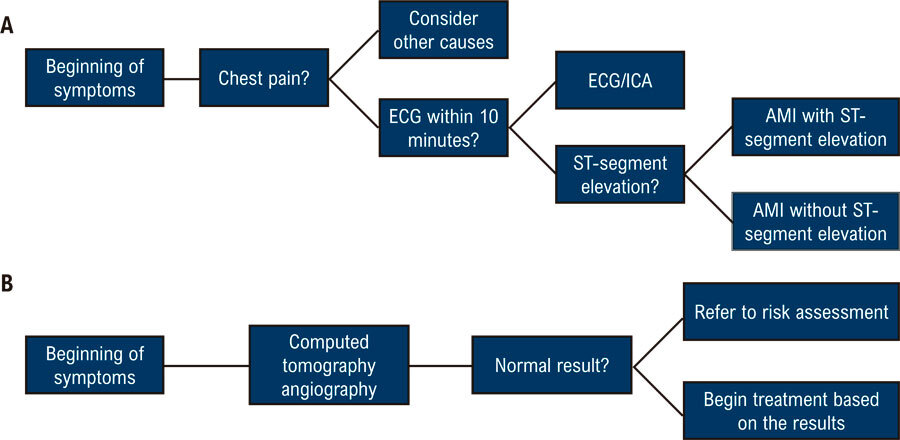
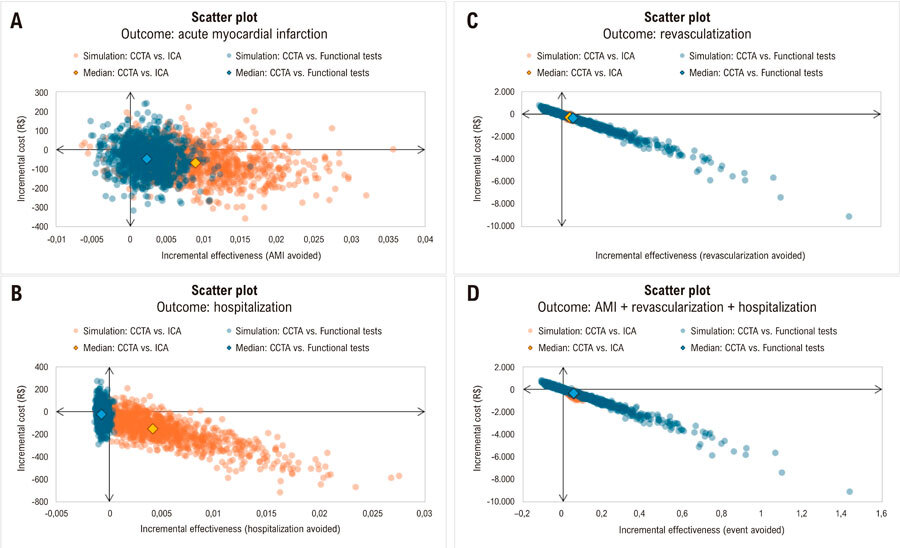
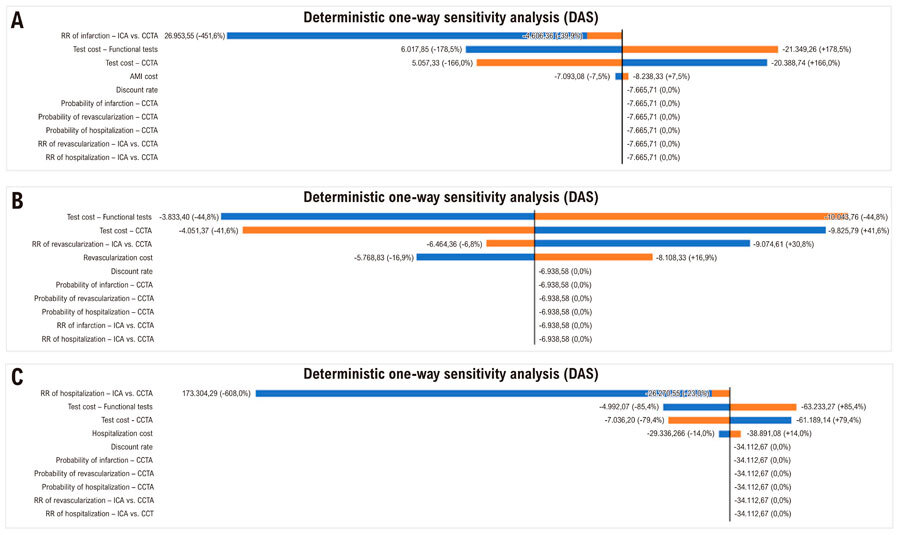
A cost-effectiveness analysis (CEA) and a budget impact analysis (BIA) were conducted, comparing CCTA with invasive coronary angiography (ICA) and with a panel of functional tests in patients with suspected stable CAD. A one-year time horizon was adopted for the CEA and five years for the BIA. Effectiveness outcomes included the incidence of acute myocardial infarction (AMI), revascularization rates, and hospitalizations. Deterministic and probabilistic sensitivity analyses were performed.
Results
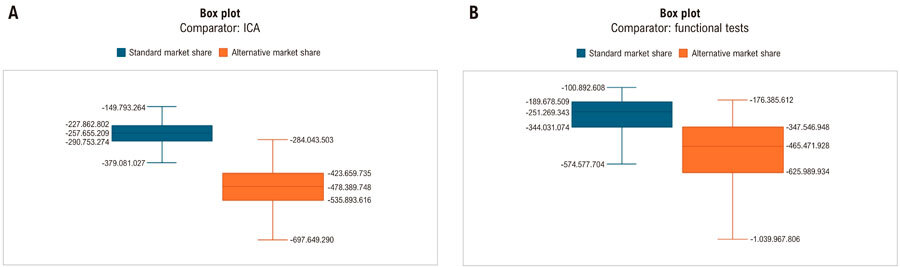
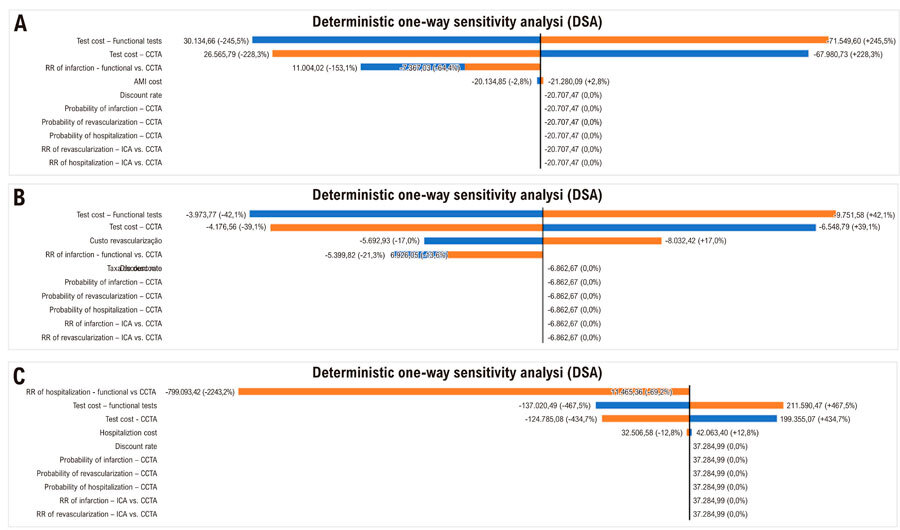
CCTA proved to be cost-effective, reducing costs related to AMI (R$610.18 vs. R$867.80), revascularization (R$1,378.14 vs. R$1,833.84), and hospitalization (R$602.86 vs. R$932.79), resulting in savings of R$329.93 per patient. Compared with functional tests, CCTA also reduced costs associated with AMI (R$610.18 vs. R$658.36), revascularization (R$1,378.14 vs. R$1,659.18), and hospitalization (R$602.86 vs. R$628.16). The BIA projected cumulative savings for SUS ranging from R$34.1 million to R$73 million over five years, depending on the comparator and diffusion scenario.
Conclusions
The results suggest that using CCTA as the initial diagnostic test for patients with low-to-moderate risk of CAD in SUS may represent an economically favorable strategy, with potential to generate substantial cost savings compared with the evaluated alternatives.
Images
Image gallery fullscreen viewer
Comments are moderated by the editorial team before publication. Discussions should be evidence-based and use scientific language. Conflicts of interest should be declared.