Protocol for a Structured, Health Policy and Systems–Oriented Scoping Review of Determinants of Single-Pill Combination Availability in Sub-Saharan Africa
Abstract
Background:
Although international guidelines recommend single-pill combinations (SPCs) as first-line therapy for hypertension, their availability and use remain limited. Evidence on access to essential medicines is largely not specific to SPCs, and the determinants influencing their availability are dispersed across heterogeneous sources that are not well captured by traditional systematic review approaches.
Objective:
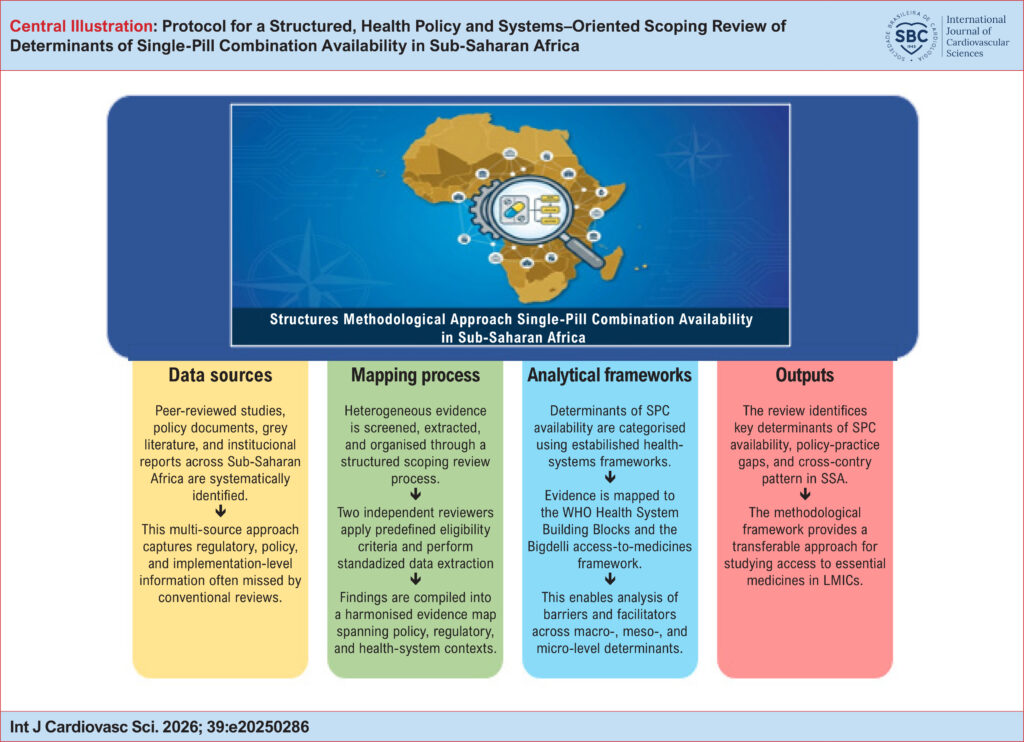
To describe the protocol for a structured, health policy and systems–oriented scoping review designed to map and synthesize the determinants of availability of antihypertensive SPCs in Sub-Saharan Africa (SSA) and to propose a transferable methodological framework applicable to other essential medicines and health system contexts.
Methods:
A comprehensive scoping review of peer-reviewed literature, grey literature, and policy documents will be conducted in accordance with the PRISMA extension for scoping reviews (PRISMA-ScR). Searches will be performed across bibliographic databases, government repositories, and relevant non governmental organization (NGO) sources. Eligible sources will include empirical studies, policy analyses, and institutional reports addressing SPC availability. Two independent reviewers will screen studies and extract data. Evidence will be synthesized narratively and mapped to the World Health Organization (WHO) Health System Building Blocks and the Bigdeli access-to-medicines framework.
Expected results:
The review will generate a structured mapping of regulatory, economic, health system, and sociocultural determinants influencing SPC availability in SSA and will identify key barriers, facilitators, and policy gaps relevant to hypertension management.
Conclusions:
This protocol outlines a replicable methodological approach for synthesizing heterogeneous evidence on access to essential medicines. The framework may be adapted to other therapeutic areas and low- and middle-income contexts, potentially supporting more informed policy and implementation decisions to reduce cardiovascular morbidity and mortality.
Images
Image gallery fullscreen viewer
Comments are moderated by the editorial team before publication. Discussions should be evidence-based and use scientific language. Conflicts of interest should be declared.