Validity of maximum heart rate prediction equations for children and adolescents
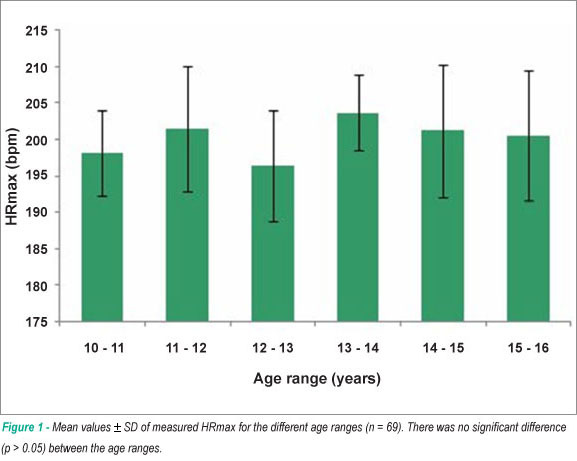
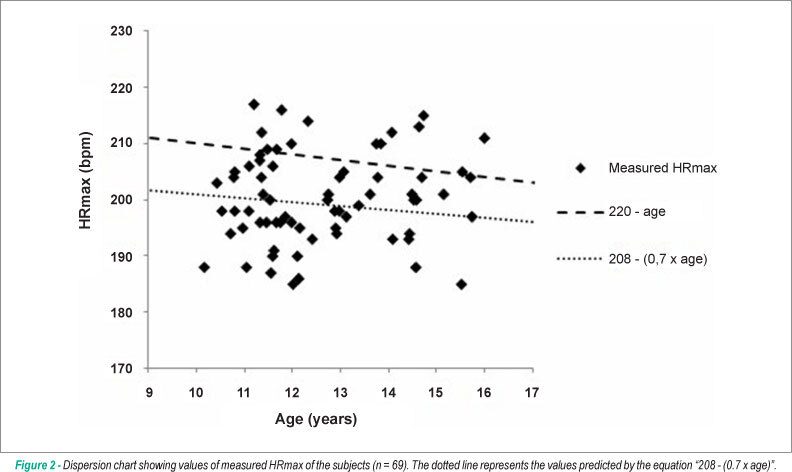
BACKGROUND: There are no studies in the literature to validate equations that predict maximum heart rate (HRmax) in children and adolescents. OBJECTIVE: To analyze the validity of the HRmax predictive equations “220 – age” and “208 – (0.7 x age)” in boys aged 10 and 16. METHODS: A progressive maximal exertion test was carried out in 69 apparently healthy boys aged 10 to 16. The initial test velocity was 9 km/h, with 1-km/h increments every three minutes. The test was maintained until maximum voluntary exertion was achieved, considering HRmax as the highest heart rate attained during the test. The measured HRmax was compared with the values predicted by the “220 – age” and “208 – (0.7 x age)” equations, using ANOVA for repeated measures. RESULTS: The mean values of HRmax (bpm) were: 200.2 ± 8.0 (measured), 207.4 ± 1.5 (“220 – age”) and 199.2 ± 1.1 (“208 – (0.7 x age)”). The HRmax predicted by the “220 – age” equation was significantly higher (p 0.05). CONCLUSION: The “220 – age” equation overestimated the measured HRmax and was not valid for this population. The “208 – (0.7 x age)” equation was valid for this population, showing results that were quite similar to those of measured HRmax. Future studies with larger sample sizes can verify whether the HRmax does not depend on age for this population, a situation in which the constant 200 bpm value would be more appropriate for HRmax.
Images
Image gallery fullscreen viewer
Comments are moderated by the editorial team before publication. Discussions should be evidence-based and use scientific language. Conflicts of interest should be declared.