Update of the Brazilian Guidelines for Valvular Heart Disease – 2020
1. Introduction
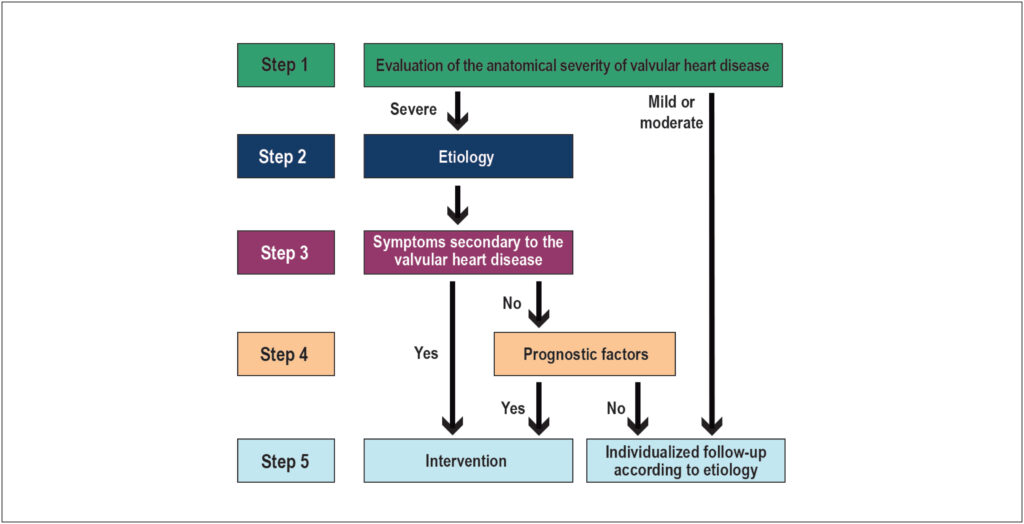
There are currently a wide modalities of interventional strategies – both transcatheter and surgical – which can be indicated for patients with valvular heart diseases (VHD), with the objective of reducing the morbidity and mortality. The correct timing for indication and the type of interventional treatment are linked to the precise anatomical and functional diagnosis of the VHD, and comprehensive global evaluation of the patient. The 2020 Update of the Brazilian Guidelines for VHD, in addition to compiling scientific evidence and expert opinion, continues with the ideal of being useful in supporting decision making for patients with VHD, and has three unique characteristics, namely:
This 2020 edition considers the evaluation process for patients with non-severe VHD, and it emphasizes the need to weigh the possibility of transcatheter intervention in elderly patients, regardless of surgical risk, in addition patients with native or prosthetic valves with high surgical risk. Notwithstanding great advances and increased availability of imaging exams, these guidelines maintain the recommendation of detailed clinical evaluation, which continues to be indispensable to diagnosis, decisions making, and the doctor-patient relationship.
[…]
Images
Image gallery fullscreen viewer
Comments are moderated by the editorial team before publication. Discussions should be evidence-based and use scientific language. Conflicts of interest should be declared.