Temporal tendency of in-hospital lethality due to acute myocardial infarction: 1994-2003
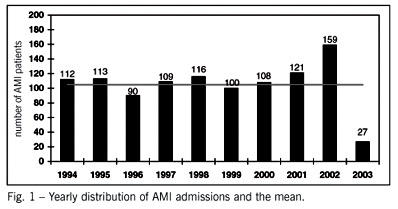
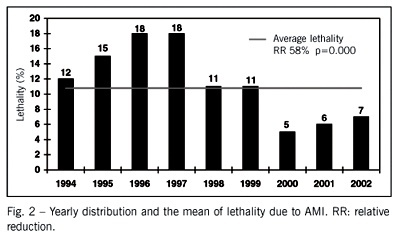
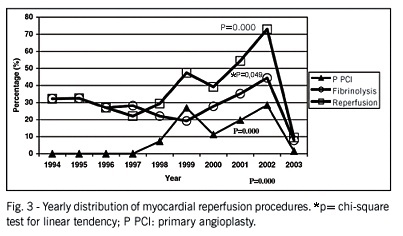
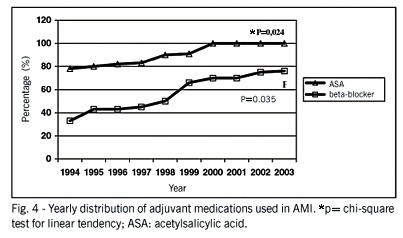
OBJECTIVE: To analyze the temporal tendency of lethality due to acute myocardial infarction (AMI) and if the change in behavior directly interfered in such lethality. METHODS: 1055 non-selected patients, who were hospitalized in coronary unit from 1994 to 2003, were assessed. Clinical and therapeutic profile-related variables were analyzed. The statistic analysis used the exponential damping of temporal series and other techniques, such as the logistic linear regression. RESULTS: The average lethality was 10.8%, being 12% in 1994 and 7% in 2002 (p=0.000), a relative reduction of 58%. There was no significant variation in the risk profile of the patients. There were 67.4% of men and 32.4% of women, with an average age of 60.93 and 64.84 years old, respectively. It was observed a significant increase in the percentage of cardiac catheterization (from 14% to 51%), in the angioplasty carried out 24 hours after the infarction (from 2% to 33%), in the surgery for myocardial revascularization (from 4% to 7%) and in the primary angioplasty (from 4% to 11%) with p=0.000, p=0.021, p=0.000 and p=0.000, respectively, for linear tendency. In the first 24 hours there was an increase of the use of aspirin and beta-blockers, from 78% to 100% and, from 33% to 76% (p=0.003 and p=0.004, respectively) along the years. After the analysis, the myocardial reperfusion therapy, the use of aspirin and beta-blocker in the first 24 hours of the AMI (p=0.010, p=0.024 and p=0.035, respectively) kept on being lethality determiners. CONCLUSION: There was a decrease in lethality and the change of behavior in the treatment of AMI along the years was responsible for the reduction of lethality in that temporal series.
Images
Image gallery fullscreen viewer
Comments are moderated by the editorial team before publication. Discussions should be evidence-based and use scientific language. Conflicts of interest should be declared.