Serum levels of interleukin-6 (Il-6), interleukin-18 (Il-18) and C-reactive protein (CRP) in patients with type-2 diabetes and acute coronary syndrome without ST-segment elevation
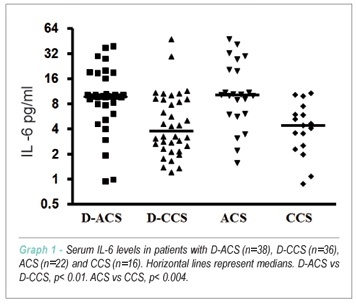
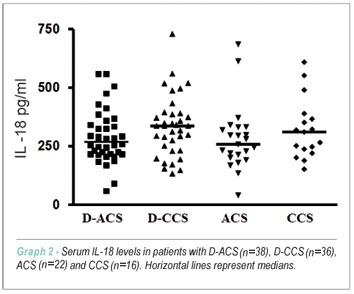
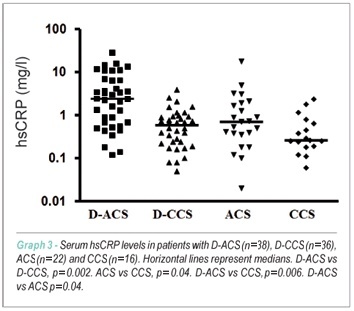
BACKGROUND: Atherosclerosis is an inflammatory disease, and serum levels of inflammatory markers such as interleukin 6 (IL-6), interleukin 18 (IL-18) and C-reactive protein (CRP) are used to evaluate patients with coronary artery disease. In patients with type-2 diabetes, atherosclerosis is related to a larger number of events such as myocardial infarction and death, when compared with patients without diabetes. OBJECTIVE: To evaluate the inflammatory response in patients with diabetes and acute events of coronary instability. METHODS: Two groups of patients were primarily selected. The first group was comprised of diabetic outpatients with stable angina (D-CCS) and presence of coronary artery disease on coronary angiography (n=36). The second group was comprised of diabetic patients seen in the emergency room with acute coronary syndrome (D-ACS) without ST-segment elevation (n=38). Non-diabetic patients with ACS (n=22) and CCS (n=16) comprised the control group. Serum levels of CRP, IL-6 and IL-18 were determined using nephelometry (CRP) and ELISA (IL-6 and IL-18) techniques. RESULTS: Higher serum IL-6 levels were found in diabetic or non-diabetic patients with ACS than in the group with CCS. On the other hand, diabetic patients with ACS had higher CRP levels in comparison with the other groups. Serum IL-18 levels were not significantly different among the patients studied. CONCLUSION: our findings suggest a more intense inflammatory activity in patients with coronary instability. This inflammatory activity, as measured by CRP, seems to be even more intense in diabetic patients.
Images
Image gallery fullscreen viewer
Comments are moderated by the editorial team before publication. Discussions should be evidence-based and use scientific language. Conflicts of interest should be declared.