Exploring the Correlations between Initial Clinical and Radiological Manifestations in Takayasu’s Arteritis
Abstract
Background
Initial clinical and imaging associations in Takayasu’s arteritis (TAK) are poorly defined.
Objectives
To characterize initial manifestations, their associations, and long-term outcomes in a TAK cohort.
Methods
A single-center retrospective cohort study (2000 to 2024) included patients diagnosed with TAK. The significance level was set at p<0.05.
Results
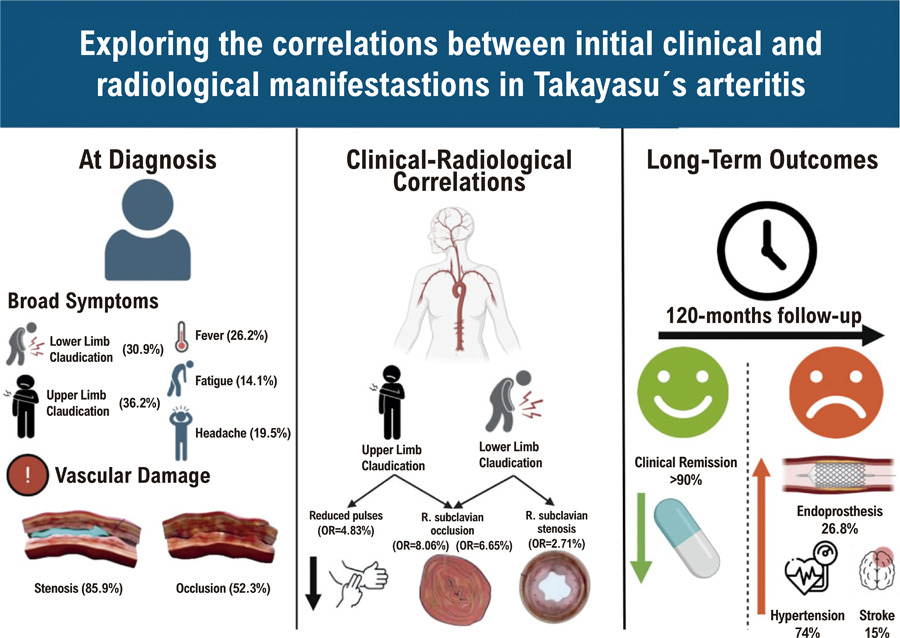
Among 203 patients identified, 54 were excluded due to incomplete data. The final cohort comprised 149 patients (89.9% female), with a median age at diagnosis of 31 years. At diagnosis, 92.6% were symptomatic. Claudication of upper (36.2%) and lower (30.9%) limbs was frequent, alongside advanced vascular damage like stenosis (85.9%) and occlusions (52.3%). Upper limb claudication was independently predicted by reduced upper limb pulses (OR=4.83; 95%CI=2.08-11.24; p=0.001) and right subclavian artery occlusion (OR=8.06; 95%CI=1.94-33.44; p=0.004). Lower limb claudication was predicted by right subclavian artery occlusion (OR=6.65; 95%CI=2.05-21.61; p=0.002), right subclavian artery thickening (OR=5.12; 95%CI=1.18-22.71; p=0.029), and left subclavian artery stenosis (OR=2.71; 95%CI=1.21-60.56; p=0.016). Over a median 10-year follow-up, despite 91.3% remission, cardiovascular comorbidities increased, and 26.8% required surgery.
Conclusions
Limb claudication is a key prognostic indicator of advanced radiological damage and diagnostic delay. This is reinforced by a long-term dissociation between high clinical remission and progressive vascular disease, demanding vigilant monitoring.
Images
Image gallery fullscreen viewer
Comments are moderated by the editorial team before publication. Discussions should be evidence-based and use scientific language. Conflicts of interest should be declared.