Comparison between international normalized ratio using a portable device and conventional methodology
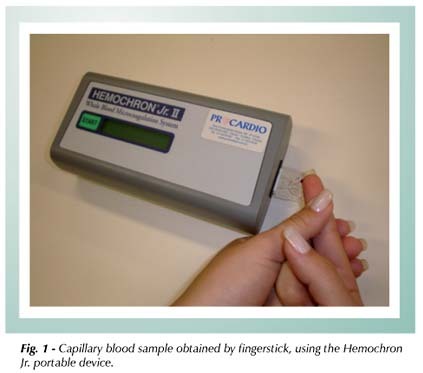
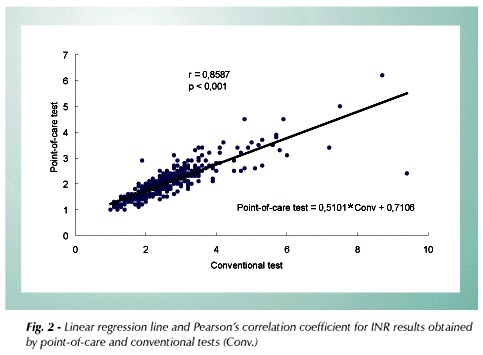
OBJECTIVE: to compare the international normalized ratio (INR) measured by a point-of-care (POC) testing device with that measured by the conventional method in patients undergoing anticoagulation therapy with warfarin sodium. METHODS: The INR of 383 warfarin-treated patients (mean age: 56.5 years; 207 female) was measured in capillary blood using the Hemochron Jr. device and compared with that of venous plasma samples determined by the conventional method performed in a Coag-A-Mate analyzer. Results were evaluated globally and for the following subgroups: INR 3.5. RESULTS: Using both methods, the comparison between INR values yielded a correlation coefficient (r) of 0.86. However, mean differences in INR in both tests, considering the three subgroups, proved to be statistically significant (p <0.001): 0.14 ± 0.21 (INR< 2.0); 0.54 ± 0.31 (2.0 < INR 3.5). Paired Student’s t-test analysis revealed a p value < 0.001 for the three subgroups studied. CONCLUSION: The use of point-of-care testing for monitoring oral anticoagulation has some limitations. Anticoagulation intensity was underestimated by this method in the three subgroups studied.
Images
Image gallery fullscreen viewer
Comments are moderated by the editorial team before publication. Discussions should be evidence-based and use scientific language. Conflicts of interest should be declared.