Clinical efficacy and safety of the percutaneous treatment of secundum atrial septal defect with the Amplatzer occluder
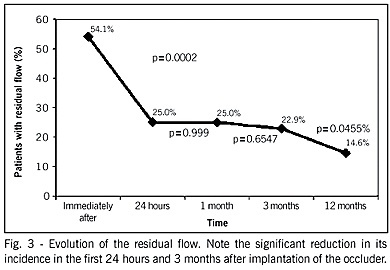
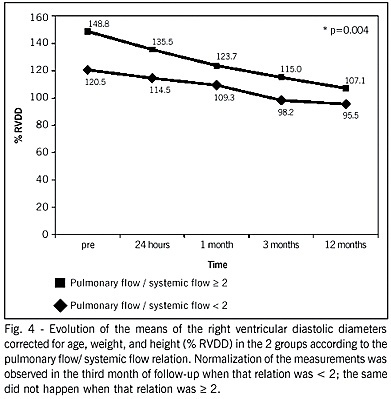
OBJECTIVE: To assess the clinical efficacy and safety of the Amplatzer occluder for percutaneous closure of secundum atrial septal defect. METHODS: Forty-nine patients underwent the procedure guided by transesophageal echocardiography (TEE) while under general anesthesia, afterwards being clinically followed up for 12 months. RESULTS: The defect presented as a single orifice in 91.8% of the cases. The means of the longitudinal and transverse diameters were 14.3±5.0 mm and 14.4±4.9 mm, respectively. The means of the stretched diameters and prostheses were 19.3±5.1 mm and 20.3±4.9 mm, respectively. Technical success occurred in 97.9% of the cases. Immediate residual flow was observed in 54.1% of the patients, being minimum or small in 45.8% and moderate in 8.3%. After 24 hours, residual flow was observed in 25% of the patients (P = 0.0002). At the end of 13.1±1.3 months, the incidence of the overall residual flow decreased to 14.6%, only 4.1% being moderate. A significant reduction in the right ventricular diastolic diameter was observed in the different phases of clinical follow-up (P < 0.001). CONCLUSION: Implantation of the Amplatzer prosthesis proved to be effective and safe, constituting an option for the treatment of the secundum atrial septal defect in selected cases.
Images
Image gallery fullscreen viewer
Comments are moderated by the editorial team before publication. Discussions should be evidence-based and use scientific language. Conflicts of interest should be declared.