ABC Family Arquivos Brasileiros de Cardiologia International Journal of Cardiovascular Sciences ABC Heart Failure & Cardiomyopathy ABC Imagem Cardiovascular
Português English
ABC Family
Português English
  • About
    • About ABC Family
    • Internal Regulation
    • Editorial Board
    • Brazilian Society of Cardiology (SBC)
  • Issues
  • SBC Guidelines
  • Content
    • Videos
    • Podcasts
    • News
  • About
    • About ABC Family
    • Internal Regulation
    • Editorial Board
    • Brazilian Society of Cardiology (SBC)
  • Issues
  • SBC Guidelines
  • Content
    • Videos
    • Podcasts
    • News

ABC Family

  • ABC Family
  • Arquivos Brasileiros de Cardiologia
  • International Journal of Cardiovascular Sciences
  • ABC Heart Failure & Cardiomyopathy
  • ABC Imagem Cardiovascular
Search in

No content found.

Journals
Ordering
Article types
Others

  1. Home
  2. Keyword: sexual behavior
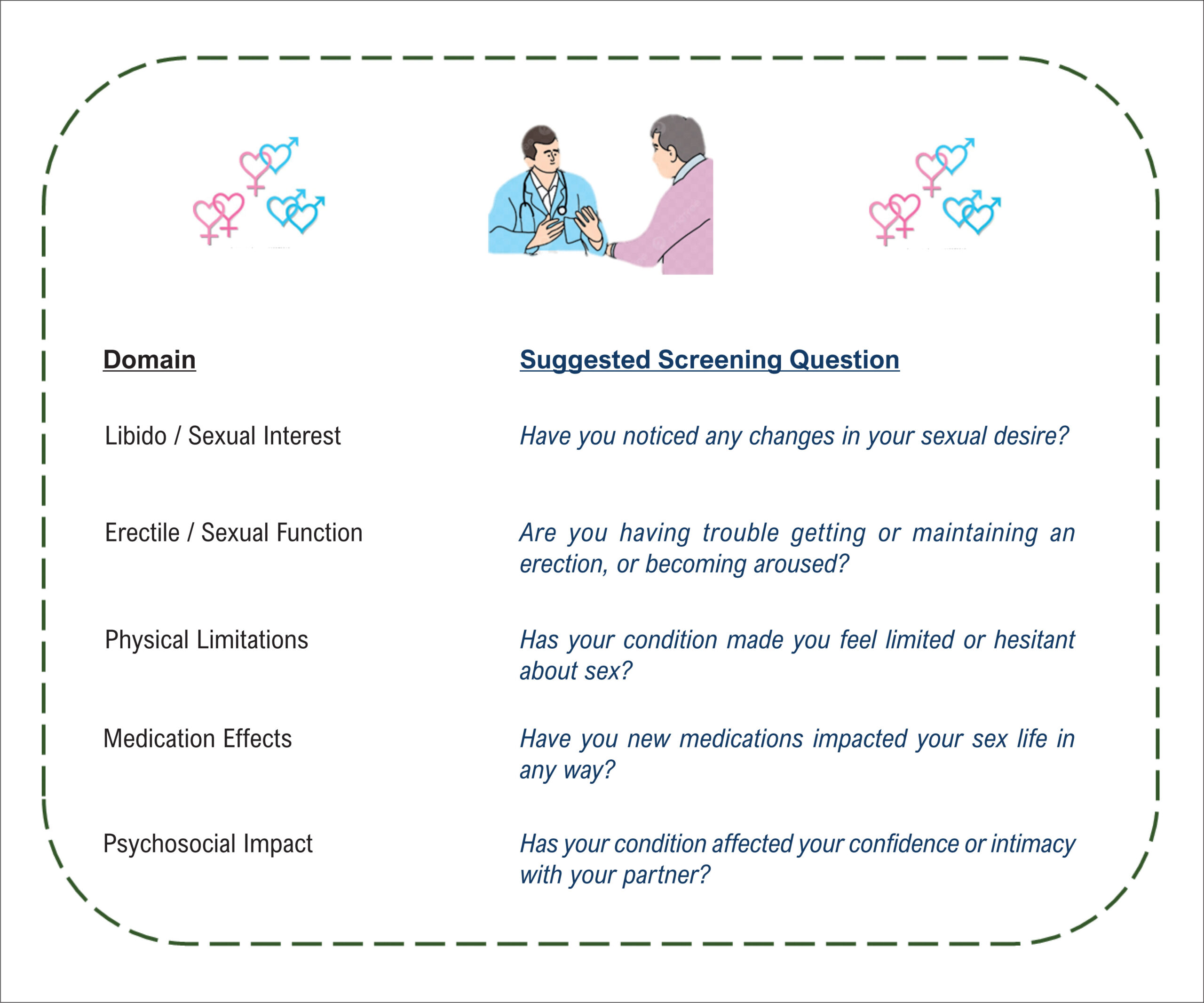
Figure 1
ABC
Editorial

Why Cardiology Can No Longer Ignore Sexual Health?

Ricardo Stein et al. Filipe Ferrari

Introduction

In an era of sophisticated diagnostics and personalized therapies, one aspect of patient care remains routinely overlooked: sexual health. Sexual activity (SA) is more than a source of pleasure; it is also a marker of vitality, intimacy, and emotional resilience.– For individuals with cardiovascular disease (CVD), the desire to resume SA often signals not only physical recovery but also emotional healing and renewed self-confidence. On the other hand, we encourage patients to walk, to eat better, and to take their medications. Nevertheless, when it comes to sex, silence prevails.

Although SA imposes cardiovascular demands comparable to moderate physical activity and is generally considered safe for most patients with stable CVD, many remain uncertain about when or how to resume sexual life after myocardial infarction (MI), coronary artery bypass graft surgery, and heart failure. They are left with unanswered questions because the topic is often met with discomfort or vague reassurances. Studies have consistently shown that patients want – and need – clear guidance on sexual functioning. However, cultural taboos, embarrassment, and lack of professional training continue to silence this conversation in clinical settings., In one study, only 16% of cardiologists routinely discussed sexual function, while 70% rarely or never offered guidance after MI. The most commonly cited barriers included time constraints, lack of privacy, and insufficient training.

[…]

  • Cardiovascular Diseases
  • Counseling
  • sexual behavior
Read Full Article
Creative Commons Attribution (CC BY) Creative Commons license
04/07/2025 DOI: 10.36660/abc.20250326i Views 2
ABC
Artigo Original

Sexual activity after myocardial infarction: taboo or lack of knowledge?

Rosana Pinheiro Lunelli et al. Eneida Rejane Rabello Ricardo Stein Sílvia Goldmeier Maria Antonieta Moraes

BACKGROUND: Despite its clinical and social relevance, resumption of sexual activity after an acute coronary syndrome (ACS) is a subject that is poorly addressed by healthcare providers and one that is given scant emphasis during hospitalization. Erectile dysfunction is a common complaint among cardiac patients, and these patients are in doubt regarding the safety of resuming sexual activity after a cardiovascular event. OBJECTIVE: To describe how well informed patients are in regard to acute an myocardial infarction (AMI) and what sort of guidance they receive regarding resumption of sexual activity. METHODS: A cross-sectional study was performed from June to July 2005 with patients on the sixth day of AMI. A questionnaire was applied to assess not only patients’ knowledge of AMI, but also their expectations regarding their resumption of sexual activity – and frequency of same – following hospital discharge. RESULTS: Ninety-six patients were included in the study (mean age 59 ± 12); 70% of them were male and 80% had experienced their first AMI. Of these, 96% lacked any knowledge of AMI clinical manifestations and possible limitations, 63% reported an active sex life before the event, 60% were in doubt regarding their sex life following hospital discharge, and only 4% received sexual guidance from healthcare providers during their hospital stay. CONCLUSION: According to our findings, the recommendations patients receive during hospitalization are suboptimal in regard to both AMI and resumption of sexual activity. The updating of healthcare providers may change this situation. This is especially true for the nursing staff, since they spend more time with patients.

  • Myocardial Infarction
  • nurses
  • sexual behavior
Read Full Article
Creative Commons Attribution (CC BY) Creative Commons license
26/03/2008 DOI: 10.1590/S0066-782X2008000300003

How to cite this article

EndNote RIS

Electronic Document Format (Vancouver)

Stein R, Ferrari F. Why Cardiology Can No Longer Ignore Sexual Health?. Arquivos Brasileiros de Cardiologia 2025;122(6):e20250326.

Electronic Document Format (ABNT)

Stein, Ricardo; Ferrari, Filipe. Why Cardiology Can No Longer Ignore Sexual Health?. Arquivos Brasileiros de Cardiologia, v. 122, n. 6, e20250326, Jul. 2025.

Electronic Document Format (APA)

Stein, R., & Ferrari, F. (2025). Why Cardiology Can No Longer Ignore Sexual Health?. Arquivos Brasileiros de Cardiologia, 122(6), e20250326.

Electronic Document Format (ISO)

Stein, Ricardo and Ferrari, Filipe. Why Cardiology Can No Longer Ignore Sexual Health?. Arquivos Brasileiros de Cardiologia [online]. 2025, vol. 122, n. 6, [cited 2026-10-14], e20250326. Available from: <https://journals.cardiol.br/en/article/why-cardiology-can-no-longer-ignore-sexual-health/>. ISSN 0066-782X

EndNote RIS

Electronic Document Format (Vancouver)

Lunelli RP, Rabello ER, Stein R, Goldmeier S, Moraes MA. Sexual activity after myocardial infarction: taboo or lack of knowledge?. Arquivos Brasileiros de Cardiologia 2008;90(3):172-6.

Electronic Document Format (ABNT)

Lunelli, Rosana Pinheiro; Rabello, Eneida Rejane; Stein, Ricardo; Goldmeier, Sílvia; Moraes, Maria Antonieta. Sexual activity after myocardial infarction: taboo or lack of knowledge?. Arquivos Brasileiros de Cardiologia, v. 90, n. 3, p. 172-176, Mar. 2008.

Electronic Document Format (APA)

Lunelli, R. P., Rabello, E. R., Stein, R., Goldmeier, S., & Moraes, M. A. (2008). Sexual activity after myocardial infarction: taboo or lack of knowledge?. Arquivos Brasileiros de Cardiologia, 90(3), 172-176.

Electronic Document Format (ISO)

Lunelli, Rosana Pinheiro and Rabello, Eneida Rejane and Stein, Ricardo and Goldmeier, Sílvia and Moraes, Maria Antonieta. Sexual activity after myocardial infarction: taboo or lack of knowledge?. Arquivos Brasileiros de Cardiologia [online]. 2008, vol. 90, n. 3, [cited 2026-10-14], pp. 172-176. Available from: <https://journals.cardiol.br/en/article/sexual-activity-after-myocardial-infarction-taboo-or-lack-of-knowledge/>. ISSN 0066-782X

  • About ABC Family
  • Internal Regulation
  • Editorial Board
  • Brazilian Society of Cardiology (SBC)

Issues

SBC Guidelines

  • Videos
  • Podcasts
  • News