Marina Lamas Figueredo et al. Matheus Alves Amaral de Lima Alexandre Moura Dos Santos Samuel Katsuyuki Shinjo
Abstract
Background:
Metabolic syndrome (MetS) is highly prevalent in systemic autoimmune diseases and associated with increased cardiovascular risk. However, its occurrence in polyarteritis nodosa (PAN) remains unexplored.
Objectives:
To assess the prevalence of MetS and identify associated factors in patients with PAN.
Methods:
A single-center, case-control study included 21 consecutive patients with PAN who were matched by sex and age to 63 controls at a 1:3 ratio. MetS was defined according to National Cholesterol Education Program – Adult Treatment Panel III (NCEP ATP III) criteria. Clinical, anthropometric, laboratory, and lifestyle data were systematically collected.
Results:
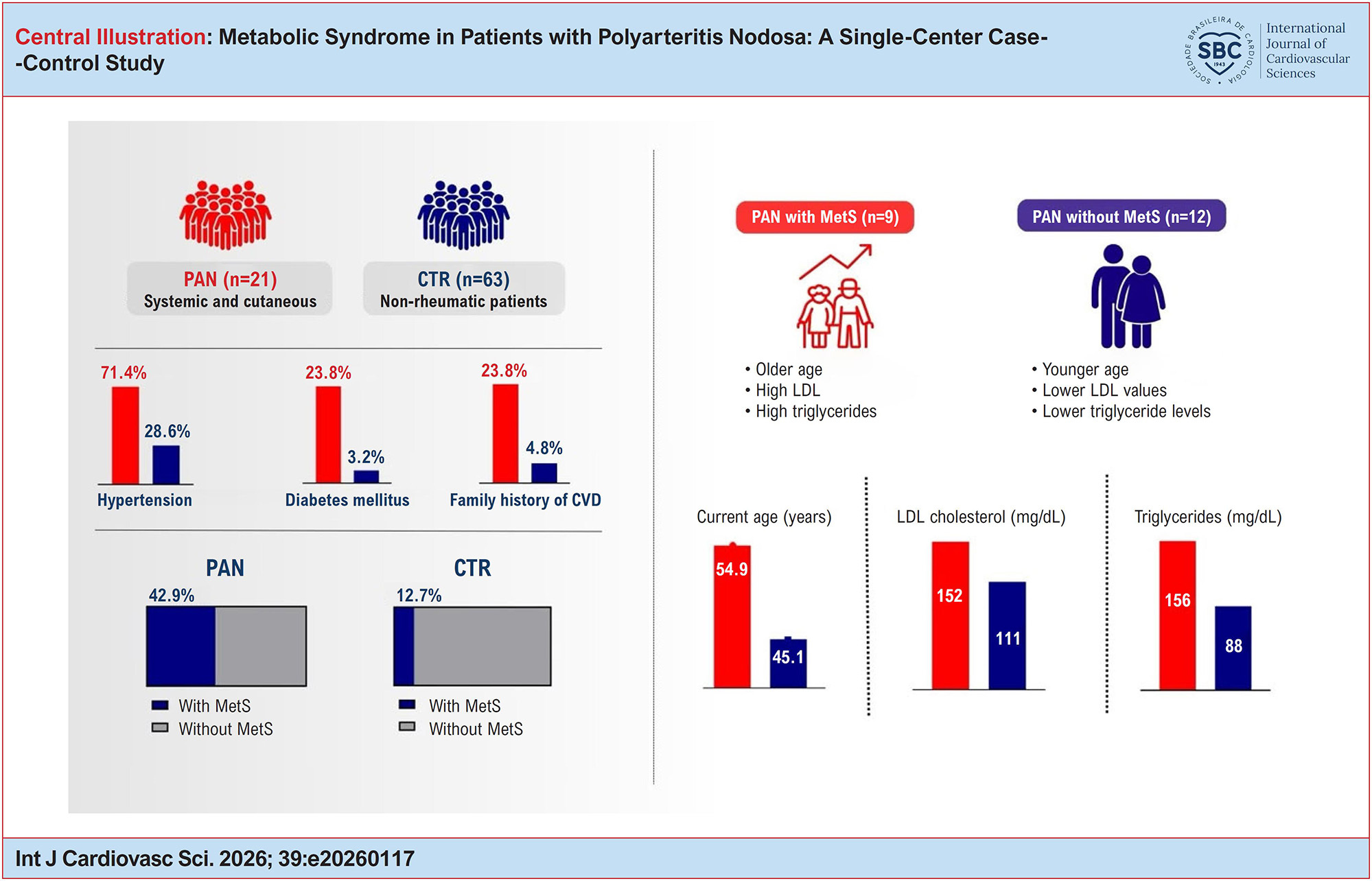
The median age at PAN diagnosis was 38.0 years (interquartile range 29.0–52.0), and current median age was 52.9 years (interquartile range 41.3–62.8); 61.9% were women. Patients with PAN showed significantly higher prevalence of MetS than controls (42.9% vs. 12.7%; p = 0.003), hypertension (71.4% vs. 28.6%; p < 0.001), diabetes mellitus (23.8% vs. 3.2%; p = 0.010), and family history of cardiovascular disease (23.8% vs. 4.8%; p = 0.021), as well as elevated low-density lipoprotein (LDL) cholesterol levels. In multivariable analysis, MetS (odds ratio [ORs] = 6.58; 95% confidence interval [CI] 1.53–23.71; p = 0.004) and family history of cardiovascular disease (ORs = 9.14; 95% CI 1.83–54.78; p = 0.015) were independently associated with PAN. Among patients with PAN, those with MetS were older (54.9 vs. 45.1 years; p = 0.048) and had higher triglyceride and LDL cholesterol levels.
Conclusions:
Patients with PAN presented a higher prevalence of MetS compared with controls. These findings highlight the need for systematic cardiovascular risk assessment and early preventive strategies in PAN management.