Luciana Moreira Lima et al. Maria das Graças Carvalho Cirilo Pereira Fonseca Neto José Carlos Faria Garcia Marinez Oliveira Sousa
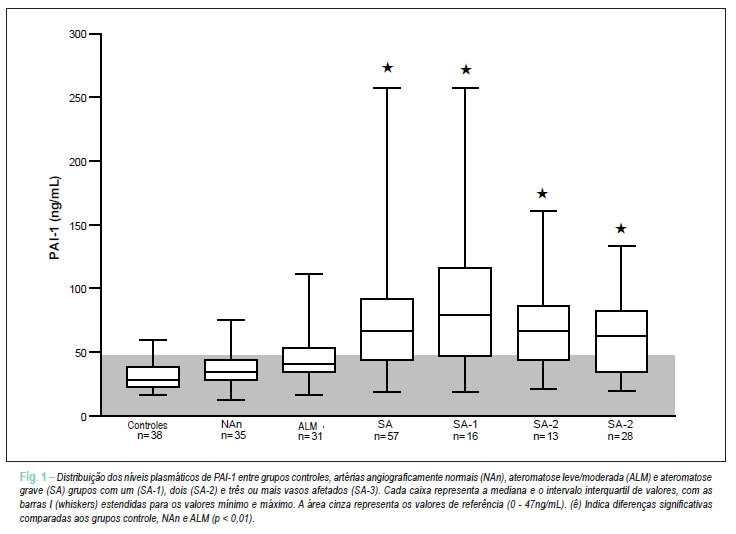
BACKGROUND: Type-1 plasminogen activator inhibitor (PAI-1) 4G/5G polymorphism may influence the PAI-1 expression. High plasma levels of PAI-1 are associated with coronary artery disease (CAD). OBJECTIVE: This study investigated the influence of PAI-1 4G/5G polymorphism on plasma PAI-1 levels and its association with CAD assessed by coronary angiography. METHODS: Blood sample of 35 individuals with angiographycally normal coronary arteries, 31 individuals presenting mild/moderate atheromatosis, 57 individuals presenting severe atheromatosis and 38 healthy individuals (controls) were evaluated. In patients and controls, the PAI-1 4G/5G polymorphism was determined by PCR amplification using allele-specific primers. Plasma PAI-1 levels were quantified by ELISA assay (American Diagnostica). RESULTS: No difference was found between groups regarding age, gender and body mass index. Plasma PAI-1 levels and 4G/4G genotype frequency were significantly higher in the severe atheromatosis group compared to the other groups (p<0.001). Furthermore, patients with 4G/4G genotype (r=0.28, p 70% (p<0.001). CONCLUSION: The most important finding of this study was the association between 4G/4G genotype, high plasma PAI-1 levels and coronary stenosis higher than 70% in Brazilian individuals. Whether high plasma PAI-1 levels are a decisive factor for atherosclerosis worsening or it is a consequence remains to be established.