ABC Family Arquivos Brasileiros de Cardiologia International Journal of Cardiovascular Sciences ABC Heart Failure & Cardiomyopathy ABC Imagem Cardiovascular
Português English
ABC Family
Português English
  • About
    • About ABC Family
    • Internal Regulation
    • Editorial Board
    • Brazilian Society of Cardiology (SBC)
  • Issues
  • SBC Guidelines
  • Content
    • Videos
    • Podcasts
    • News
  • About
    • About ABC Family
    • Internal Regulation
    • Editorial Board
    • Brazilian Society of Cardiology (SBC)
  • Issues
  • SBC Guidelines
  • Content
    • Videos
    • Podcasts
    • News

ABC Family

  • ABC Family
  • Arquivos Brasileiros de Cardiologia
  • International Journal of Cardiovascular Sciences
  • ABC Heart Failure & Cardiomyopathy
  • ABC Imagem Cardiovascular
Search in

No content found.

Journals
Ordering
Article types
Others

  1. Home
  2. Keyword: physicial exertion
Maximal workload prediction models in the clinical cardio-pulmonary effort test
ABC
Artigo Original

Maximal workload prediction models in the clinical cardio-pulmonary effort test

Fernando dos Santos Nogueira et al. Fernando Augusto Monteiro Sabóia Pompeu

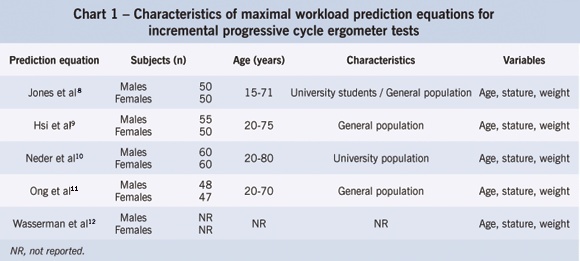
OBJECTIVE: This study sought to derive generalized equations for predicting maximal workload for young men and women. METHODS: Direct ergospirometry (Aerosport® TEEM 100, USA) was used to determine VO2máx and the maximal work load (Wmax) on the cycle ergometer test (Monark®, Brazil) of thirty men (25 ± 5 years, 75.0 ± 10.7 kg; 48.4 ± 8.8 mL . kg -1 . min -1 and 243 ± 51 Watts) and thirty women (26 ± 5 years, 56.7 ± 5.9 kg, 39.8 ± 7.6 mL . kg -1 . min -1 and 172 ± 37 Watts). Age and body mass were used as independent variables. For all statistic tests, a p < 0.05 significance level was adopted. RESULTS: In the multiple linear adjustment, the maximal workload was explained by age and body mass as 54% (r = 0.73) for men, and as 76% (r = 0.87) for women, with standard errors of 0.66 W . kg -1 and 25 Watts. The proposed equations were cross-validated using another sample with similar age and VO2máx characteristics comprised of fifteen men and fifteen women. The intraclass correlation between the predicted Wmax values and those measures by ergospirometry were 0.70 and 0.69, with standard errors of 28.4 and 15.8 Watts, respectively, for men and women. CONCLUSIONS: This study exhibits valid generalized equations for determining the maximal cycle ergonometer workload for men and women.

  • Anaerobic Threshold
  • Oxygen Consumption
  • physicial exertion
  • stress test
  • ventilatory threshold
Read Full Article
Creative Commons Attribution (CC BY) Creative Commons license
28/09/2006 DOI: 10.1590/S0066-782X2006001500011 Views 2

How to cite this article

EndNote RIS

Electronic Document Format (Vancouver)

Nogueira FS, Pompeu FAMS. Maximal workload prediction models in the clinical cardio-pulmonary effort test. Arquivos Brasileiros de Cardiologia 2006;87(2):137-45.

Electronic Document Format (ABNT)

Nogueira, Fernando dos Santos; Pompeu, Fernando Augusto Monteiro Sabóia. Maximal workload prediction models in the clinical cardio-pulmonary effort test. Arquivos Brasileiros de Cardiologia, v. 87, n. 2, p. 137-145, Sep. 2006.

Electronic Document Format (APA)

Nogueira, F. S., & Pompeu, F. A. M. S. (2006). Maximal workload prediction models in the clinical cardio-pulmonary effort test. Arquivos Brasileiros de Cardiologia, 87(2), 137-145.

Electronic Document Format (ISO)

Nogueira, Fernando dos Santos and Pompeu, Fernando Augusto Monteiro Sabóia. Maximal workload prediction models in the clinical cardio-pulmonary effort test. Arquivos Brasileiros de Cardiologia [online]. 2006, vol. 87, n. 2, [cited 2026-10-14], pp. 137-145. Available from: <https://journals.cardiol.br/en/article/maximal-workload-prediction-models-in-the-clinical-cardio-pulmonary-effort-test/>. ISSN 0066-782X

  • About ABC Family
  • Internal Regulation
  • Editorial Board
  • Brazilian Society of Cardiology (SBC)

Issues

SBC Guidelines

  • Videos
  • Podcasts
  • News