ABC Family Arquivos Brasileiros de Cardiologia International Journal of Cardiovascular Sciences ABC Heart Failure & Cardiomyopathy ABC Imagem Cardiovascular
Português English
ABC Family
Português English
  • About
    • About ABC Family
    • Internal Regulation
    • Editorial Board
    • Brazilian Society of Cardiology (SBC)
  • Issues
  • SBC Guidelines
  • Content
    • Videos
    • Podcasts
    • News
  • About
    • About ABC Family
    • Internal Regulation
    • Editorial Board
    • Brazilian Society of Cardiology (SBC)
  • Issues
  • SBC Guidelines
  • Content
    • Videos
    • Podcasts
    • News

ABC Family

  • ABC Family
  • Arquivos Brasileiros de Cardiologia
  • International Journal of Cardiovascular Sciences
  • ABC Heart Failure & Cardiomyopathy
  • ABC Imagem Cardiovascular
Search in

No content found.

Journals
Ordering
Article types
Others

  1. Home
  2. Keyword: Parasympathetic Nervous System
I - Evaluation of Cardiovascular Autonomic Function in Healthy Individuals
ABC
Review Article

I – Evaluation of Cardiovascular Autonomic Function in Healthy Individuals

Benedito Carlos Maciel et al. Lourenço Gallo-Jr André Schmidt José Antonio Marin-Neto

Abstract

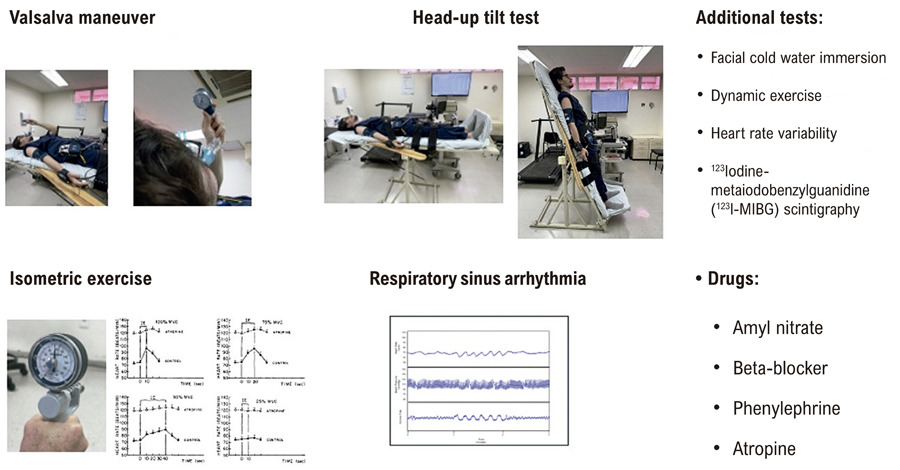
This first part of the review presents nearly 60 years of experience from our laboratory in standardizing cardiovascular autonomic tests in healthy individuals. The wide range of tests includes pharmacological blockade of both the sympathetic and parasympathetic divisions, baroreflex sensitivity assessment through transient hypertension and hypotension, the Valsalva maneuver, head-up tilt testing, isometric and dynamic exercise, facial immersion in cold water, respiratory sinus arrhythmia, heart rate variability analysis in the frequency domain, and imaging with 123I-metaiodobenzylguanidine. Autonomic function was evaluated based on test responses under baseline conditions in healthy individuals. The analysis also covers physiological adaptations to endurance training and aging, providing a reference framework for identifying autonomic dysfunction involving both parasympathetic and adrenergic components in patients with various pathophysiological conditions, as discussed in the second part of this review.
  • Autonomic Nervous System Diseases
  • Heart Rate
  • Parasympathetic Nervous System
  • Sympathetic Nervous System
Read Full Article
Creative Commons Attribution (CC BY) Creative Commons license
30/01/2026 DOI: 10.36660/abc.20250111i Views 1
II – Evaluation of Autonomic Control of Heart Rate in Various Clinical Conditions
ABC
Review Article

II – Evaluation of Autonomic Control of Heart Rate in Various Clinical Conditions

Benedito Carlos Maciel et al. Lourenço Gallo-Jr André Schmidt José Antonio Marin-Neto

Abstract

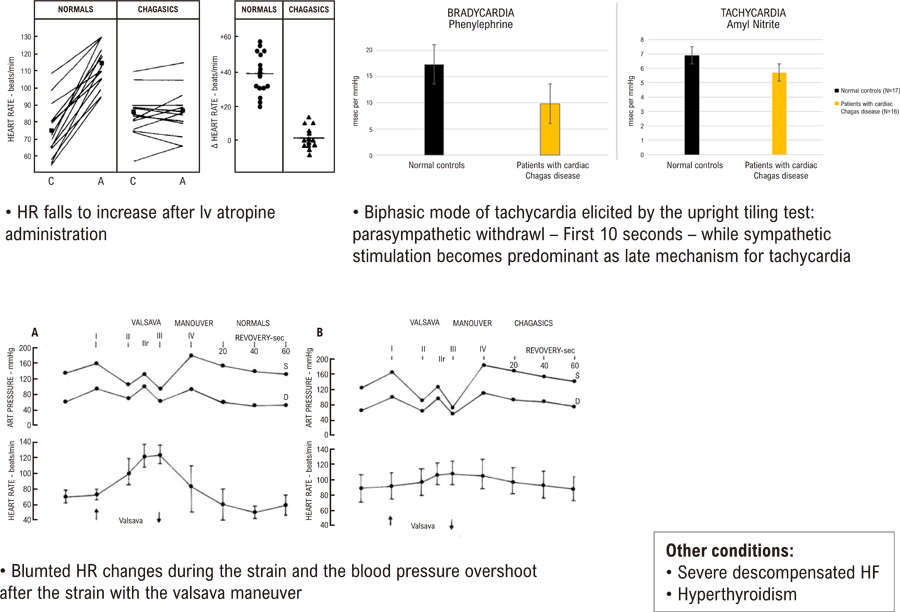
Through the comparison of responses of normal volunteers, assessment of autonomic function under abnormal clinical conditions focused on the detection of dysautonomia involving both the parasympathetic and adrenergic limbs in patients with Chagas heart disease, post-cardiac surgery, chronic heart failure, mitral valve prolapse, and hyperthyroidism. In particular, the autonomic impairment observed in Chagas disease patients involved predominantly the parasympathetic control of heart rate at the sinus node level, and the adrenergic innervation at the myocardial ventricular level. The autonomic derangements observed in Chagas cardiomyopathy patients have only recently been explored in terms of their prognostic relevance, and their potential clinical implications for therapeutic purposes remain to be investigated.

Over the last nearly seven decades, our laboratory has accumulated significant expertise using several tests described above to evaluate autonomic control of heart rate, now focusing on various pathophysiological clinical conditions. The effect of endurance physical training and of aging was mostly focused on studies of normal volunteers whose responses at baseline served as controls to be compared during tests employed in individuals with some morbid clinical conditions. By far, the pathophysiology of Chagas heart disease involving the autonomic nervous system was the most predominant subject studied in our laboratory, since the early studies in the 1960s until the late studies just recently published in international journals (Central Illustration). Other pathological conditions focused on our studies were mitral valve prolapse, heart failure, post-cardiac surgery, and hyperthyroidism.

  • Autonomic Nervous System Diseases
  • Heart Rate
  • Parasympathetic Nervous System
  • Sympathetic Nervous System
Read Full Article
Creative Commons Attribution (CC BY) Creative Commons license
30/01/2026 DOI: 10.36660/abc.20250112i Views 1
ABC
Editorial

The Neurolinguistics of the Heart

Esteban Wisnivesky Rivarola et al. Mauricio Scanavacca

The association between mental stress and cardiac function has always been of major interest. In the 19th century, Claude Bernard, the father of evidence-based medicine, first acknowledged the vagus nerve as a structural and functional link connecting the heart and the brain. Nowadays, stress is considered one of the most significant health problems in modern society, related to the physiopathology of psychiatric, metabolic and cardiovascular diseases, and the search for its biomarkers remains a challenging task for researchers and clinicians.

But what is stress? How can we define it, before we tackle it?

[…]

  • Heart Failure;Gini Coefficient
  • Neurolinguistic Programming
  • Parasympathetic Nervous System
  • Stress, Psychological, Action Spectrum
  • Sympathetic Nervous System
Read Full Article
Creative Commons Attribution (CC BY) Creative Commons license
04/11/2019 DOI: 10.5935/abc.20190218 Views 2
Figure 1
ABC
Original Article

Introduction of Application of Gini Coefficient to Heart Rate Variability Spectrum for Mental Stress Evaluation

Miguel Enrique Sánchez-Hechavarría et al. Shreya Ghiya Ramon Carrazana-Escalona Sergio Cortina-Reyna … Adán Andreu-Heredia Carlos Acosta-Batista Nicolás Armando Saá-Muñoz

Abstract

Background:

The Gini coefficient is a statistical tool generally used by economists to quantify income inequality. However, it can be applied to any kind of data with unequal distribution, including heart rate variability (HRV).

Objectives:

To assess the application of the Gini coefficient to measure inequality in power spectral density of RR intervals, and to use this application as a psychophysiological indicator of mental stress.

Methods:

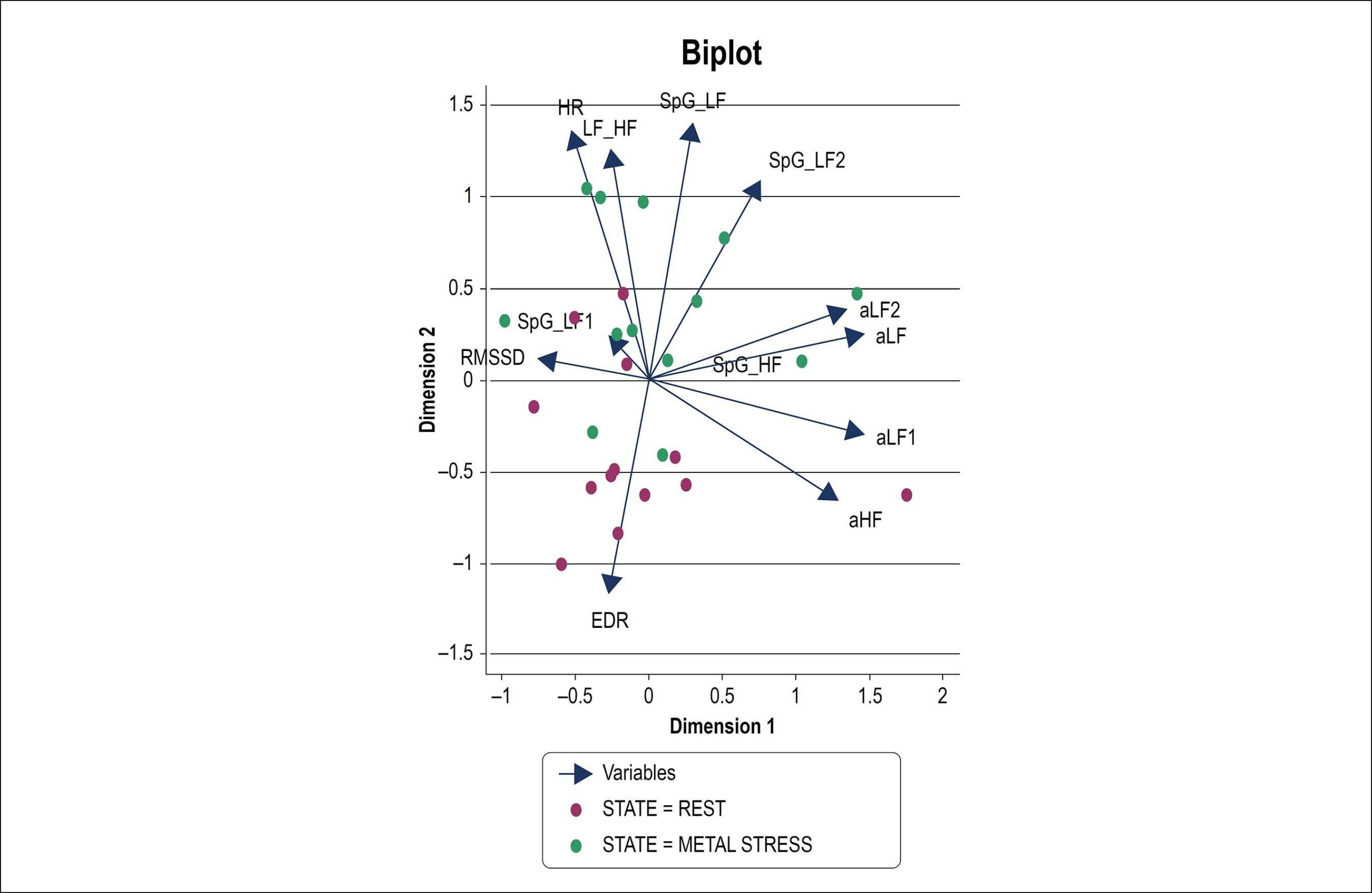
Thirteen healthy subjects (19 ± 1.5 years) participated in this study, and their RR intervals were obtained by electrocardiogram during rest (five minutes) and during mental stress (arithmetic challenge; five minutes). These RR intervals were used to obtain the estimates of power spectral densities (PSD). The limits for the PSD bands were defined from 0.15 to 0.40 Hz for high frequency band (HF), from 0.04 to 0.15 Hz for low frequency band (LF), from 0.04 to 0.085 Hz for first low frequency sub-band (LF1) and from 0.085 to 0.15 Hz for second low frequency sub-band (LF2). The spectral Gini coefficient (SpG) was proposed to measure the inequality in the power distribution of the RR intervals in each of above-mentioned HRV bands. SpG from each band was compared with its respective traditional index of HRV during the conditions of rest and mental stress. All the differences were considered statistically significant for p < 0.05.

Results:

There was a significant decrease in HF power (p = 0.046), as well as significant increases in heart rate (p = 0.004), LF power (p = 0.033), LF2 power (p = 0.019) and LF/HF (p = 0.002) during mental stress. There was also a significant increase in SpG(LF) (p = 0.009) and SpG(LF2) (p = 0.033) during mental stress. Coefficient of variation showed SpG has more homogeneity compared to the traditional index of HRV during mental stress.

Conclusions:

This pilot study suggested that spectral inequality of Heart Rate Variability analyzed using the Gini coefficient seems to be an independent and homogeneous psychophysiological indicator of mental stress. Also, HR, LF/HF, SpG(LF) of HRV are possibly important, reliable and valid indicators of mental stress.

  • Action, Spectrum
  • Gini Coefficient
  • Heart Rate
  • Parasympathetic Nervous System
  • Simpathetic Nervous System
  • Stress, Psychological/physiopathology
Read Full Article
Creative Commons Attribution (CC BY) Creative Commons license
09/09/2019 DOI: 10.5935/abc.20190185 Views 2

How to cite this article

EndNote RIS

Electronic Document Format (Vancouver)

Maciel BC, Gallo-Jr L, Schmidt A, Marin-Neto JA. I – Evaluation of Cardiovascular Autonomic Function in Healthy Individuals. Arquivos Brasileiros de Cardiologia 2026;122(12):e20250111.

Electronic Document Format (ABNT)

Maciel, Benedito Carlos; Gallo-Jr, Lourenço; Schmidt, André; Marin-Neto, José Antonio. I – Evaluation of Cardiovascular Autonomic Function in Healthy Individuals. Arquivos Brasileiros de Cardiologia, v. 122, n. 12, e20250111, Jan. 2026.

Electronic Document Format (APA)

Maciel, B. C., Gallo-Jr, L., Schmidt, A., & Marin-Neto, J. A. (2026). I – Evaluation of Cardiovascular Autonomic Function in Healthy Individuals. Arquivos Brasileiros de Cardiologia, 122(12), e20250111.

Electronic Document Format (ISO)

Maciel, Benedito Carlos and Gallo-Jr, Lourenço and Schmidt, André and Marin-Neto, José Antonio. I – Evaluation of Cardiovascular Autonomic Function in Healthy Individuals. Arquivos Brasileiros de Cardiologia [online]. 2026, vol. 122, n. 12, [cited 2026-10-14], e20250111. Available from: <https://journals.cardiol.br/en/article/i-evaluation-of-cardiovascular-autonomic-function-in-healthy-individuals/>. ISSN 0066-782X

EndNote RIS

Electronic Document Format (Vancouver)

Maciel BC, Gallo-Jr L, Schmidt A, Marin-Neto JA. II – Evaluation of Autonomic Control of Heart Rate in Various Clinical Conditions. Arquivos Brasileiros de Cardiologia 2026;122(12):e20250112.

Electronic Document Format (ABNT)

Maciel, Benedito Carlos; Gallo-Jr, Lourenço; Schmidt, André; Marin-Neto, José Antonio. II – Evaluation of Autonomic Control of Heart Rate in Various Clinical Conditions. Arquivos Brasileiros de Cardiologia, v. 122, n. 12, e20250112, Jan. 2026.

Electronic Document Format (APA)

Maciel, B. C., Gallo-Jr, L., Schmidt, A., & Marin-Neto, J. A. (2026). II – Evaluation of Autonomic Control of Heart Rate in Various Clinical Conditions. Arquivos Brasileiros de Cardiologia, 122(12), e20250112.

Electronic Document Format (ISO)

Maciel, Benedito Carlos and Gallo-Jr, Lourenço and Schmidt, André and Marin-Neto, José Antonio. II – Evaluation of Autonomic Control of Heart Rate in Various Clinical Conditions. Arquivos Brasileiros de Cardiologia [online]. 2026, vol. 122, n. 12, [cited 2026-10-14], e20250112. Available from: <https://journals.cardiol.br/en/article/ii-evaluation-of-autonomic-control-of-heart-rate-in-various-clinical-conditions/>. ISSN 0066-782X

EndNote RIS

Electronic Document Format (Vancouver)

Rivarola EW, Scanavacca M. The Neurolinguistics of the Heart. Arquivos Brasileiros de Cardiologia 2019;113(4):734-6.

Electronic Document Format (ABNT)

Rivarola, Esteban Wisnivesky; Scanavacca, Mauricio. The Neurolinguistics of the Heart. Arquivos Brasileiros de Cardiologia, v. 113, n. 4, p. 734-736, Nov. 2019.

Electronic Document Format (APA)

Rivarola, E. W., & Scanavacca, M. (2019). The Neurolinguistics of the Heart. Arquivos Brasileiros de Cardiologia, 113(4), 734-736.

Electronic Document Format (ISO)

Rivarola, Esteban Wisnivesky and Scanavacca, Mauricio. The Neurolinguistics of the Heart. Arquivos Brasileiros de Cardiologia [online]. 2019, vol. 113, n. 4, [cited 2026-10-14], pp. 734-736. Available from: <https://journals.cardiol.br/en/article/the-neurolinguistics-of-the-heart/>. ISSN 0066-782X

EndNote RIS

Electronic Document Format (Vancouver)

Sánchez-Hechavarría ME, Ghiya S, Carrazana-Escalona R, Cortina-Reyna S, Andreu-Heredia A, Acosta-Batista C, Saá-Muñoz NA, et al. Introduction of Application of Gini Coefficient to Heart Rate Variability Spectrum for Mental Stress Evaluation. Arquivos Brasileiros de Cardiologia 2019;113(4):725-33.

Electronic Document Format (ABNT)

Sánchez-Hechavarría, Miguel Enrique; Ghiya, Shreya; Carrazana-Escalona, Ramon; Cortina-Reyna, Sergio; Andreu-Heredia, Adán; Acosta-Batista, Carlos; Saá-Muñoz, Nicolás Armando. Introduction of Application of Gini Coefficient to Heart Rate Variability Spectrum for Mental Stress Evaluation. Arquivos Brasileiros de Cardiologia, v. 113, n. 4, p. 725-733, Sep. 2019.

Electronic Document Format (APA)

Sánchez-Hechavarría, M. E., Ghiya, S., Carrazana-Escalona, R., Cortina-Reyna, S., Andreu-Heredia, A., Acosta-Batista, C., & Saá-Muñoz, N. A. (2019). Introduction of Application of Gini Coefficient to Heart Rate Variability Spectrum for Mental Stress Evaluation. Arquivos Brasileiros de Cardiologia, 113(4), 725-733.

Electronic Document Format (ISO)

Sánchez-Hechavarría, Miguel Enrique and Ghiya, Shreya and Carrazana-Escalona, Ramon and Cortina-Reyna, Sergio and Andreu-Heredia, Adán and Acosta-Batista, Carlos and Saá-Muñoz, Nicolás Armando. Introduction of Application of Gini Coefficient to Heart Rate Variability Spectrum for Mental Stress Evaluation. Arquivos Brasileiros de Cardiologia [online]. 2019, vol. 113, n. 4, [cited 2026-10-14], pp. 725-733. Available from: <https://journals.cardiol.br/en/article/introduction-of-application-of-gini-coefficient-to-heart-rate-variability-spectrum-for-mental-stress-evaluation/>. ISSN 0066-782X

  • About ABC Family
  • Internal Regulation
  • Editorial Board
  • Brazilian Society of Cardiology (SBC)

Issues

SBC Guidelines

  • Videos
  • Podcasts
  • News