Diego Busin et al. Leandro Tolfo Franzoni Douglas Turella Olga Sergueevna Tairova … Anderson Donelli da Silveira Ricardo Stein Gabriel Lopes Amorim Pedro Dal Lago Ramiro Barcos Nunes
Abstract
Background
Aerobic training (AT), whether moderate or high intensity, is widely employed in cardiovascular rehabilitation. Photobiomodulation therapy (PBMT) has shown potential to enhance exercise performance in athletes; however, its effects in patients with heart failure (HF) remain uncertain.
Objective
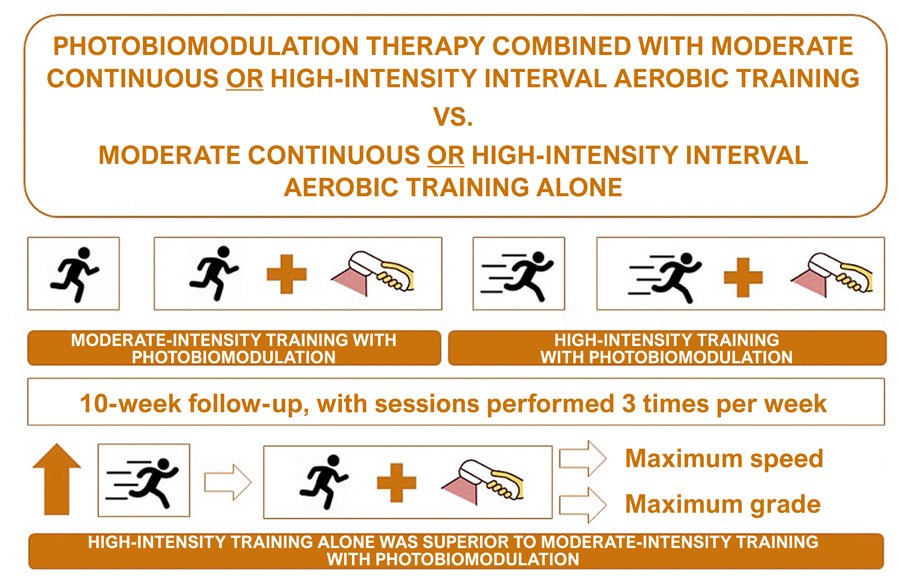
To investigate whether the addition of PBMT to moderate- or high-intensity AT improves cardiopulmonary exercise performance in individuals with HF.
Methods
This nonrandomized clinical trial included 49 patients with HF (mean age 62.7 years; ejection fraction < 40%), allocated into 5 groups: i) moderate training alone, ii) moderate training + PBMT, iii) high-intensity training alone, iv) high-intensity training + PBMT, and iv) control group. All participants underwent a 10-week intervention. Cardiopulmonary exercise testing was used to assess VO2peak, ventilatory efficiency, and exercise tolerance. Statistical analysis was performed using Generalized Estimating Equations, with alpha set at 5% (p < 0.05).
Results
Significant improvements in speed and grade during the exercise test were observed in the training groups, particularly in the high-intensity training group. This group demonstrated a greater increase in oxygen consumption (mean difference: 1.80 ml.kg-1.min-1 ± 0.59 ml.kg-1.min-1; p = 0.002) and superior performance in time to exhaustion (speed: p = 0.05; grade: p < 0.01). Comparisons across groups revealed that PBMT did not provide any relevant additional effects when combined with training.
Conclusion
AT, especially at high intensity, enhances exercise performance in patients with HF. The addition of PBMT did not confer significant additional benefits in this study. Further trials using optimized PBMT protocols are warranted.