ABC Family Arquivos Brasileiros de Cardiologia International Journal of Cardiovascular Sciences ABC Heart Failure & Cardiomyopathy ABC Imagem Cardiovascular
Português English
ABC Family
Português English
  • About
    • About ABC Family
    • Internal Regulation
    • Editorial Board
    • Brazilian Society of Cardiology (SBC)
  • Issues
  • SBC Guidelines
  • Content
    • Videos
    • Podcasts
    • News
  • About
    • About ABC Family
    • Internal Regulation
    • Editorial Board
    • Brazilian Society of Cardiology (SBC)
  • Issues
  • SBC Guidelines
  • Content
    • Videos
    • Podcasts
    • News

ABC Family

  • ABC Family
  • Arquivos Brasileiros de Cardiologia
  • International Journal of Cardiovascular Sciences
  • ABC Heart Failure & Cardiomyopathy
  • ABC Imagem Cardiovascular
Search in

No content found.

Journals
Ordering
Article types
Others

  1. Home
  2. Keyword: Health Information System/trends
Figure 1
ABC
Original Article

Cardiovascular Disease Mortality According to the Brazilian Information System on Mortality and the Global Burden of Disease Study Estimates in Brazil, 2000-2017

Deborah Carvalho Malta et al. Renato Teixeira Gláucia Maria Moraes de Oliveira Antonio Luiz Pinho Ribeiro

Abstract

Background

The Brazilian Information System on Mortality (SIM) is of vital importance in monitoring the trends of cardiovascular diseases (CVDs) and is aimed at supporting public policies.

Objective

To compare historical series of CVD mortality based on data from the SIM, with and without correction, and from the Brazil Global Burden of Disease (GBD) Study 2017, in the 2000-2017 period.

Methods

Analysis of CVD mortality in Brazil between 2000 and 2017. Three CVD mortality estimates were compared: Crude SIM, Corrected SIM, and GBD 2017. Absolute numbers and age-standardized rates were used to compare the estimates for Brazil, its states and the Federal District.

Results

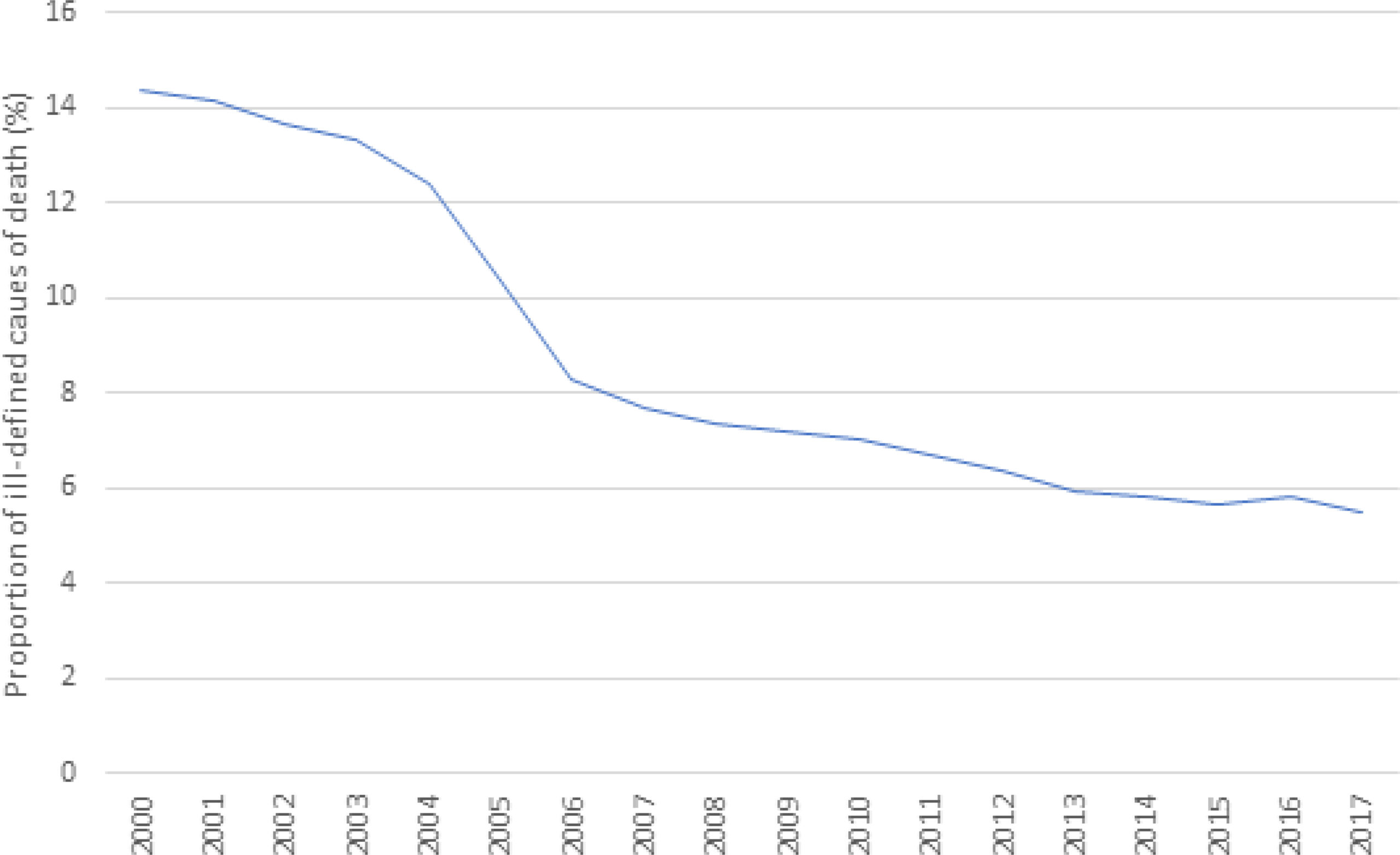
In the SIM, the total of deaths ranged from 261,000, in 2000, to 359,000, in 2017. In the GBD 2017, the total of deaths ranged from 292,000 to 388,000, for the same years, respectively. A high proportion of the causes of death from CVD corresponded to garbage codes, classified according to the GBD 2017, reaching 42% in 2017. The rates estimated by GBD ranged from 248.8 (1990) to 178.0 (2017) deaths per 100,000 inhabitants. The rates of the Crude SIM and Corrected SIM also showed a reduction for the whole series analyzed, the Crude SIM showing lower rates: 204.9 (1990) and 155.1 (2017) deaths per 100 thousand inhabitants. When analyzing by the states and Federal District, the Crude SIM trends reversed, with an increase in mortality rates in the Northern and Northeastern states.

Conclusion

This study shows the decrease in CVD mortality rates in Brazil in the period analyzed. Conversely, when analyzing by the states and Federal District, the Crude SIM showed an increase in those rates for the Northern and Northeastern states. The use of crude data from the SIM can result in interpretation errors, indicating an increase in rates, due to the increase in death data capture and the improvement in the definition of the underlying causes of death in the past decade, especially in the Northern and Northeastern regions, justifying the use of corrected data in mortality analyses. (Arq Bras Cardiol. 2020; 115(2):152-160)

  • Cardiovascular Diseases, mortality
  • Data Accuracy/trends
  • Epidemiology
  • Health Information System/trends
Read Full Article
Creative Commons Attribution (CC BY) Creative Commons license
28/08/2020 DOI: 10.36660/abc.20190867
ABC
Editorial

Epidemiology of Cardiovascular Diseases in Brazil: The Truth Hidden in the Numbers

Carisi Anne Polanczyk

According to the 2030 Agenda of the World Health Organization for Sustainable Development, member states are committed to a 30% reduction in premature mortality from non-communicable diseases, particularly cardiovascular diseases (CVD) (ischemic cardiomyopathy and stroke), cancer, respiratory diseases and diabetes. These conditions account for about 41 million deaths per year, i.e., 71% of deaths worldwide. To direct strategies for to prevent and treat these with these diseases, information from reliable, transparent and reproducible systems is essential. The analysis of mortality trends is key for the effective development of health, social security, investment and other policies.

The Global Burden of Disease (GBD) studies initiative is in line with this agenda, as it aims to improve understanding of diseases through the analysis of data on incidence, prevalence and mortality in a consistent, updated and global manner, both at a regional level and at a national level. Over the past few years, this methodological proposal has brought practical information for reducing these diseases around the world, overcoming challenges regarding methodology, particularly the heterogeneity of records and data from different countries. , Through data from multiple sources (health records, cohorts and prospective trials, administrative data, verbal analysis and others) and applying complex statistical models, the initiative has provided data by sex, age and country, to more than 310 diseases and conditions, with continuous methodological improvement.

[…]

  • Cardiovascular Diseases, mortality
  • Data Accuracy/trends
  • Epidemiology
  • Health Information System/trends
  • Policy Making
Read Full Article
Creative Commons Attribution (CC BY) Creative Commons license
28/08/2020 DOI: 10.36660/abc.20200793

How to cite this article

EndNote RIS

Electronic Document Format (Vancouver)

Malta DC, Teixeira R, Oliveira GMM, Ribeiro ALP. Cardiovascular Disease Mortality According to the Brazilian Information System on Mortality and the Global Burden of Disease Study Estimates in Brazil, 2000-2017. Arquivos Brasileiros de Cardiologia 2020;115(2):152-60.

Electronic Document Format (ABNT)

Malta, Deborah Carvalho; Teixeira, Renato; Oliveira, Gláucia Maria Moraes de; Ribeiro, Antonio Luiz Pinho. Cardiovascular Disease Mortality According to the Brazilian Information System on Mortality and the Global Burden of Disease Study Estimates in Brazil, 2000-2017. Arquivos Brasileiros de Cardiologia, v. 115, n. 2, p. 152-160, Aug. 2020.

Electronic Document Format (APA)

Malta, D. C., Teixeira, R., Oliveira, G. M. M. , & Ribeiro, A. L. P. (2020). Cardiovascular Disease Mortality According to the Brazilian Information System on Mortality and the Global Burden of Disease Study Estimates in Brazil, 2000-2017. Arquivos Brasileiros de Cardiologia, 115(2), 152-160.

Electronic Document Format (ISO)

Malta, Deborah Carvalho and Teixeira, Renato and Oliveira, Gláucia Maria Moraes de and Ribeiro, Antonio Luiz Pinho. Cardiovascular Disease Mortality According to the Brazilian Information System on Mortality and the Global Burden of Disease Study Estimates in Brazil, 2000-2017. Arquivos Brasileiros de Cardiologia [online]. 2020, vol. 115, n. 2, [cited 2026-10-14], pp. 152-160. Available from: <https://journals.cardiol.br/en/article/cardiovascular-disease-mortality-according-to-the-brazilian-information-system-on-mortality-and-the-global-burden-of-disease-study-estimates-in-brazil-2000-2017/>. ISSN 0066-782X

EndNote RIS

Electronic Document Format (Vancouver)

Polanczyk CA. Epidemiology of Cardiovascular Diseases in Brazil: The Truth Hidden in the Numbers. Arquivos Brasileiros de Cardiologia 2020;115(2):161-2.

Electronic Document Format (ABNT)

Polanczyk, Carisi Anne. Epidemiology of Cardiovascular Diseases in Brazil: The Truth Hidden in the Numbers. Arquivos Brasileiros de Cardiologia, v. 115, n. 2, p. 161-162, Aug. 2020.

Electronic Document Format (APA)

Polanczyk, C. A. (2020). Epidemiology of Cardiovascular Diseases in Brazil: The Truth Hidden in the Numbers. Arquivos Brasileiros de Cardiologia, 115(2), 161-162.

Electronic Document Format (ISO)

Polanczyk, Carisi Anne. Epidemiology of Cardiovascular Diseases in Brazil: The Truth Hidden in the Numbers. Arquivos Brasileiros de Cardiologia [online]. 2020, vol. 115, n. 2, [cited 2026-10-14], pp. 161-162. Available from: <https://journals.cardiol.br/en/article/epidemiology-of-cardiovascular-diseases-in-brazil-the-truth-hidden-in-the-numbers/>. ISSN 0066-782X

  • About ABC Family
  • Internal Regulation
  • Editorial Board
  • Brazilian Society of Cardiology (SBC)

Issues

SBC Guidelines

  • Videos
  • Podcasts
  • News