Robinson Tadeu Munhoz et al. Carlos Eduardo Negrão Antonio Carlos Pereira Barretto Marcelo Eidi Ochiai … Juliano Novaes Cardoso Paulo Cesar Morgado Carlos Henrique Del Carlo José Antonio Franchini Ramires
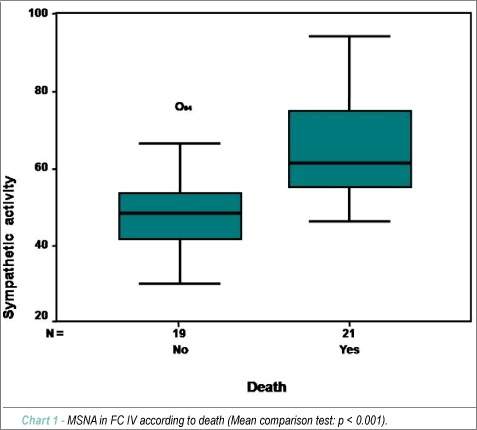
BACKGROUND: Microneurography and venous occlusion plethysmography can be considered methods of assessment of the sympathetic activity. OBJECTIVE: To evaluate the intensity of the sympathetic activity through microneurography and venous occlusion plethysmography in patients with heart failure (HF) and correlate this intensity with prognosis. METHODS: 52 patients with HF (ejection fraction < 45% at the echocardiogram): 12 with FCII and 40 with FCIV. After compensation, the muscular sympathetic nervous activity (MSNA) in the peroneal nerve (microneurography) and the muscular blood flow (MBF) in the forearm were evaluated (venous occlusion plethysmography). After an 18-month follow-up, the patients were divided in 3 groups: 12 with FCII, 19 with FCIV that did not die and 21 with FCIV that died. The intensity of the sympathetic activity was compared in the three different groups. RESULTS: Patients with FCII presented lower MSNA (p=0.026) and higher MBF (p=0.045) than the ones with FCIV that did not die. The patients with FCIV that died presented higher MSNA (p53.5 impulses/min for MSNA (S=90.55. E=73.68%) and < 1.81 ml/min/100gr for MBF (S=90.4%. E=73.7%). Kaplan-Meier curve: higher survival with MSNA < 53.5 impulses/min (p1.81 ml/min/100gr (P<0.001). Logistic regression analysis: the higher the MSNA and the lower the MBF, the higher is the probability of death. CONCLUSION: The intensity of the MSNA and the MBF can be considered prognostic markers in advanced HF.