ABC Family Arquivos Brasileiros de Cardiologia International Journal of Cardiovascular Sciences ABC Heart Failure & Cardiomyopathy ABC Imagem Cardiovascular
Português English
ABC Family
Português English
  • About
    • About ABC Family
    • Internal Regulation
    • Editorial Board
    • Brazilian Society of Cardiology (SBC)
  • Issues
  • SBC Guidelines
  • Content
    • Videos
    • Podcasts
    • News
  • About
    • About ABC Family
    • Internal Regulation
    • Editorial Board
    • Brazilian Society of Cardiology (SBC)
  • Issues
  • SBC Guidelines
  • Content
    • Videos
    • Podcasts
    • News

ABC Family

  • ABC Family
  • Arquivos Brasileiros de Cardiologia
  • International Journal of Cardiovascular Sciences
  • ABC Heart Failure & Cardiomyopathy
  • ABC Imagem Cardiovascular
Search in

No content found.

Journals
Ordering
Article types
Others

  1. Home
  2. Keyword: clinical evalution
Small ventricular septal defect: long-term expectant clinical management
ABC
Artigo Original

Small ventricular septal defect: long-term expectant clinical management

Edmar Atik

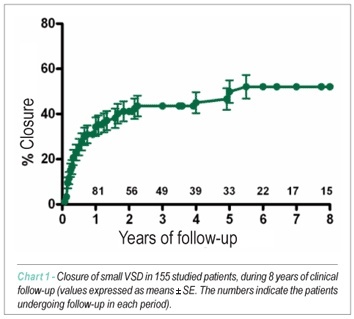
BACKGROUND: The small ventricular septal defect (VSD) usually presents good clinical evolution, even at long-term follow-up. OBJECTIVE: To verify the clinical evolution of patients with small VSD in order to determine the continuation or not of the expectant conduct, considering the low operative risk, which results in a more liberal indication for surgery. METHODS: From October 1976 to December 2007, 187 cases of small VSD (diameter < 3 mm at the echocardiogram) were evaluated and 155 of them were assessed at long-term follow-up. Time of the clinical manifestation of the murmur and evolution aspects such as the spontaneous closure of the defect (group I) – 64 cases, persistence of the initial size (group II – 74 cases and decrease in the size of the defect (group III) – 17 cases, in addition to clinical complications, were studied. RESULTS: The clinical manifestation of the murmur occurred, in the majority of cases, during the first month of life, corresponding to 48 (75%), 54 (72.9%) and 12 (70.5%) patients, in the three groups, respectively and after the first year of life in 11 (5.8%) patients. Spontaneous closure occurred in the first year of life in 48 cases (75%), mean of 7.6 months and from 1 to 5.5 years in 15 patients (23.4%), with a maximum follow-up of 18 years. The persistence of the defect until 40 years of age was observed. The decrease in the size of the defect occurred on a mean of 15 months, followed for up to 9 years. The probability of VSD closure by the actuarial curve was 34.38% in 1 year and 49.89% in 5 years. There were no clinical complications. CONLCUSION: A favorable evolution of the small VSD at long-term follow-up does not require surgical intervention, with concerns regarding the strict antibiotic prophylaxis.

  • clinical evalution
  • Heart Defects, Congenital
  • ventricular septal defect
Read Full Article
Creative Commons Attribution (CC BY) Creative Commons license
20/07/2009 DOI: 10.1590/S0066-782X2009000600003

How to cite this article

EndNote RIS

Electronic Document Format (Vancouver)

Atik E. Small ventricular septal defect: long-term expectant clinical management. Arquivos Brasileiros de Cardiologia 2009;92(6):429-32.

Electronic Document Format (ABNT)

Atik, Edmar. Small ventricular septal defect: long-term expectant clinical management. Arquivos Brasileiros de Cardiologia, v. 92, n. 6, p. 429-432, Jul. 2009.

Electronic Document Format (APA)

Atik, E. (2009). Small ventricular septal defect: long-term expectant clinical management. Arquivos Brasileiros de Cardiologia, 92(6), 429-432.

Electronic Document Format (ISO)

Atik, Edmar. Small ventricular septal defect: long-term expectant clinical management. Arquivos Brasileiros de Cardiologia [online]. 2009, vol. 92, n. 6, [cited 2026-10-14], pp. 429-432. Available from: <https://journals.cardiol.br/en/article/small-ventricular-septal-defect-long-term-expectant-clinical-management/>. ISSN 0066-782X

  • About ABC Family
  • Internal Regulation
  • Editorial Board
  • Brazilian Society of Cardiology (SBC)

Issues

SBC Guidelines

  • Videos
  • Podcasts
  • News