ABC Family Arquivos Brasileiros de Cardiologia International Journal of Cardiovascular Sciences ABC Heart Failure & Cardiomyopathy ABC Imagem Cardiovascular
Português English
ABC Family
Português English
  • About
    • About ABC Family
    • Internal Regulation
    • Editorial Board
    • Brazilian Society of Cardiology (SBC)
  • Issues
  • SBC Guidelines
  • Content
    • Videos
    • Podcasts
    • News
  • About
    • About ABC Family
    • Internal Regulation
    • Editorial Board
    • Brazilian Society of Cardiology (SBC)
  • Issues
  • SBC Guidelines
  • Content
    • Videos
    • Podcasts
    • News

ABC Family

  • ABC Family
  • Arquivos Brasileiros de Cardiologia
  • International Journal of Cardiovascular Sciences
  • ABC Heart Failure & Cardiomyopathy
  • ABC Imagem Cardiovascular
Search in

No content found.

Journals
Ordering
Article types
Others

  1. Home
  2. Keyword: Chagas Disease / history
Figure 1
IJCS
Review Article

Revisiting the History of Chagas Disease: "Live to tell"

Ademir Batista da Cunha et al. Delma Maria Cunha

Abstract

In 1907, Carlos Chagas was designated to fight paludism in the Rio das Velhas region along the Central do Brasil railroad. During his field research, Chagas discovered a hematophagous insect ( Panstrongylus megitus ) carrying a new trypanosomatide, which he named Trypanosoma cruzi . On April 14th, 1909, he found the same parasite in the blood of a febrile child, submitting the announcement of his discoveries to the Brasil Médico scientific journal. Here, we discuss the early stages in the establishment of a new human morbid entity during the first decades after its discovery with a definite influence from its discoverer, Carlos Chagas, as well the first collaborators. Moreover, we cover the importance of the Center for the Study and Prophylaxis of Chagas Disease in Bambuí (MG), unraveling the most advanced developments in research within the disease’s habitat and the widening perspectives for modern research that have emerged after the 1960s and continue to improve to this day. In this revisitation to the history of Chagas disease, we begin at Manguinhos (RJ ), making our way to Lassance (MG), where the discovery took place. Then, we travel back to Rio de Janeiro in the beginning of the twentieth century and Brazilian republic until the current day, revealing milestone publications that settled Chagas disease both as a source of pride for Brazilian medicine and as a challenge with important aspects that remain to be clarified. Any similarities to our country’s politics and economy in the twentieth century are not mere coincidences.

  • Chagas Disease / history
  • Chagas Disease/ etiology
  • Trypanosoma Cruzi/ Chagas, Cardiomyopathy
Read Full Article
Creative Commons Attribution (CC BY) Creative Commons license
07/01/2022 DOI: 10.36660/ijcs.20200199 Views 1
Figure 1
ABC
Special Article

Chagas Disease: Are Kissing Bugs the Only Culprit?

Abilio Augusto Fragata Filho

Preface

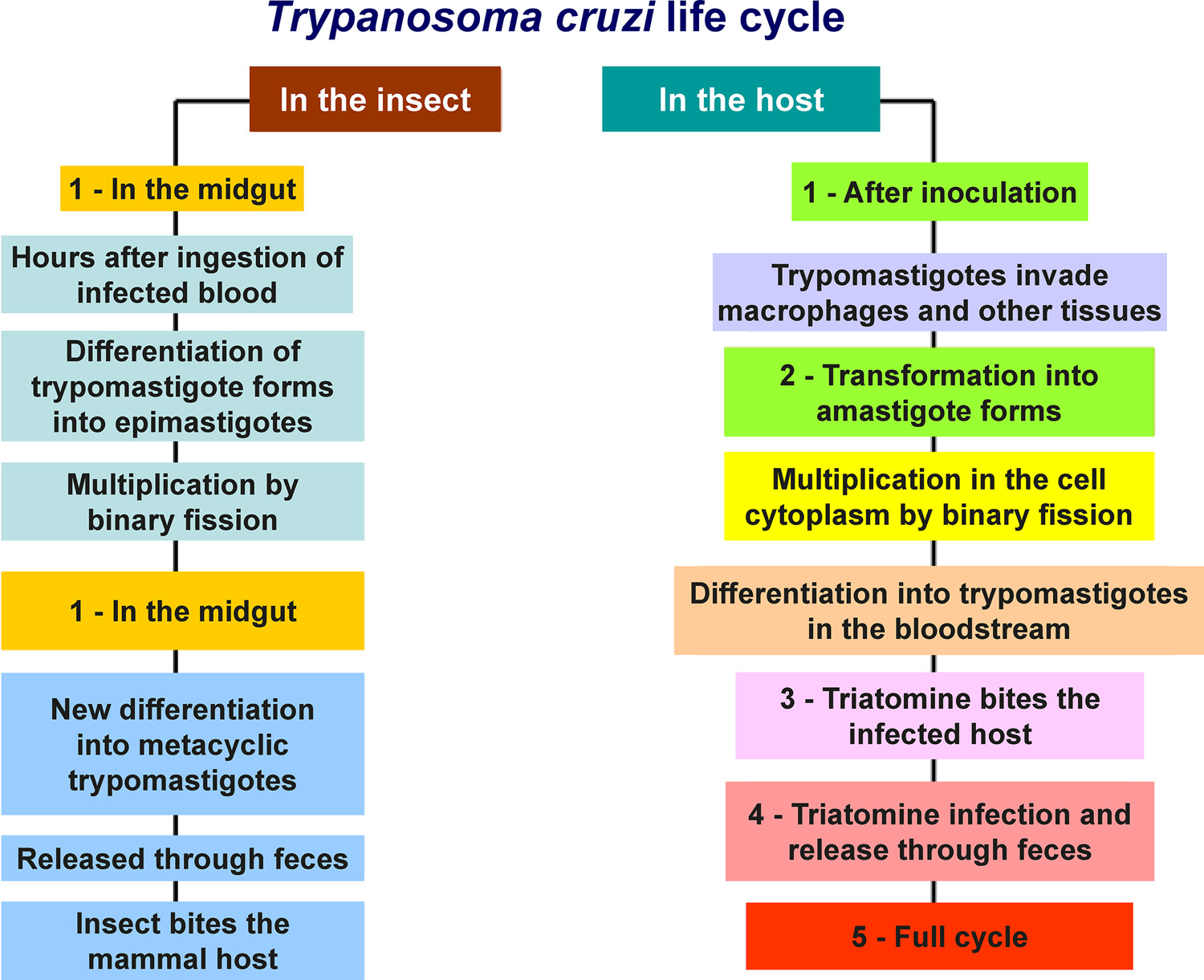
Chagas disease, first described by Carlos Chagas in 1909, is caused by a single-celled parasite (Trypanosoma cruzi). Throughout history, the main mechanism of transmission has been via contact with the feces of an insect infected with the parasite. This insect, known as the “kissing bug” in English, is popularly known as “barbeiro,” “chupão,” or “chupança” in Brazil. The “kissing bugs” are not born with the parasite in their intestine; rather, they acquire it by feeding on the blood of infected mammals. (This disease only affects mammals). When taking a blood meal, the insects eliminate feces, where the parasites are present, and the parasites can contaminate the bite, allowing the parasite to enter the organism. In this manner, the disease begins. The kissing bugs mainly make their nests in cracks in clay walls of houses made in a style known as “pau-a-pique” in Brazil. These houses are very common in diverse regions of Brazil, especially throughout the sertão of the Northeast Region. Other mechanisms of transmission can occur, for example, via blood transfusion, organ donation, mother-to-child transmission, ingestion of contaminated foods, etc.

During the acute phase of the disease, complaints may be mild or even non-existent. They may include general manifestations, such as low fever, malaise or more severe ones, such as shortness of breath and swelling. As bites from kissing bugs usually occur on the face, swelling of the eyebrows, known as the Romaña sign, may occur. As the years pass, generally after 10 years or more, cardiac complaints appear in one third of patients, such as fatigue, shortness of breath, and swelling in the body (heart failure). In some cases, the electrical system of the heart may be compromised, with alterations in cardiac rhythm, fainting, and even sudden death. Dilatation of the esophagus and the colon can also occur, with progressive difficulty in swallowing food and defecating.

[…]

  • Chagas Cardiomyopathy
  • Chagas Disease / history
  • Mortality
  • Myocardites
  • Trypanosoma cruzi
Read Full Article
Creative Commons Attribution (CC BY) Creative Commons license
19/07/2021 DOI: 10.36660/abc.20210290 Views 1
Figure 1
ABC
Review Article

Carlos Chagas Discoveries as a Drop Back to Scientific Construction of Chronic Chagas Heart Disease

Reinaldo B. Bestetti et al. Carolina Baraldi A. Restini Lucélio B. Couto

Abstract

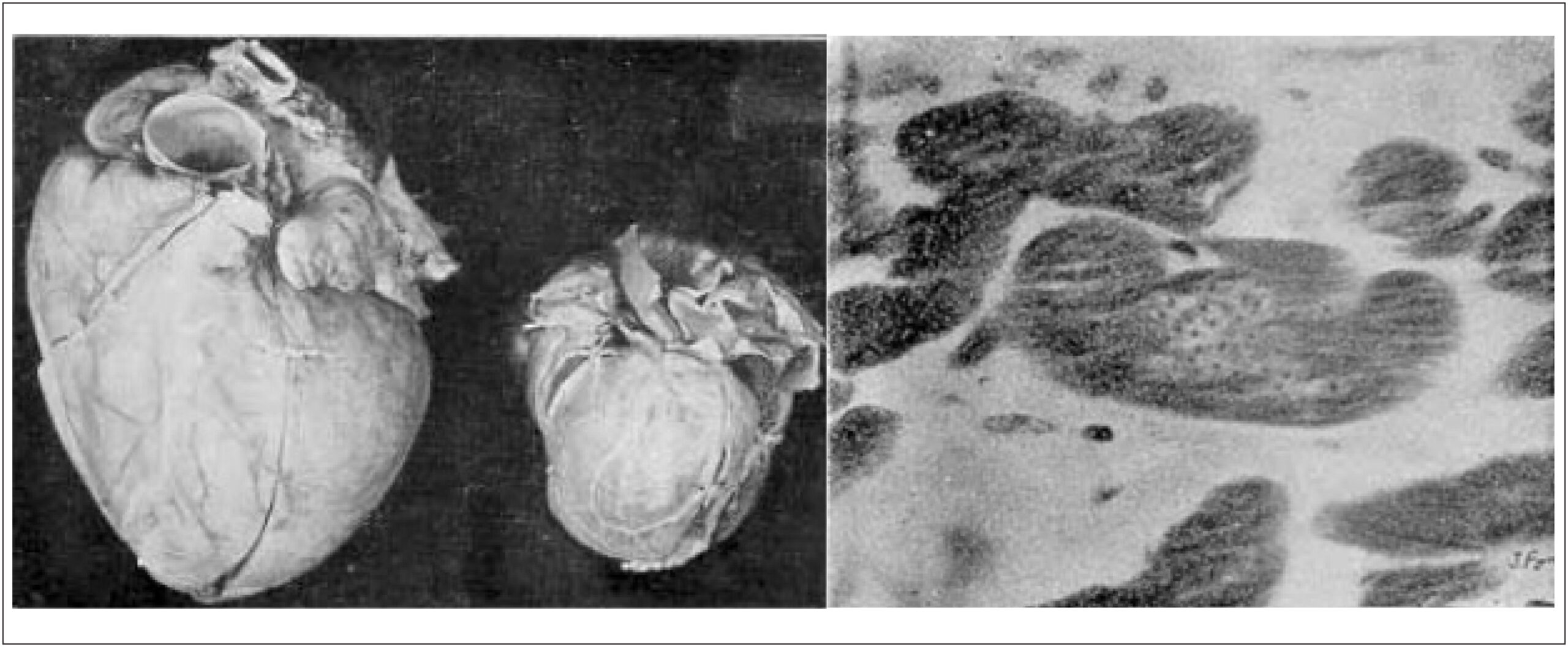
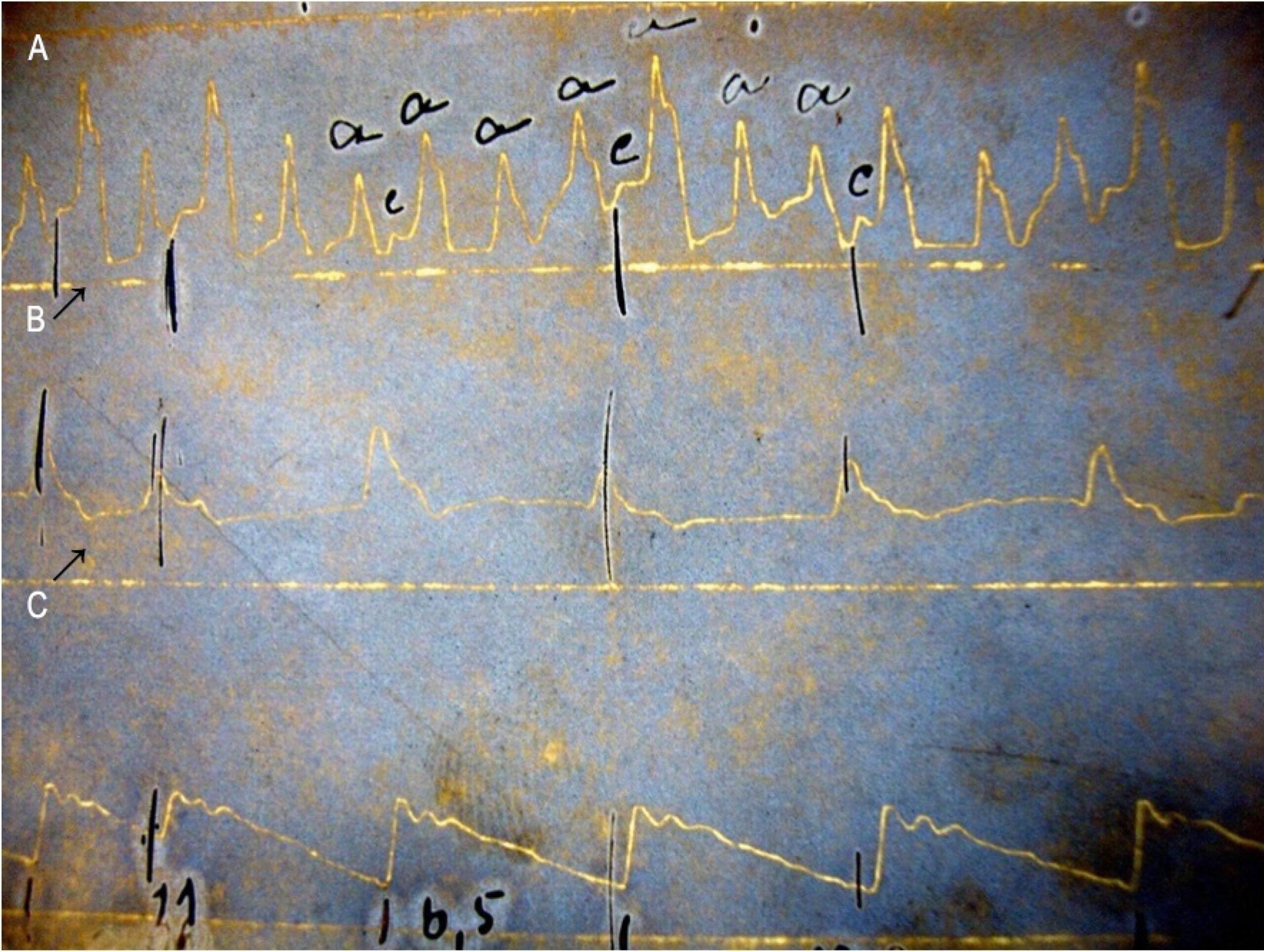
The scientific construction of chronic Chagas heart disease (CCHD) started in 1910 when Carlos Chagas highlighted the presence of cardiac arrhythmia during physical examination of patients with chronic Chagas disease, and described a case of heart failure associated with myocardial inflammation and nests of parasites at autopsy. He described sudden cardiac death associated with arrhythmias in 1911, and its association with complete AV block detected by Jacquet’s polygraph as Chagas reported in 1912. Chagas showed the presence of myocardial fibrosis underlying the clinical picture of CCHD in 1916, he presented a full characterization of the clinical aspects of CCHD in 1922. In 1928, Chagas detected fibrosis of the conductive system, and pointed out the presence of marked cardiomegaly at the chest X-Ray associated with minimal symptomatology. The use of serological reaction to diagnose CCHD was put into clinical practice in 1936, after Chagas’ death, which along with the 12-lead ECG, revealed the epidemiological importance of CCHD in 1945. In 1953, the long period between initial infection and appearance of CCHD was established, whereas the annual incidence of CCHD from patients with the indeterminate form of the disease was established in 1956. The use of heart catheterization in 1965, exercise stress testing in 1973, Holter monitoring in 1975, Electrophysiologic testing in 1973, echocardiography in 1975, endomyocardial biopsy in 1981, and Magnetic Resonance Imaging in 1995, added to the fundamental clinical aspects of CCHD as described by Carlos Chagas.

  • Arrhythmias Cardiac
  • Carlos Chagas
  • Chagas Cardiomyopathy
  • Chagas Disease / history
  • Heart Failure
Read Full Article
Creative Commons Attribution (CC BY) Creative Commons license
24/05/2016 DOI: 10.5935/abc.20160079 Views 1

How to cite this article

EndNote RIS

Electronic Document Format (Vancouver)

Cunha AB, Cunha DM. Revisiting the History of Chagas Disease: “Live to tell”. International Journal of Cardiovascular Sciences 2022;35(2):267-82.

Electronic Document Format (ABNT)

Cunha, Ademir Batista da; Cunha, Delma Maria. Revisiting the History of Chagas Disease: “Live to tell”. International Journal of Cardiovascular Sciences, v. 35, n. 2, p. 267-282, Jan. 2022.

Electronic Document Format (APA)

Cunha, A. B. , & Cunha, D. M. (2022). Revisiting the History of Chagas Disease: “Live to tell”. International Journal of Cardiovascular Sciences, 35(2), 267-282.

Electronic Document Format (ISO)

Cunha, Ademir Batista da and Cunha, Delma Maria. Revisiting the History of Chagas Disease: “Live to tell”. International Journal of Cardiovascular Sciences [online]. 2022, vol. 35, n. 2, [cited 2026-10-14], pp. 267-282. Available from: <https://journals.cardiol.br/en/article/revisiting-the-history-of-chagas-disease-live-to-tell/>. ISSN 2359-4802

EndNote RIS

Electronic Document Format (Vancouver)

Fragata Filho AA. Chagas Disease: Are Kissing Bugs the Only Culprit?. Arquivos Brasileiros de Cardiologia 2021;117(1 suppl 1):1-7.

Electronic Document Format (ABNT)

Fragata Filho, Abilio Augusto. Chagas Disease: Are Kissing Bugs the Only Culprit?. Arquivos Brasileiros de Cardiologia, v. 117, n. 1 suppl 1, p. 1-7, Jul. 2021.

Electronic Document Format (APA)

Fragata Filho, A. A. (2021). Chagas Disease: Are Kissing Bugs the Only Culprit?. Arquivos Brasileiros de Cardiologia, 117(1 suppl 1), 1-7.

Electronic Document Format (ISO)

Fragata Filho, Abilio Augusto. Chagas Disease: Are Kissing Bugs the Only Culprit?. Arquivos Brasileiros de Cardiologia [online]. 2021, vol. 117, n. 1 suppl 1, [cited 2026-10-14], pp. 1-7. Available from: <https://journals.cardiol.br/en/article/chagas-disease-are-kissing-bugs-the-only-culprit/>. ISSN 0066-782X

EndNote RIS

Electronic Document Format (Vancouver)

Bestetti RB, Restini CBA, Couto LB. Carlos Chagas Discoveries as a Drop Back to Scientific Construction of Chronic Chagas Heart Disease. Arquivos Brasileiros de Cardiologia 2016;107(1):63-70.

Electronic Document Format (ABNT)

Bestetti, Reinaldo B.; Restini, Carolina Baraldi A.; Couto, Lucélio B.. Carlos Chagas Discoveries as a Drop Back to Scientific Construction of Chronic Chagas Heart Disease. Arquivos Brasileiros de Cardiologia, v. 107, n. 1, p. 63-70, May. 2016.

Electronic Document Format (APA)

Bestetti, R. B., Restini, C. B. A., & Couto, L. B. (2016). Carlos Chagas Discoveries as a Drop Back to Scientific Construction of Chronic Chagas Heart Disease. Arquivos Brasileiros de Cardiologia, 107(1), 63-70.

Electronic Document Format (ISO)

Bestetti, Reinaldo B. and Restini, Carolina Baraldi A. and Couto, Lucélio B.. Carlos Chagas Discoveries as a Drop Back to Scientific Construction of Chronic Chagas Heart Disease. Arquivos Brasileiros de Cardiologia [online]. 2016, vol. 107, n. 1, [cited 2026-10-14], pp. 63-70. Available from: <https://journals.cardiol.br/en/article/carlos-chagas-discoveries-as-a-drop-back-to-scientific-construction-of-chronic-chagas-heart-disease/>. ISSN 0066-782X

  • About ABC Family
  • Internal Regulation
  • Editorial Board
  • Brazilian Society of Cardiology (SBC)

Issues

SBC Guidelines

  • Videos
  • Podcasts
  • News