Risk Factors Associated with Preeclampsia and Their Impact on Maternal and Neonatal Morbidity and Mortality in the Dominican Republic
Abstract
Background
Hypertensive disorders of pregnancy complicate 5%-10% of pregnancies and account for 23%-38% of maternal deaths in the Dominican Republic.
Objective
To identify factors associated with the development of preeclampsia and evaluate their relationship with maternal and perinatal morbidity and mortality.
Methods
This multicenter, prospective, observational, cross-sectional, analytical study included 469 parturients from 17 hospitals across the Dominican Republic over a 30-day period. Statistical significance was set at p < 0.05.
Results
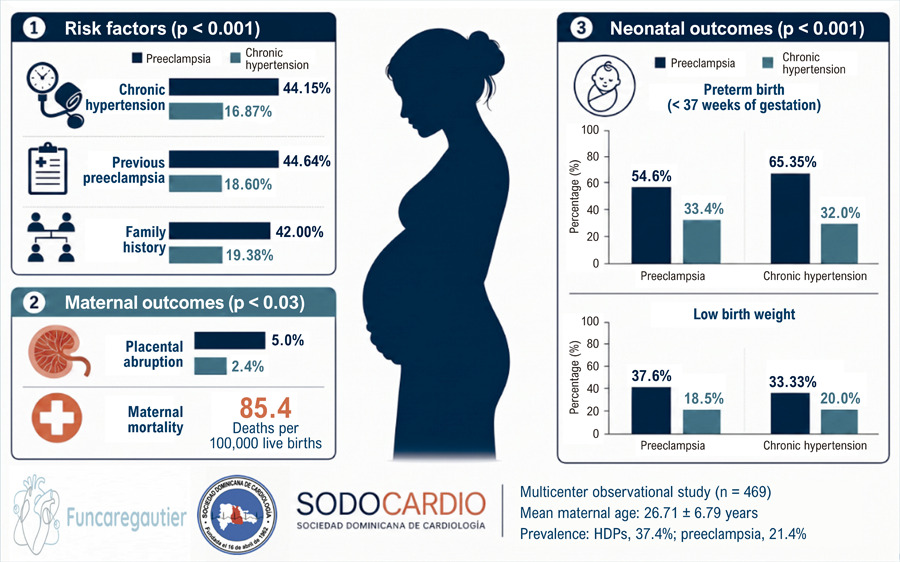
Preeclampsia was significantly associated with chronic hypertension (44.15% vs 16.87%; odds ratio [OR], 3.91; 95%CI, 2.51-6.09), previous preeclampsia (44.64% vs 18.60%; OR, 3.53; 95%CI, 2.24-5.56), and a family history of preeclampsia (42.0% vs 19.38%; OR, 3.01; 95%CI, 1.96-4.62). Preeclampsia was also associated with prematurity (54.6% vs 33.4%; OR, 2.40; 95%CI, 1.62-3.55), low birth weight (37.6% vs 18.5%; OR, 2.65; 95%CI, 1.73-4.07), and placental abruption (5.0% vs 2.4%; OR, 2.14; 95%CI, 0.81-5.62). Maternal and fetal mortality were not significantly associated with preeclampsia. In the multivariable logistic regression analysis, chronic hypertension (adjusted OR [AOR], 3.64; 95%CI, 2.25–5.88), a family history of preeclampsia (AOR, 2.86; 95%CI, 1.85-4.42), and pregestational obesity (AOR, 2.26; 95%CI, 1.52-3.36) emerged as independent predictors of preeclampsia (all p < 0.05).
Conclusion
Preeclampsia is associated with an increased risk of adverse maternal and neonatal outcomes, particularly prematurity and low birth weight.
Images
Image gallery fullscreen viewer
Comments are moderated by the editorial team before publication. Discussions should be evidence-based and use scientific language. Conflicts of interest should be declared.