Chagas Disease: Are Kissing Bugs the Only Culprit?
Preface
Chagas disease, first described by Carlos Chagas in 1909, is caused by a single-celled parasite (Trypanosoma cruzi). Throughout history, the main mechanism of transmission has been via contact with the feces of an insect infected with the parasite. This insect, known as the “kissing bug” in English, is popularly known as “barbeiro,” “chupão,” or “chupança” in Brazil. The “kissing bugs” are not born with the parasite in their intestine; rather, they acquire it by feeding on the blood of infected mammals. (This disease only affects mammals). When taking a blood meal, the insects eliminate feces, where the parasites are present, and the parasites can contaminate the bite, allowing the parasite to enter the organism. In this manner, the disease begins. The kissing bugs mainly make their nests in cracks in clay walls of houses made in a style known as “pau-a-pique” in Brazil. These houses are very common in diverse regions of Brazil, especially throughout the sertão of the Northeast Region. Other mechanisms of transmission can occur, for example, via blood transfusion, organ donation, mother-to-child transmission, ingestion of contaminated foods, etc.
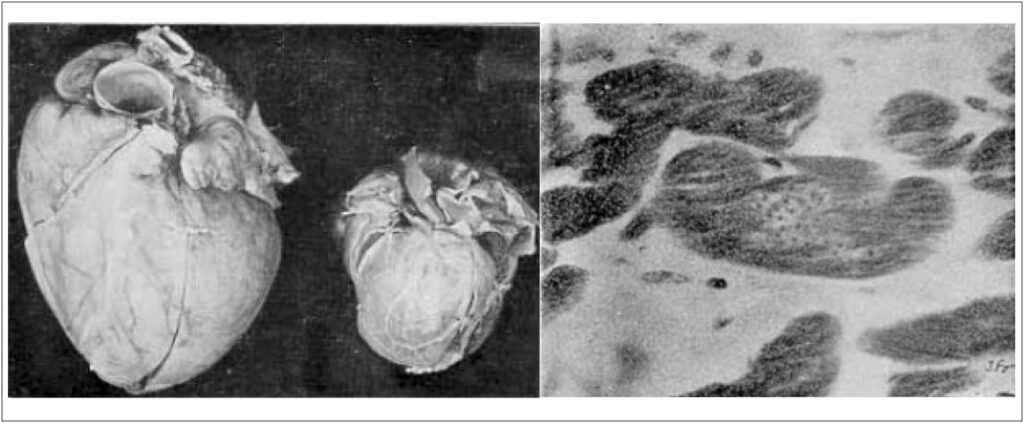
During the acute phase of the disease, complaints may be mild or even non-existent. They may include general manifestations, such as low fever, malaise or more severe ones, such as shortness of breath and swelling. As bites from kissing bugs usually occur on the face, swelling of the eyebrows, known as the Romaña sign, may occur. As the years pass, generally after 10 years or more, cardiac complaints appear in one third of patients, such as fatigue, shortness of breath, and swelling in the body (heart failure). In some cases, the electrical system of the heart may be compromised, with alterations in cardiac rhythm, fainting, and even sudden death. Dilatation of the esophagus and the colon can also occur, with progressive difficulty in swallowing food and defecating.
[…]
Images
Image gallery fullscreen viewer
Comments are moderated by the editorial team before publication. Discussions should be evidence-based and use scientific language. Conflicts of interest should be declared.