Coronary Flow Velocity Reserve during Dobutamine Stress Echocardiography
Background:
A coronary flow velocity reserve (CFVR) ≥ 2 is adequate to infer a favorable prognosis or the absence of significant coronary artery disease.
Objective:
To identify parameters which are relevant to obtain CFVR (adequate or inadequate) in the left anterior descending coronary artery (LAD) during dobutamine stress echocardiography (DSE).
Methods:
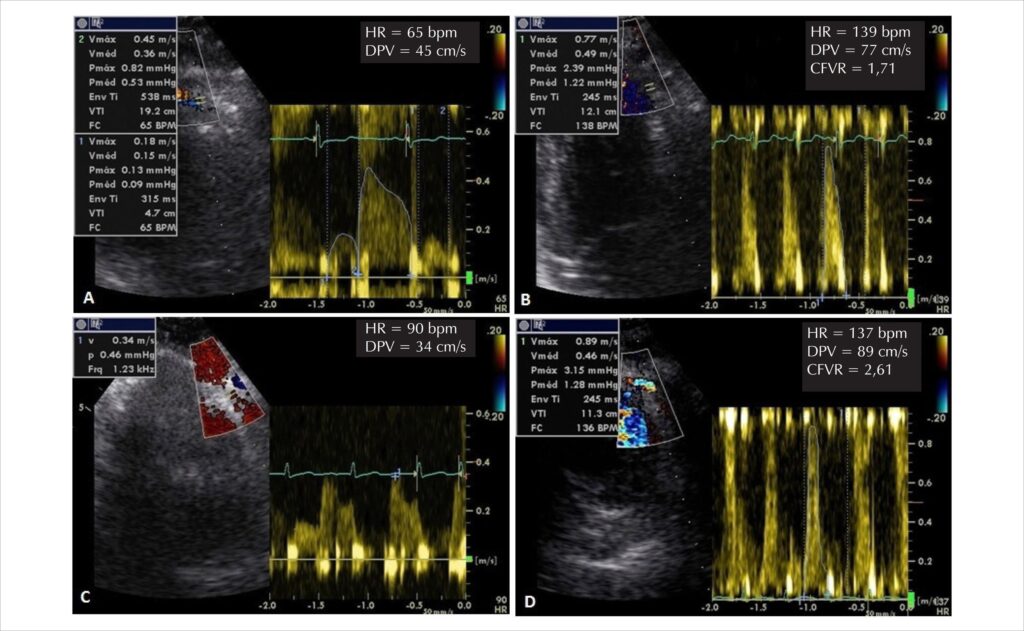
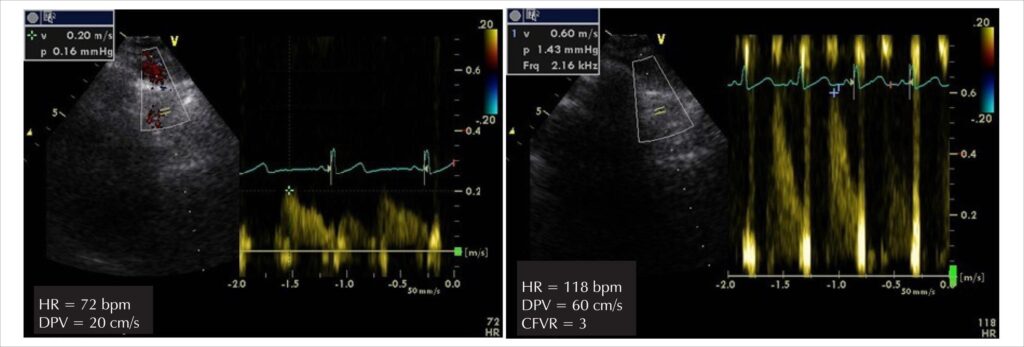
100 patients referred for detection of myocardial ischemia by DSE were evaluated; they were instructed to discontinue the use of β-blockers 72 hours prior to the test. CFVR was calculated as a ratio of the diastolic peak velocity (cm/s) (DPV) on DSE (DPV-DSE) to baseline DPV at rest (DPV-Rest). In group I, CFVR was < 2 and, in group II, CFVR was ≥ 2. The Fisher's exact test and Student's t test were used for the statistical analyses. P values < 0.05 were considered statistically significant.
Results:
At rest, the time (in seconds) to obtain Doppler in LAD in groups I and II was not different (53±31 vs. 45±32; p=0.23). During DSE, LAD was recorded in 92 patients. Group I patients were older (65.9±9.3 vs. 61.2±10.8 years; p=0.04), had lower ejection fraction (61±10 vs. 66±6%; p=0.005), higher DPV-Rest (36.81±08 vs. 25.63 ± 06cm/s; p<0.0001) and lower CFVR (1.67 ± 0.24 vs. 2.53 ± 0.57; p<0.0001), but no difference was observed regarding DPVDSE (61.40±16 vs. 64.23±16cm/s; p=0.42). β-blocker discontinuation was associated with a 4-fold higher chance of a CFVR < 2 (OR= 4; 95% CI [1.171-13.63], p=0.027).
Conclusion:
DPV-Rest was the main parameter to determine an adequate CFVR. β-blocker discontinuation was significantly associated with inadequate CFVR. The high feasibility and the time to record the LAD corroborate the use of this methodology.
Images
Image gallery fullscreen viewer
Comments are moderated by the editorial team before publication. Discussions should be evidence-based and use scientific language. Conflicts of interest should be declared.