Inhibition of L-type calcium current by tramadol and enantiomers in cardiac myocytes from rats
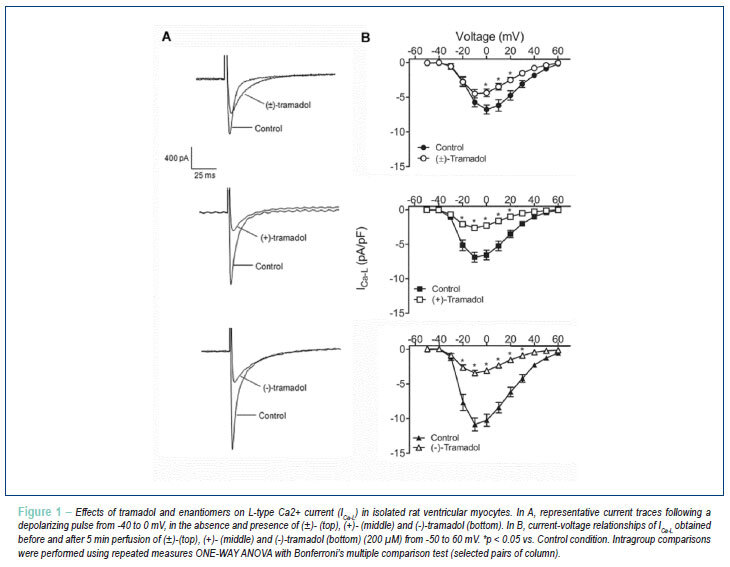
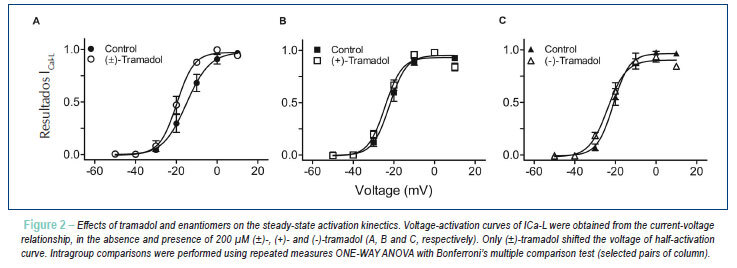
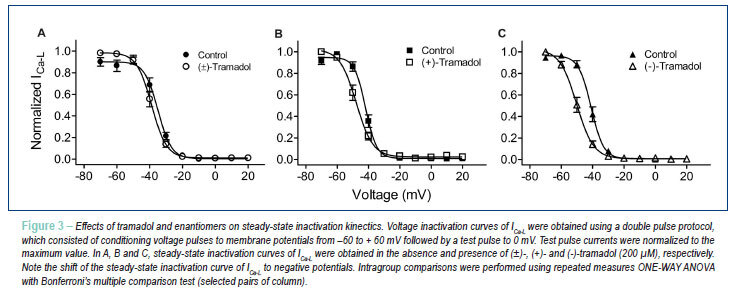
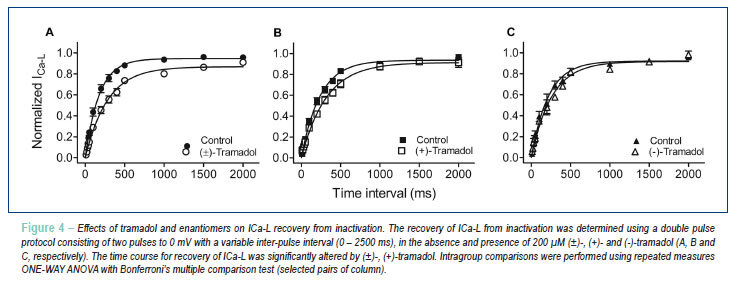
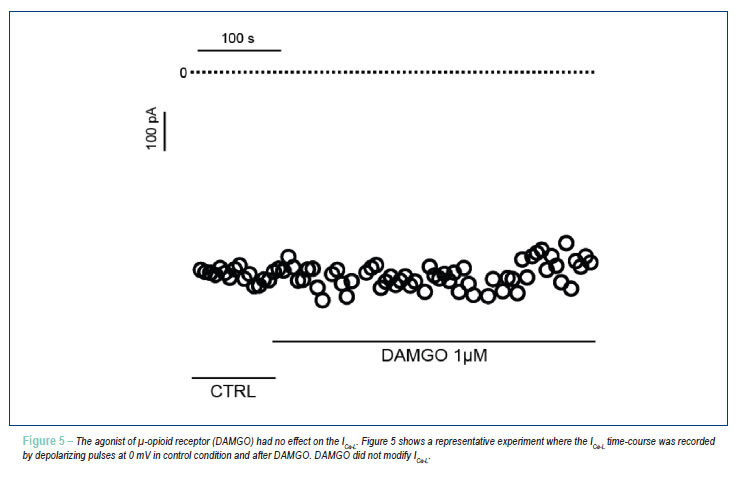
BACKGROUND: Tramadol is a centrally acting analgesic, whose mechanism of action involves opioid-receptor activation. Previously, we have shown that tramadol and its enantiomers had a negative inotropic effect on the papillary muscle in which the (+)-enantiomer is more potent than (-)- and (±)-tramadol. OBJECTIVE: In this study, we investigated the effects of tramadol and its enantiomers on L-type calcium current (I Ca-L). RESULTS: Tramadol (200 µM) reduced the peak amplitude of I Ca-L at potentials from 0 to +50 mV. At 0 mV, I Ca-L was reduced by 33.7 ± 7.2%. (+)- and (-)-tramadol (200 µM) produced a similar inhibition of I Ca-L, in which the peak amplitude was reduced by 64.4 ± 2.8% and 68.9 ± 5.8%, respectively at 0 mV (p > 0.05). Tramadol, (+)- and (-)-tramadol shifted the steady-state inactivation of I Ca-L to more negative membrane potentials. Also, tramadol and (+)-tramadol markedly shifted the time-dependent recovery curve of I Ca-L to the right and slowed down the recovery of I Ca-L from inactivation. The time constant was increased from 175.6 ± 18.6 to 305.0 ± 32.9 ms (p < 0.01) for tramadol and from 248.1 ± 28.1 ms to 359.0 ± 23.8 ms (p < 0.05) for (+)-tramadol. The agonist of µ-opioid receptor DAMGO had no effect on the I Ca-L. CONCLUSION: The inhibition of I Ca-L induced by tramadol and its enantiomers was unrelated to the activation of opioid receptors and could explain, at least in part, their negative cardiac inotropic effect.
Images
Image gallery fullscreen viewer
Comments are moderated by the editorial team before publication. Discussions should be evidence-based and use scientific language. Conflicts of interest should be declared.