Intima-media thickness in the origin of right subclavian artery as an early marker of cardiovascular risk
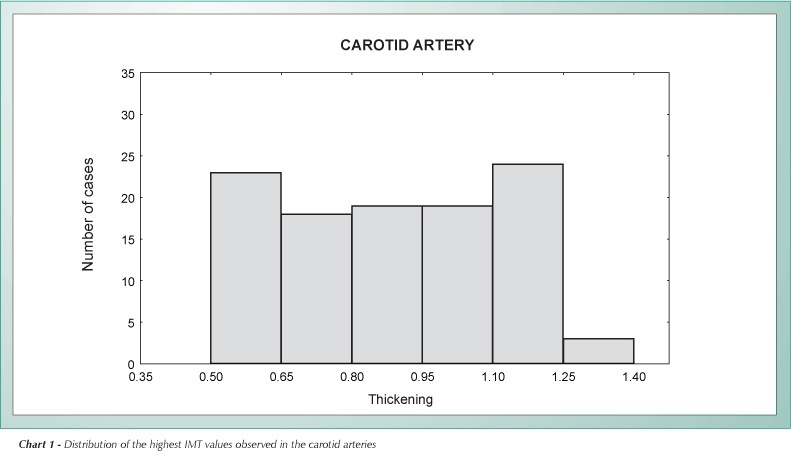
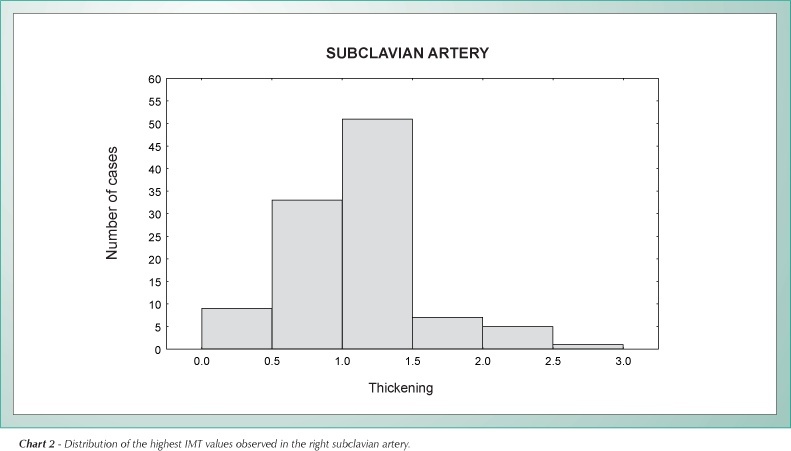
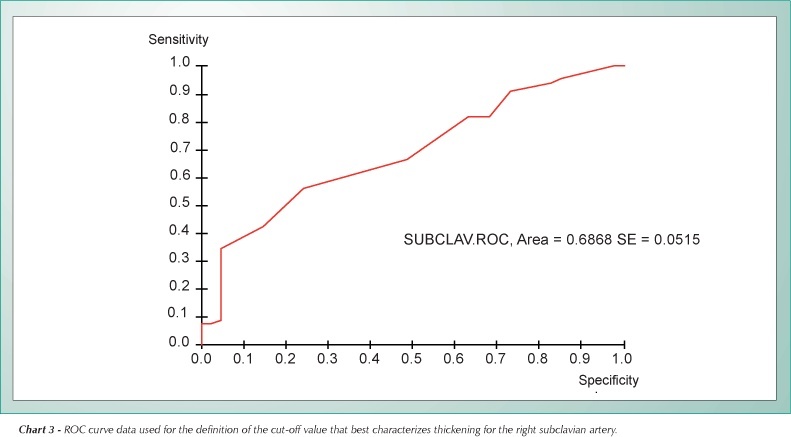
OBJECTIVE: Common carotid artery intima-media thickness (IMT) is considered a factor of cardiovascular risk and an early marker of coronary artery disease. This study aimed to investigate the existence of a correlation between IMT in the carotid arteries and at the origin of the right subclavian artery, as well as to evaluate IMT in the subclavian artery as an earlier marker of cardiovascular risk. METHODS: One hundred and six consecutive patients, 52 males and 54 females, average age 51 years, underwent color Doppler ultrasonography to evaluate carotid and right subclavian arteries. The relationship between carotid IMT and right subclavian IMT was assessed using the Pearson’s correlation coefficient analysis and a 95% confidence interval. Reliability of right subclavian artery IMT measurement for the diagnosis of early thickening (considering a > 0.8 mm carotid thickness as reference) was described as to sensitivity, specificity, positive predictive value, negative predictive value, and accuracy. Cut-off values for the right subclavian IMT were indicated by the ROC curve, and p values 0.8 mm. The mean IMT value for the carotid artery was 0.87 mm (SD = 0.23) and for the subclavian artery, 1.17 mm (SD = 0.46), with a 0.31 correlation coefficient (95% CI: 0.12; 0.47). The ROC curve analysis indicated a cut-off value of 0.7 mm for the right subclavian artery IMT, using as reference a 0.8 mm cut-off value for the carotid artery (91% sensitivity, 27% specificity, 66% PPV, 65% NPV, and 66% accuracy). CONCLUSION: Our study showed that carotid artery IMT correlates well with right subclavian artery IMT. With a 0.7 mm cut-off value, it is possible to detect IMT in the right subclavian artery earlier than in the carotid arteries. The IMT at the origin of the right subclavian artery can be considered an earlier marker for the assessment of cardiovascular risk.
Images
Image gallery fullscreen viewer
Comments are moderated by the editorial team before publication. Discussions should be evidence-based and use scientific language. Conflicts of interest should be declared.