Ventricular arrhythmias and left ventricular hypertrophy in hypertrophic cardiomyopathy
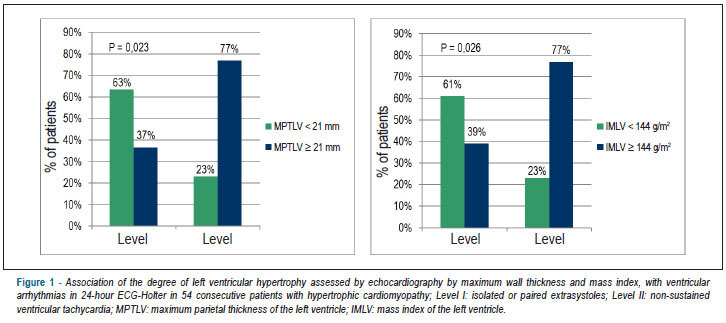
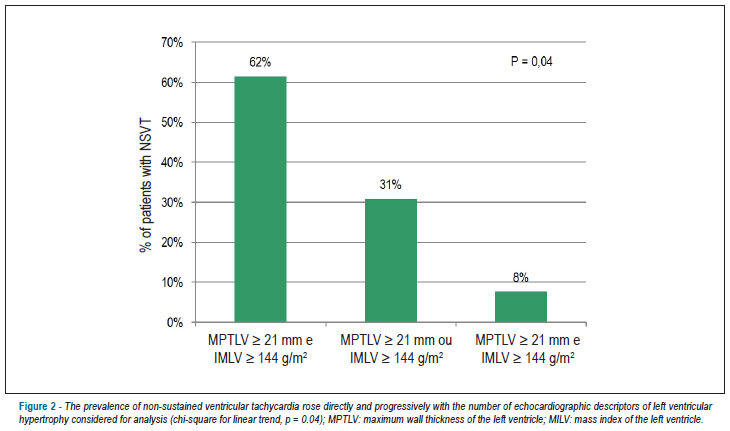
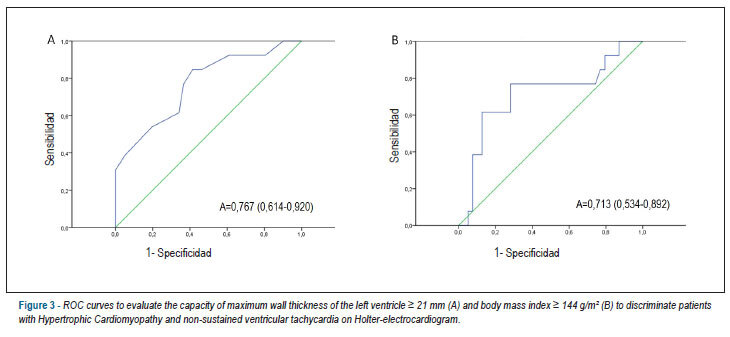
BACKGROUND: In hypertrophic cardiomyopathy (HCM), the degree of left ventricular hypertrophy (LVH) could influence the development of ventricular arrhythmias. OBJECTIVE: In HCM, analyze the association between the occurrence of ventricular arrhythmias determined by Holter electrocardiogram (ECG-Holter) and the degree of LVH determined by maximum wall thickness (MWT) in echocardiography and body mass index (BMI). METHODS: Fifty-four consecutive patients with HCM underwent 24-hour ECG-Holter and echocardiography for assessment of level of LVH through MWT and BMI. Two levels were established for the occurrence of Ventricular Arrhythmias: I – alone or paired extrasystoles and II – Non- Sustained Ventricular Tachycardia (NSVT). RESULTS: In 13 patients (24%) with NSVT (level II), there was a higher frequency of MWT of the left ventricle (LV) > 21 mm (n = 10, 77%, 25 ± 4 mm) and LLLV = 144 g/m² (n = 10, 77%, 200 ± 30 g/m²), in comparison with those presenting with extrasystole arrhythmias (level I) (n = 41, 76%), in which these measures were identified in, respectively, 37 % (n= 15, 23 ± 1 mm), p = 0.023, and 39% (n = 16, 192 ± 53 g / m²) of the cases (p = 0.026). The cut-off values mentioned were determined by the ROC curve with a confidence interval of 95%. NSVT was more common in patients with MWTLV > 21 mm and LLLV > 144 g/m² (8 of 13, 62%) than in those with (4 of 13, 31%) or without (1 of 13; 8%) echocardiographic variables above cut-off values (p = 0.04). CONCLUSION: In HCM, occurrence of ventricular arrhythmias by Holter was associated with the degree of LVH assessed by echocardiography through MWT and BMI.
Images
Image gallery fullscreen viewer
Comments are moderated by the editorial team before publication. Discussions should be evidence-based and use scientific language. Conflicts of interest should be declared.