Assessment of Carotid Intima-Media Thickness as an Early Marker Of Vascular Damage In Hypertensive Children
Abstract
Background:
The increased carotid intima-media thickness (CIMT) correlates with the presence of atherosclerosis in adults and describes vascular abnormalities in both hypertensive children and adolescents.
Objective:
To assess CIMT as an early marker of atherosclerosis and vascular damage in hypertensive children and adolescents compared with non-hypertensive controls and to evaluate the influence of gender, age, and body mass index (BMI) on CIMT on each group.
Methods:
Observational cohort study. A total of 133 hypertensive subjects (male, n = 69; mean age, 10.5 ± 4 years) underwent carotid ultrasound exam for assessment of CIMT. One hundred and twenty-one non-hypertensive subjects (male, n = 64; mean age, 9.8 ± 4.1 years) were selected as controls for gender, age (± 1 year), and BMI (± 10%).
Results:
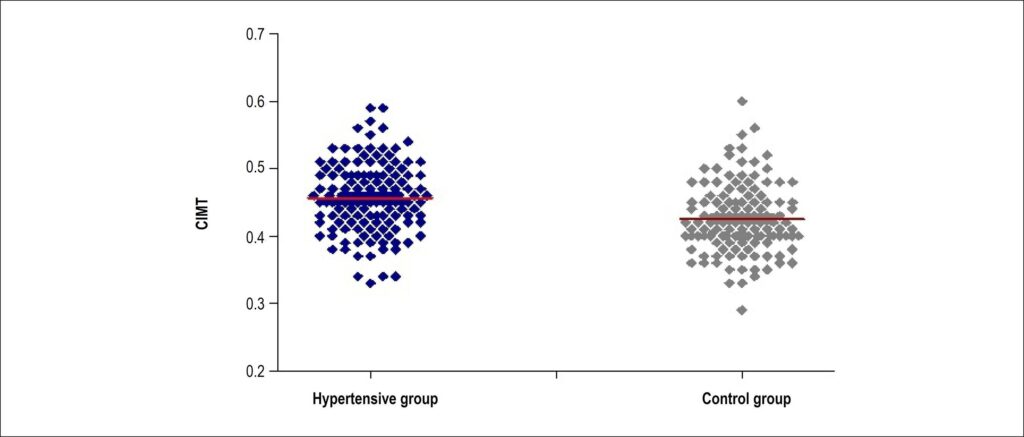
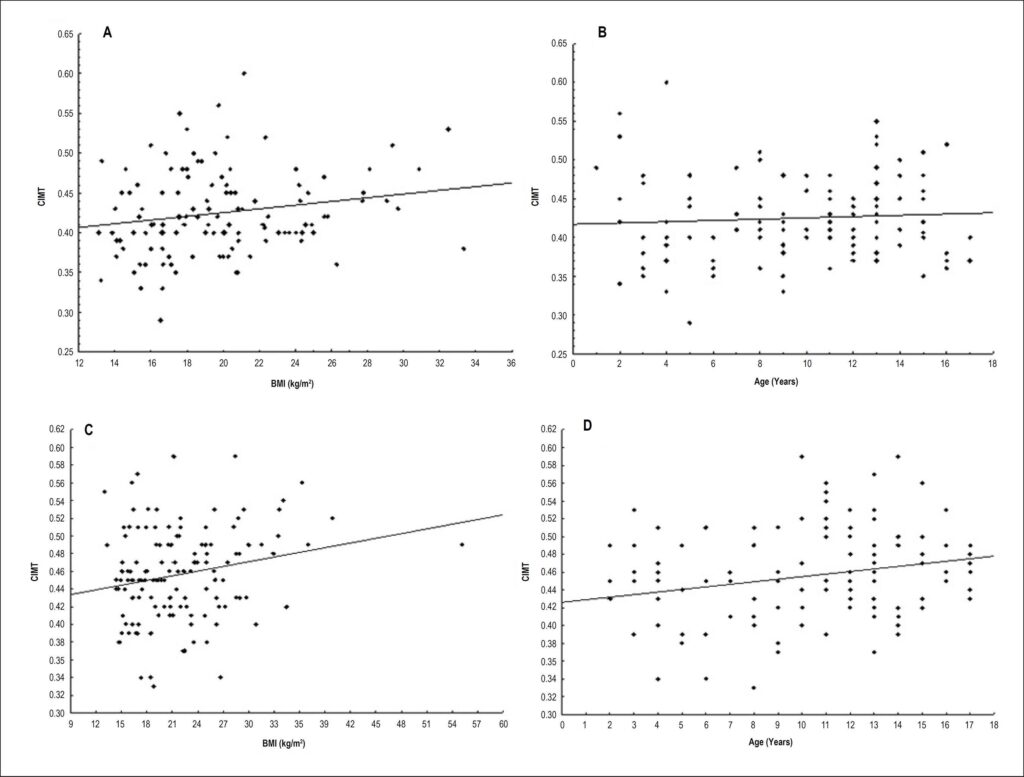
There were no significant difference regarding gender (p = 0.954) and age (p = 0.067) between groups. Hypertensive subjects had higher BMI when compared to control group (p = 0.004), although within the established range of 10%. Subjects in the hypertensive group had higher CIMT values when compared to control group (0.46 ± 0.05 versus 0.42 ± 0.05 mm, respectively, p < 0.001; one-way ANOVA). Carotid IMT values were not significantly influenced by gender, age, and BMI when analyzed in both groups separately (Student's t-test for independent samples). According to the adjusted determination coefficient (R²) only 11.7% of CIMT variations were accounted for by group variations, including age, gender, and BMI.
Conclusions:
Carotid intima-media thickness was higher in hypertensive children and adolescents when compared to the control group. The presence of hypertension increased CIMT regardless of age, gender, and BMI.
Images
Image gallery fullscreen viewer
Comments are moderated by the editorial team before publication. Discussions should be evidence-based and use scientific language. Conflicts of interest should be declared.