Letícia Cunha Pereira de Souza et al. Miriam Allein Zago Marcolino Pedro Henrique Engster Yohan Casiraghi … Thiago Brusca da Costa Linn Jerry Eduardo de Almeida de Bairos Luciana Rodrigues de Lara Nayê Balzan Schneider Ana Paula Beck da Silva Etges Carisi Anne Polanczyk
Abstract
Background
The assessment of cardiovascular care in Brazil is challenged by the country’s vast territory and the large volume of data. Business Intelligence (BI) tools may enhance the visualization and utilization of such information to support public health decision-making.
Objectives
To demonstrate the practical application of the interactive dashboard iCardio in analyzing regional inequalities in high-complexity cardiovascular care in Brazil.
Methods
Descriptive study based on secondary data made available by the iCardio dashboard, which integrates healthcare information from the Brazilian Unified Health System (SUS). Variables from 2019 were analyzed by region, considering service volume, mortality rates, hospital readmissions, and patient travel distance.
Results
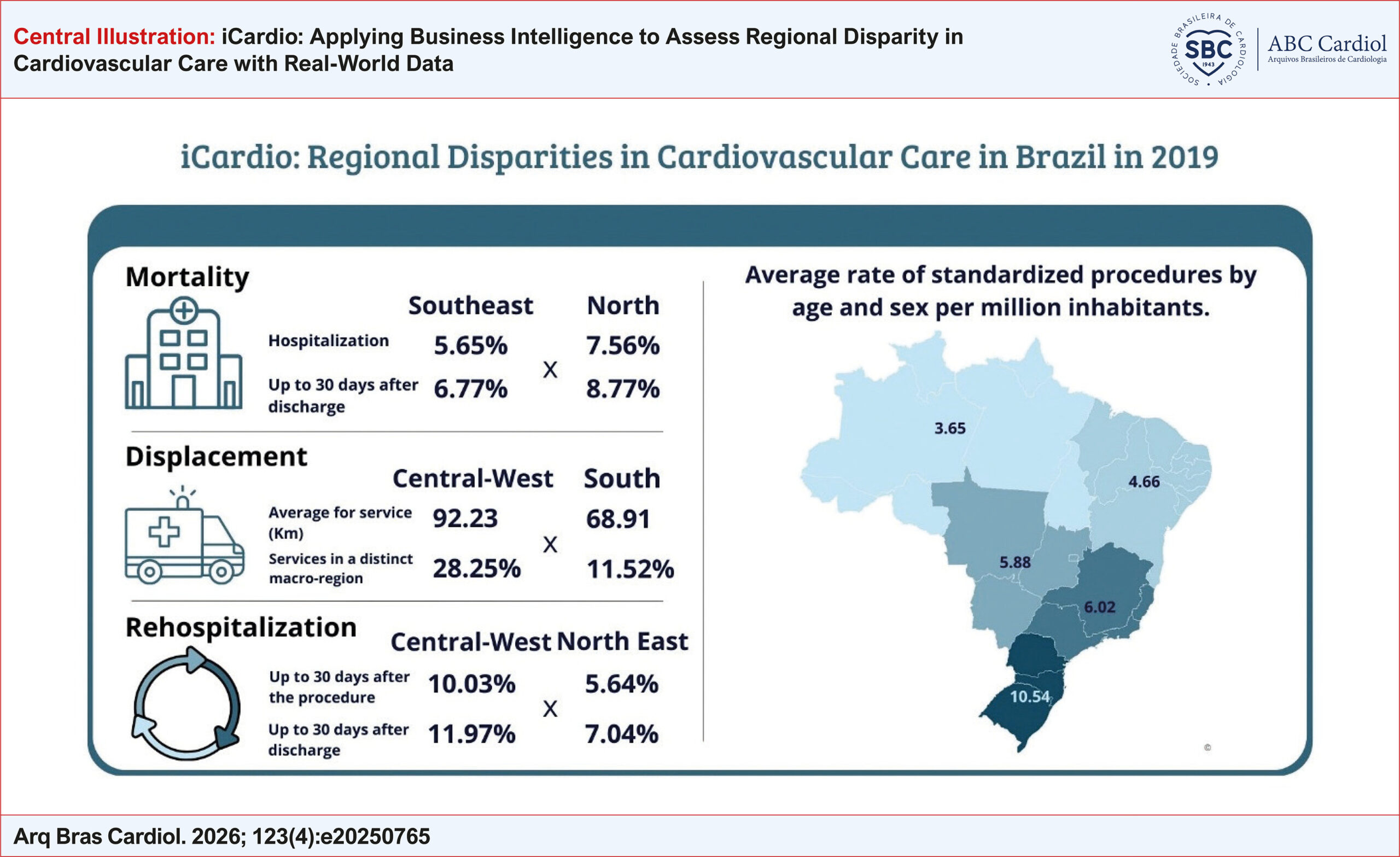
Analyses of cardiovascular surgery and interventional cardiology procedures indicated that the Southeast region exhibited the lowest mortality rates (in-hospital: 5.65%, 30 days after procedure: 5.73%, and 30 days after discharge: 6.77%). The North had the highest mortality rates (in-hospital: 7.56%, within 30 days after the procedure: 7.7%, and within 30 days after discharge: 8.7%). The South and Central-West regions registered the highest readmission rates within 30 days after the procedure (9.79% and 10.3%, respectively) and within 30 days after discharge (11.7% and 11.97%, respectively). The South also presented the highest standardized procedure rate (10.54), nearly double that of the Southeast (6.02). The Northeast showed the longest mean patient travel distance (94.59 km).
Conclusions
The use of BI through the iCardio dashboard enables rapid and accessible analysis of healthcare data, with the potential to inform evidence-based decision-making, optimize resource allocation, and identify regional disparities in cardiovascular care.