ABC Family Arquivos Brasileiros de Cardiologia International Journal of Cardiovascular Sciences ABC Heart Failure & Cardiomyopathy ABC Imagem Cardiovascular
Português English
ABC Family
Português English
  • About
    • About ABC Family
    • Internal Regulation
    • Editorial Board
    • Brazilian Society of Cardiology (SBC)
  • Issues
  • SBC Guidelines
  • Content
    • Videos
    • Podcasts
    • News
  • About
    • About ABC Family
    • Internal Regulation
    • Editorial Board
    • Brazilian Society of Cardiology (SBC)
  • Issues
  • SBC Guidelines
  • Content
    • Videos
    • Podcasts
    • News

ABC Family

  • ABC Family
  • Arquivos Brasileiros de Cardiologia
  • International Journal of Cardiovascular Sciences
  • ABC Heart Failure & Cardiomyopathy
  • ABC Imagem Cardiovascular
Search in

No content found.

Journals
Ordering
Article types
Others

  1. Home
  2. Keyword: Prehospital Care
ABC
Editorial

Recognition by the Regulatory Physician of Expressions Used by Lay People when Asking for Help in Supposed Cardiorespiratory Arrest

Ronaldo C. O. Vinagre

Out-of-hospital cardiac arrest (OHCA) is a time-sensitive, life-threatening emergency that occurs millions of times every year. Data from countries around the world with emergency medical services (EMS) in place suggest a global average of 82.1 EMS-attended OHCAs per 100,000 people per annum. Survival after OHA remains modest despite standardized dispatch protocols in EMS systems, increased community training, and the introduction of post-resuscitation care. Ten percent (range, 6%–22%) of people who experience OHCA can expect to survive with a favorable neurological outcome. However, early prehospital interventions have a substantial impact on the survival of OHA victims.

Bystander-initiated cardiopulmonary resuscitation (CPR) increases the odds of 30-day survival by two-fold and is associated with improved long-term neurological outcomes. So, early recognition of cardiac arrest is the cornerstone of the chain of survival. Well-known clinical signs of cardiac arrest are unresponsiveness and absent or abnormal breathing. However, it is unclear how these signs and symptoms, especially agonistic respirations, are interpreted and described by laypeople. Besides that, dispatcher-assisted CPR increases neurologically intact survival in OHCA, according to several studies.,

[…]

  • Emergency Medical Dispatcher
  • Out-of-Hospital Cardiac Arrest
  • Prehospital Care
Read Full Article
Creative Commons Attribution (CC BY) Creative Commons license
10/01/2025 DOI: 10.36660/abc.20240669i
Observational Study of Words Used by Emergency Callers and Their Impact on the Recognition of an Out-Of-Hospital Cardiopulmonary Arrest by the Medical Dispatcher
ABC
Original Article

Observational Study of Words Used by Emergency Callers and Their Impact on the Recognition of an Out-Of-Hospital Cardiopulmonary Arrest by the Medical Dispatcher

Matheus Henrique Ramos Voos et al. Caroline Manami Okamoto Artur Boeck Trommer Amanda Berlinck da Silva … Eduardo Franke da Cruz Gustavo Andreazza Laporte Antônio Rogério Proença Tavares Crespo Andrea Regner Karin Viegas

Abstract

Background

Survival of victims of out-of-hospital cardiopulmonary arrest (CA) is related to the time and quality of cardiopulmonary resuscitation (CPR).1 Considering that most CAs occur outside the hospital setting, it is evident that the early recognition of this condition is the cornerstone of the chain of survival. Current literature on the theme is still scarce.

Objectives

To analyze categories and subcategories of words and expressions spontaneously used by laypeople during emergency calls for CA and their relationship with the recognition of this event by the medical dispatcher.

Methods

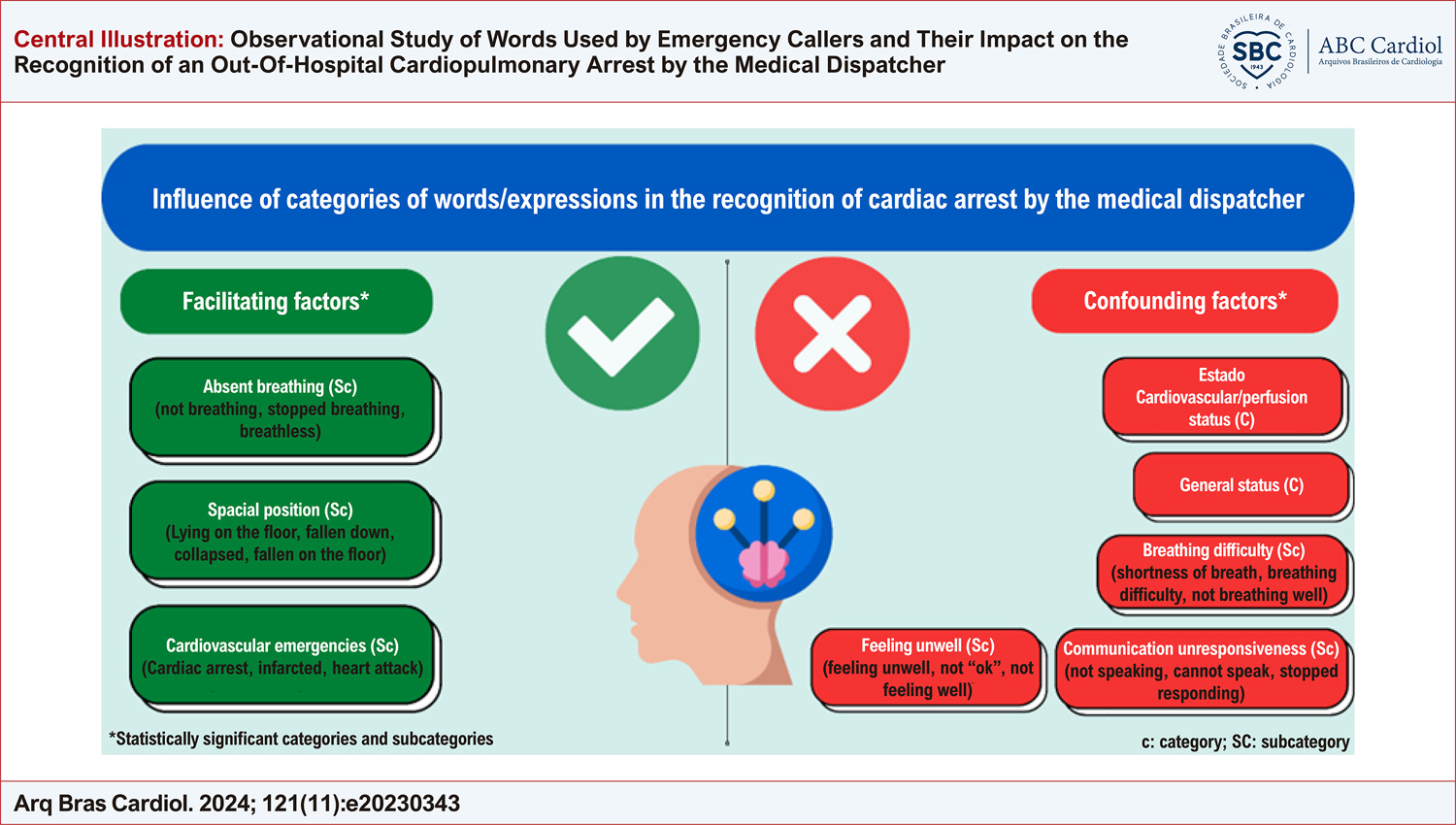
This was a cross-sectional study, with analysis of calls made by laypeople due to suspected CA to emergency medical services in Brazil. The expressions used were classified into six categories and 31 subcategories. Univariate and multivariate models were used to assess the strength of the association of categories and subcategories of words and expressions with the presumption of CA. The level of significance was set at 5%. Results: A total of 284 calls were included, and after applying the inclusion criteria, 101 calls were analyzed. The categories “cardiovascular/perfusion status” (p=0.019) and “general status” (p=0.011) were identified as confounding factors for the recognition of CA, and the subcategories “breathing difficulty” (p=0.023), “verbal unresponsiveness” (p=0.034), “facial coloration” (p=0.068) and “feeling unwell” (p=0.013) were also considered as confounders. On the other hand, the subcategories “not breathing” (p=0.010); “spatial position” (p=0.016), and “cardiovascular emergencies” (p=0.045) were identified as facilitating factors for the recognition of CA.

Conclusion

Categories and subcategories of expressions used by emergency callers for CA can influence the timely recognition of this condition by the medical dispatcher.

  • Emergency Medical Dispatcher
  • Out-of-Hospital Cardiac Arrest
  • Prehospital Care
Read Full Article
Creative Commons Attribution (CC BY) Creative Commons license
25/11/2024 DOI: 10.36660/abc.20230343i

How to cite this article

EndNote RIS

Electronic Document Format (Vancouver)

Vinagre RCO. Recognition by the Regulatory Physician of Expressions Used by Lay People when Asking for Help in Supposed Cardiorespiratory Arrest. Arquivos Brasileiros de Cardiologia 2025;121(11):e20240669.

Electronic Document Format (ABNT)

Vinagre, Ronaldo C. O.. Recognition by the Regulatory Physician of Expressions Used by Lay People when Asking for Help in Supposed Cardiorespiratory Arrest. Arquivos Brasileiros de Cardiologia, v. 121, n. 11, e20240669, Jan. 2025.

Electronic Document Format (APA)

Vinagre, R. C. O. (2025). Recognition by the Regulatory Physician of Expressions Used by Lay People when Asking for Help in Supposed Cardiorespiratory Arrest. Arquivos Brasileiros de Cardiologia, 121(11), e20240669.

Electronic Document Format (ISO)

Vinagre, Ronaldo C. O.. Recognition by the Regulatory Physician of Expressions Used by Lay People when Asking for Help in Supposed Cardiorespiratory Arrest. Arquivos Brasileiros de Cardiologia [online]. 2025, vol. 121, n. 11, [cited 2026-10-14], e20240669. Available from: <https://journals.cardiol.br/en/article/recognition-by-the-regulatory-physician-of-expressions-used-by-lay-people-when-asking-for-help-in-supposed-cardiorespiratory-arrest/>. ISSN 0066-782X

EndNote RIS

Electronic Document Format (Vancouver)

Voos MHR, Okamoto CM, Trommer AB, Silva AB, Cruz EF, Laporte GA, Crespo ARPT, et al. Observational Study of Words Used by Emergency Callers and Their Impact on the Recognition of an Out-Of-Hospital Cardiopulmonary Arrest by the Medical Dispatcher. Arquivos Brasileiros de Cardiologia 2024;121(11):e20230343.

Electronic Document Format (ABNT)

Voos, Matheus Henrique Ramos; Okamoto, Caroline Manami; Trommer, Artur Boeck; Silva, Amanda Berlinck da; Cruz, Eduardo Franke da; Laporte, Gustavo Andreazza; Crespo, Antônio Rogério Proença Tavares; Regner, Andrea; Viegas, Karin. Observational Study of Words Used by Emergency Callers and Their Impact on the Recognition of an Out-Of-Hospital Cardiopulmonary Arrest by the Medical Dispatcher. Arquivos Brasileiros de Cardiologia, v. 121, n. 11, e20230343, Nov. 2024.

Electronic Document Format (APA)

Voos, M. H. R., Okamoto, C. M., Trommer, A. B., Silva, A. B. , Cruz, E. F. , Laporte, G. A., Crespo, A. R. P. T., Regner, A., & Viegas, K. (2024). Observational Study of Words Used by Emergency Callers and Their Impact on the Recognition of an Out-Of-Hospital Cardiopulmonary Arrest by the Medical Dispatcher. Arquivos Brasileiros de Cardiologia, 121(11), e20230343.

Electronic Document Format (ISO)

Voos, Matheus Henrique Ramos and Okamoto, Caroline Manami and Trommer, Artur Boeck and Silva, Amanda Berlinck da and Cruz, Eduardo Franke da and Laporte, Gustavo Andreazza and Crespo, Antônio Rogério Proença Tavares and Regner, Andrea and Viegas, Karin. Observational Study of Words Used by Emergency Callers and Their Impact on the Recognition of an Out-Of-Hospital Cardiopulmonary Arrest by the Medical Dispatcher. Arquivos Brasileiros de Cardiologia [online]. 2024, vol. 121, n. 11, [cited 2026-10-14], e20230343. Available from: <https://journals.cardiol.br/en/article/observational-study-of-words-used-by-emergency-callers-and-their-impact-on-the-recognition-of-an-out-of-hospital-cardiopulmonary-arrest-by-the-medical-dispatcher/>. ISSN 0066-782X

  • About ABC Family
  • Internal Regulation
  • Editorial Board
  • Brazilian Society of Cardiology (SBC)

Issues

SBC Guidelines

  • Videos
  • Podcasts
  • News