ABC Family Arquivos Brasileiros de Cardiologia International Journal of Cardiovascular Sciences ABC Heart Failure & Cardiomyopathy ABC Imagem Cardiovascular
Português English
ABC Family
Português English
  • About
    • About ABC Family
    • Internal Regulation
    • Editorial Board
    • Brazilian Society of Cardiology (SBC)
  • Issues
  • SBC Guidelines
  • Content
    • Videos
    • Podcasts
    • News
  • About
    • About ABC Family
    • Internal Regulation
    • Editorial Board
    • Brazilian Society of Cardiology (SBC)
  • Issues
  • SBC Guidelines
  • Content
    • Videos
    • Podcasts
    • News

ABC Family

  • ABC Family
  • Arquivos Brasileiros de Cardiologia
  • International Journal of Cardiovascular Sciences
  • ABC Heart Failure & Cardiomyopathy
  • ABC Imagem Cardiovascular
Search in

No content found.

Journals
Ordering
Article types
Others

  1. Home
  2. Keyword: Mitophagy
ABC
Editorial

Pharmacological Conditioning is Salvageable by Dexmedetomidine: How a Sedative Can Mitigate I/R Injuries?

Leonardo Maciel

Acute myocardial infarction (AMI) is a severe condition affecting millions worldwide.During AMI, the blood supply to the heart muscle is interrupted, reducing the availability of nutrients and oxygen. Restoring blood flow is essential to save the heart muscle; paradoxically, reperfusion is not an entirely benign mechanism, and it induces reperfusion injuries.Therefore, treatments to mitigate ischemia-reperfusion (I/R) injuries are necessary. So far, there are no entirely effective pharmacological treatments to relieve I/R injuries in patients under AMI. However, pharmacological conditioning with Dexmedetomidine, a medication primarily used as a sedative and analgesic, has been reported as a promising cardioprotective agent against I/R injuries.

Due to its sedative and analgesic effects, Dexmedetomidine is a selective agonist of the alpha-2 adrenergic receptor (α2-AR) commonly used in hospitals, especially in intensive care units and surgery rooms. Although its association with cardiac protection has been suggested in previous studies, – the work of Chen et al.,the topic of this short editorial, delved into understanding Dexmedetomidine’s underlying mechanism of cardioprotection. Thus, in addition to demonstrating that pharmacological preconditioning with Dexmedetomidine improves cardiac function and reduces the myocardial infarct area after I/R, one of the most significant findings of this study was the relationship between Dexmedetomidine and mitophagy.

[…]

  • Dexmedetomidine
  • Farmacologia
  • Mitophagy
Read Full Article
Creative Commons Attribution (CC BY) Creative Commons license
24/11/2023 DOI: 10.36660/abc.20230696 Views 2
Dexmedetomidine Preconditioning Attenuates Myocardial Ischemia/Reperfusion Injury in Rats by Suppressing Mitophagy Via Activating Α2-Adrenergic Receptor
ABC
Original Article

Dexmedetomidine Preconditioning Attenuates Myocardial Ischemia/Reperfusion Injury in Rats by Suppressing Mitophagy Via Activating Α2-Adrenergic Receptor

YaHua Chen et al. Hui Chen YuJiao Chen ZaiQun Yang … Tao Zhou Wei Xu

Abstract

Background

Dexmedetomidine (DEX), a specific α2-adrenergic receptor agonist, is protective against myocardial ischemia/reperfusion injury (MIRI). However, the association between DEX preconditioning-induced cardioprotection and mitophagy suppression remains unclear.

Objective

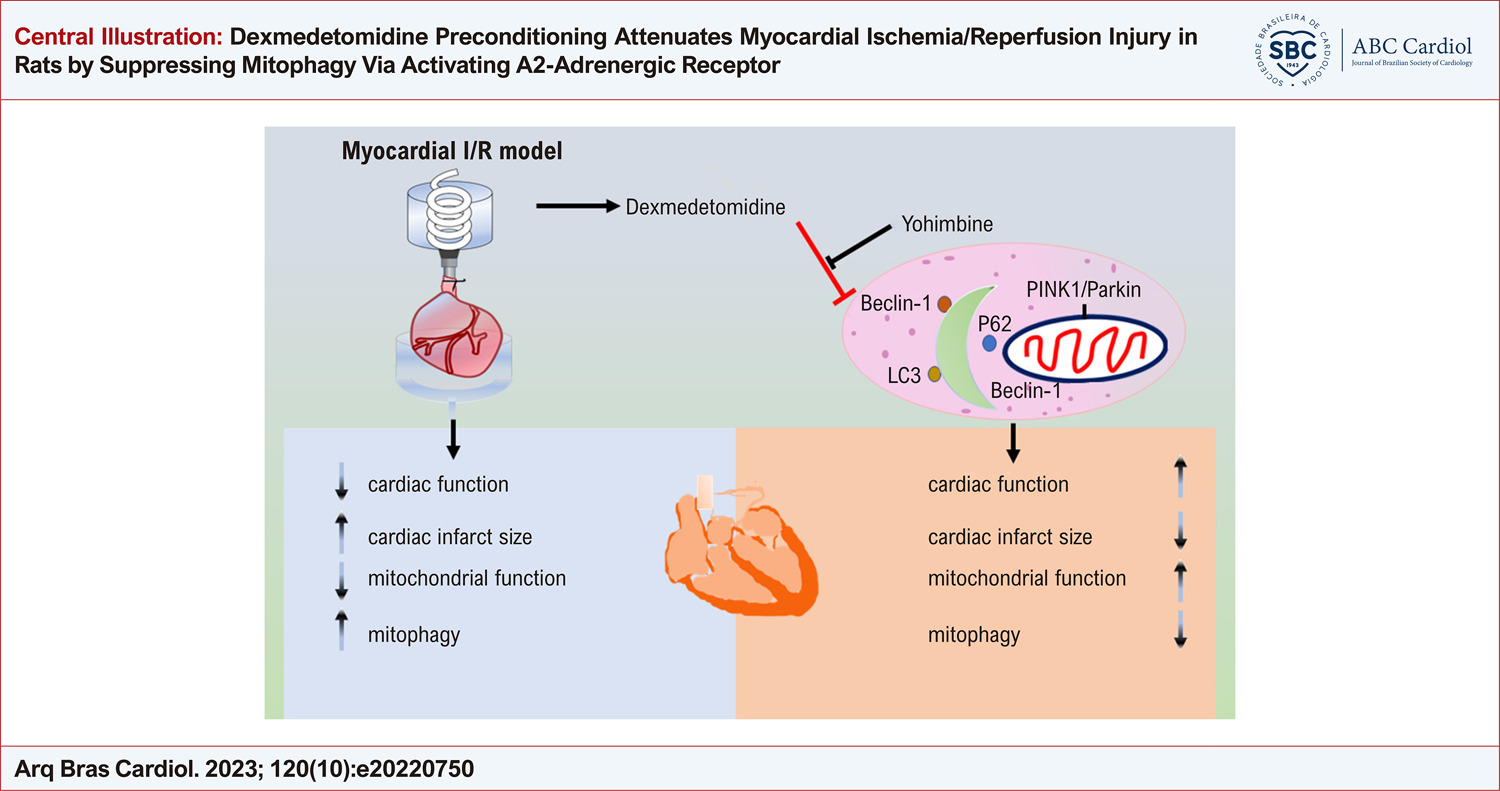
Hence, we aimed to investigate whether DEX preconditioning alleviates MIRI by suppressing mitophagy via α2-adrenergic receptor activation.

Method

Sixty isolated rat hearts were treated with or without DEX before inducing ischemia and reperfusion; an α2-adrenergic receptor antagonist, yohimbine (YOH), was also administered before ischemia, alone or with DEX. The heart rate (HR), left ventricular diastolic pressure (LVDP), left ventricular end-diastolic pressure (LVEDP), maximal and minimal rate of left ventricular pressure development (±dp/dtmax), and myocardial infarction size were measured. The mitochondrial ultrastructure and autophagosomes were assessed using transmission electron microscopy. Mitochondrial membrane potential and reactive oxygen species (ROS) levels were measured using JC-1 and dichloride hydrofluorescein diacetate assays, respectively. The expression levels of the mitophagy-associated proteins Beclin1, LC3II/I ratio, p62, PINK1, and Parkin were detected by western blotting.

Results

Compared with the control group, in the ischemia/reperfusion group, the HR, LVDP, and ±dp/dtmax were remarkably decreased (p< 0.05), whereas LVEDP and infarct sizes were significantly increased (p< 0.05). DEX preconditioning significantly improved cardiac dysfunction reduced myocardial infarction size, maintained mitochondrial structural integrity, increased mitochondrial membrane potential, inhibited autophagosomes formation, and decreased ROS production and Beclin1, LC3II/I ratio, PINK1, Parkin, and p62 expression(p< 0.05). When DEX and YOH were combined, YOH canceled the effect of DEX, whereas the use of YOH alone had no effect.

Conclusion

Therefore, DEX preconditioning was cardioprotective against MIRI in rats by suppressing mitophagy via α2-adrenergic receptor activation.

  • Dexmedetomidine
  • Mitophagy
  • Rats
  • Reperfusion Injury
Read Full Article
Creative Commons Attribution (CC BY) Creative Commons license
30/10/2023 DOI: 10.36660/abc.20220750 Views 2

How to cite this article

EndNote RIS

Electronic Document Format (Vancouver)

Maciel L. Pharmacological Conditioning is Salvageable by Dexmedetomidine: How a Sedative Can Mitigate I/R Injuries?. Arquivos Brasileiros de Cardiologia 2023;120(10):e20230696.

Electronic Document Format (ABNT)

Maciel, Leonardo. Pharmacological Conditioning is Salvageable by Dexmedetomidine: How a Sedative Can Mitigate I/R Injuries?. Arquivos Brasileiros de Cardiologia, v. 120, n. 10, e20230696, Nov. 2023.

Electronic Document Format (APA)

Maciel, L. (2023). Pharmacological Conditioning is Salvageable by Dexmedetomidine: How a Sedative Can Mitigate I/R Injuries?. Arquivos Brasileiros de Cardiologia, 120(10), e20230696.

Electronic Document Format (ISO)

Maciel, Leonardo. Pharmacological Conditioning is Salvageable by Dexmedetomidine: How a Sedative Can Mitigate I/R Injuries?. Arquivos Brasileiros de Cardiologia [online]. 2023, vol. 120, n. 10, [cited 2026-10-14], e20230696. Available from: <https://journals.cardiol.br/en/article/pharmacological-conditioning-is-salvageable-by-dexmedetomidine-how-a-sedative-can-mitigate-i-r-injuries/>. ISSN 0066-782X

EndNote RIS

Electronic Document Format (Vancouver)

Chen Y, Chen H, Chen Y, Yang Z, Zhou T, Xu W. Dexmedetomidine Preconditioning Attenuates Myocardial Ischemia/Reperfusion Injury in Rats by Suppressing Mitophagy Via Activating Α2-Adrenergic Receptor. Arquivos Brasileiros de Cardiologia 2023;120(10):e20220750.

Electronic Document Format (ABNT)

Chen, YaHua; Chen, Hui; Chen, YuJiao; Yang, ZaiQun; Zhou, Tao; Xu, Wei. Dexmedetomidine Preconditioning Attenuates Myocardial Ischemia/Reperfusion Injury in Rats by Suppressing Mitophagy Via Activating Α2-Adrenergic Receptor. Arquivos Brasileiros de Cardiologia, v. 120, n. 10, e20220750, Oct. 2023.

Electronic Document Format (APA)

Chen, Y., Chen, H., Chen, Y., Yang, Z., Zhou, T., & Xu, W. (2023). Dexmedetomidine Preconditioning Attenuates Myocardial Ischemia/Reperfusion Injury in Rats by Suppressing Mitophagy Via Activating Α2-Adrenergic Receptor. Arquivos Brasileiros de Cardiologia, 120(10), e20220750.

Electronic Document Format (ISO)

Chen, YaHua and Chen, Hui and Chen, YuJiao and Yang, ZaiQun and Zhou, Tao and Xu, Wei. Dexmedetomidine Preconditioning Attenuates Myocardial Ischemia/Reperfusion Injury in Rats by Suppressing Mitophagy Via Activating Α2-Adrenergic Receptor. Arquivos Brasileiros de Cardiologia [online]. 2023, vol. 120, n. 10, [cited 2026-10-14], e20220750. Available from: <https://journals.cardiol.br/en/article/dexmedetomidine-preconditioning-attenuates-myocardial-ischemia-reperfusion-injury-in-rats-by-suppressing-mitophagy-via-activating-%ce%b12-adrenergic-receptor/>. ISSN 0066-782X

  • About ABC Family
  • Internal Regulation
  • Editorial Board
  • Brazilian Society of Cardiology (SBC)

Issues

SBC Guidelines

  • Videos
  • Podcasts
  • News