ABC Family Arquivos Brasileiros de Cardiologia International Journal of Cardiovascular Sciences ABC Heart Failure & Cardiomyopathy ABC Imagem Cardiovascular
Português English
ABC Family
Português English
  • About
    • About ABC Family
    • Internal Regulation
    • Editorial Board
    • Brazilian Society of Cardiology (SBC)
  • Issues
  • SBC Guidelines
  • Content
    • Videos
    • Podcasts
    • News
  • About
    • About ABC Family
    • Internal Regulation
    • Editorial Board
    • Brazilian Society of Cardiology (SBC)
  • Issues
  • SBC Guidelines
  • Content
    • Videos
    • Podcasts
    • News

ABC Family

  • ABC Family
  • Arquivos Brasileiros de Cardiologia
  • International Journal of Cardiovascular Sciences
  • ABC Heart Failure & Cardiomyopathy
  • ABC Imagem Cardiovascular
Search in

No content found.

Journals
Ordering
Article types
Others

  1. Home
  2. Keyword: Infant, low birth weight
Figure 1
ABC
Original Article

What Should be the First-line Treatment for the Closure of Hemodynamically Significant Patent Ductus Arteriosus in Premature Infants?

Ufuk Cakir et al. Cuneyt Tayman

Abstract

Background

It is important which medicine to use as a first-line treatment to close the duct.

Objectives

The aim of this study is to compare the effectiveness and side effects of intravenous (IV) forms of ibuprofen and paracetamol and to contribute to the literature investigating the first drug selected in the medical treatment of patent ductus arteriosus (PDA).

Methods

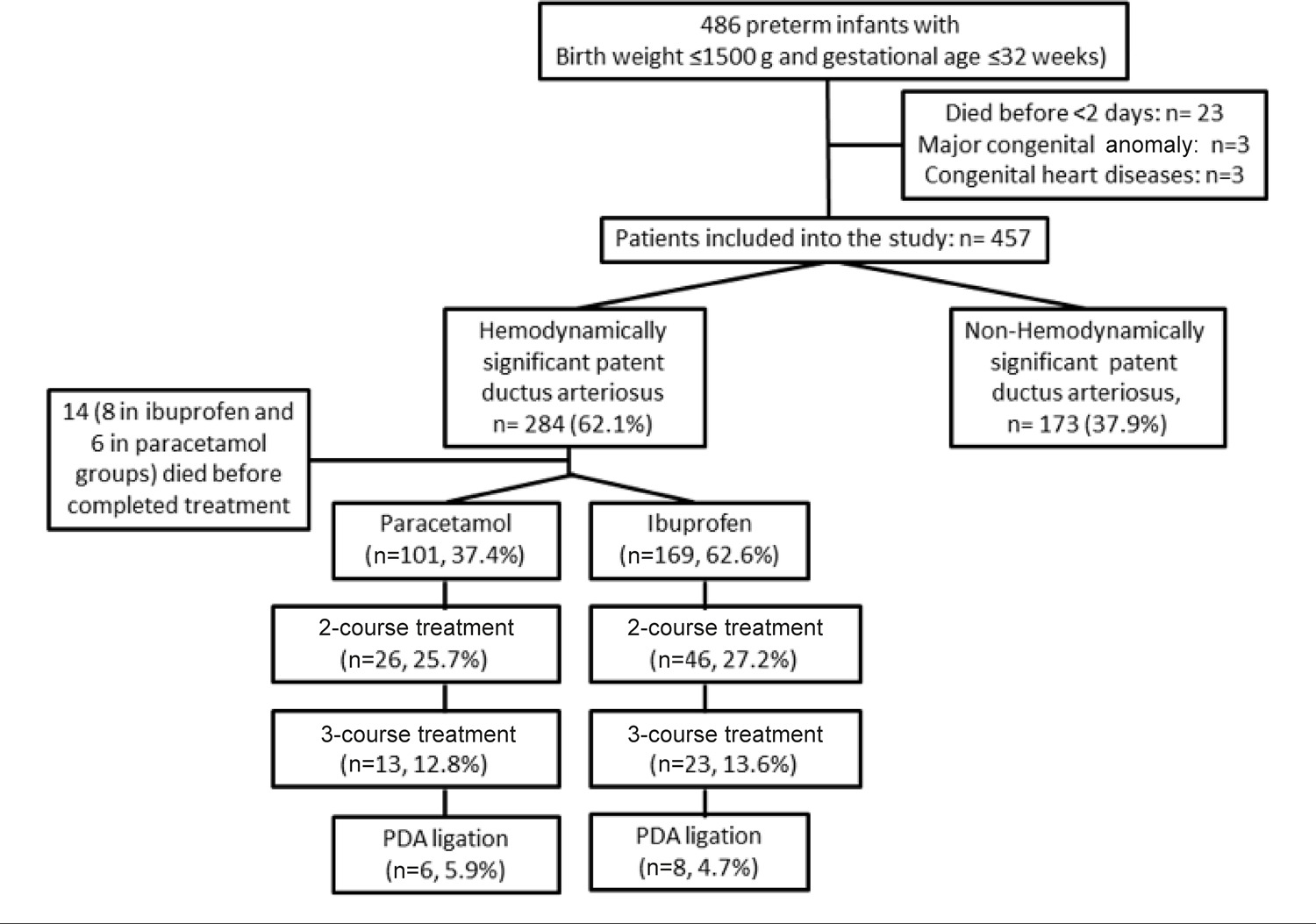
Our study was conducted between January 2017 and December 2019. Premature infants with birth weight (BW) ≤1500 g and gestational age (GA) ≤32 weeks were included in the study. In the study period, all infants with hemodynamically significant patent ductus arteriosus (hsPDA) were given rescue intravenous (IV) ibuprofen as a primary medical treatment or IV paracetamol treatment if there were contraindications for ibuprofen. The patients were divided into two groups: patients receiving IV ibuprofen and patients receiving IV paracetamol.

Results

Of these patients, 101 were given IV paracetamol and 169 were given IV ibuprofen. The success rate of PDA closure with first-course treatment was 74.3% in the IV paracetamol group and 72.8% in the IV ibuprofen group (p=0.212).

Conclusions

Our results show that IV paracetamol is as effective as IV ibuprofen in the first-line treatment of hsPDA, and can become the preferred treatment for the management of hsPDA.

  • Acetaminophen/therapeutic use
  • Ductus Arteriosus Patent/surgery
  • Ibuprofen/therapeutic use
  • Infant, low birth weight
  • Infant, premature
Read Full Article
Creative Commons Attribution (CC BY) Creative Commons license
18/03/2022 DOI: 10.36660/abc.20201361
Low birth weight as a marker of changes in ambulatory blood pressure monitoring
ABC
Artigo Original

Low birth weight as a marker of changes in ambulatory blood pressure monitoring

Cláudia Maria Salgado et al. Paulo César Brandão Veiga Jardim Flávio Bittencourt Gonçalves Teles Mariana Cabral Nunes

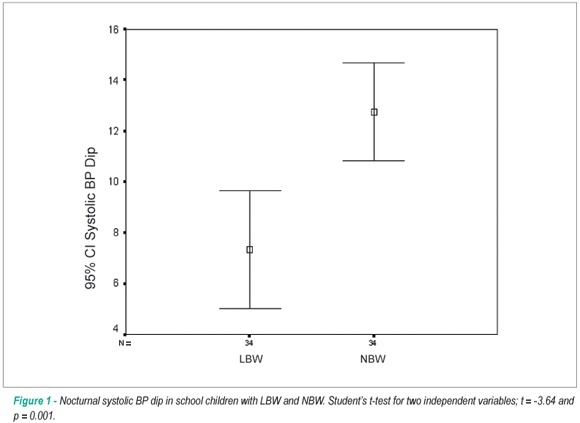
BACKGROUND: Low birth weight (LBW) is associated with increased incidence of high blood pressure (BP) and cardiovascular diseases in adulthood. OBJECTIVE: To evaluate possible changes in Ambulatory Blood Pressure Monitoring (ABPM) in LBW children. METHODS: The birth weight (BW) of 1049 school children (ages 8 to 11) living in Goiânia was assessed. Children with low birth weight (BW 3.0 Kg). Information on birth weight was obtained from each child’s health card. Casual BP and ABPM were measured. Height and weight measurements were obtained to calculate the body mass index (BMI), and sexual maturity was assessed according to Tanner’s criteria (those at Tanner stage > 2 were excluded). RESULTS: Thirty-four children had low birth weight (LBW) and 34 had normal birth weight (NBW). Both groups were similar regarding age, gender, race, body weight, height, BMI, and family history of hypertension. Low-birth-weight children had higher casual systolic blood pressure (SBP) (p = 0.007). ABPM recordings showed that these children had higher 24-hour diastolic blood pressure (DBP) (p = 0.009), daytime DBP (p = 0.002), night-time DBP and SBP (p = 0.005 and p = 0.001), and reduced nocturnal dip in SBP and DBP (p = 0.001) than those born with normal weight. Birth weight was positively correlated with nocturnal dip in SBP (p = 0.022) and negatively correlated with sleep SBP (p = 0.032). CONCLUSION: Low-birth-weight children have higher BP and changes in circadian rhythm of blood pressure, with reduced nocturnal dipping. These findings may reflect increased risk of adult hypertension and cardiovascular diseases.

  • Blood Pressure
  • Infant, low birth weight
  • monitoring ambulatory
Read Full Article
Creative Commons Attribution (CC BY) Creative Commons license
06/04/2009 DOI: 10.1590/S0066-782X2009000200007

How to cite this article

EndNote RIS

Electronic Document Format (Vancouver)

Cakir U, Tayman C. What Should be the First-line Treatment for the Closure of Hemodynamically Significant Patent Ductus Arteriosus in Premature Infants?. Arquivos Brasileiros de Cardiologia 2022;118(3):548-55.

Electronic Document Format (ABNT)

Cakir, Ufuk; Tayman, Cuneyt. What Should be the First-line Treatment for the Closure of Hemodynamically Significant Patent Ductus Arteriosus in Premature Infants?. Arquivos Brasileiros de Cardiologia, v. 118, n. 3, p. 548-555, Mar. 2022.

Electronic Document Format (APA)

Cakir, U., & Tayman, C. (2022). What Should be the First-line Treatment for the Closure of Hemodynamically Significant Patent Ductus Arteriosus in Premature Infants?. Arquivos Brasileiros de Cardiologia, 118(3), 548-555.

Electronic Document Format (ISO)

Cakir, Ufuk and Tayman, Cuneyt. What Should be the First-line Treatment for the Closure of Hemodynamically Significant Patent Ductus Arteriosus in Premature Infants?. Arquivos Brasileiros de Cardiologia [online]. 2022, vol. 118, n. 3, [cited 2026-10-14], pp. 548-555. Available from: <https://journals.cardiol.br/en/article/what-should-be-the-first-line-treatment-for-the-closure-of-hemodynamically-significant-patent-ductus-arteriosus-in-premature-infants/>. ISSN 0066-782X

EndNote RIS

Electronic Document Format (Vancouver)

Salgado CM, Jardim PCBV, Teles FBG, Nunes MC. Low birth weight as a marker of changes in ambulatory blood pressure monitoring. Arquivos Brasileiros de Cardiologia 2009;92(2):113-21.

Electronic Document Format (ABNT)

Salgado, Cláudia Maria; Jardim, Paulo César Brandão Veiga; Teles, Flávio Bittencourt Gonçalves; Nunes, Mariana Cabral. Low birth weight as a marker of changes in ambulatory blood pressure monitoring. Arquivos Brasileiros de Cardiologia, v. 92, n. 2, p. 113-121, Apr. 2009.

Electronic Document Format (APA)

Salgado, C. M., Jardim, P. C. B. V., Teles, F. B. G., & Nunes, M. C. (2009). Low birth weight as a marker of changes in ambulatory blood pressure monitoring. Arquivos Brasileiros de Cardiologia, 92(2), 113-121.

Electronic Document Format (ISO)

Salgado, Cláudia Maria and Jardim, Paulo César Brandão Veiga and Teles, Flávio Bittencourt Gonçalves and Nunes, Mariana Cabral. Low birth weight as a marker of changes in ambulatory blood pressure monitoring. Arquivos Brasileiros de Cardiologia [online]. 2009, vol. 92, n. 2, [cited 2026-10-14], pp. 113-121. Available from: <https://journals.cardiol.br/en/article/low-birth-weight-as-a-marker-of-changes-in-ambulatory-blood-pressure-monitoring/>. ISSN 0066-782X

  • About ABC Family
  • Internal Regulation
  • Editorial Board
  • Brazilian Society of Cardiology (SBC)

Issues

SBC Guidelines

  • Videos
  • Podcasts
  • News