ABC Family Arquivos Brasileiros de Cardiologia International Journal of Cardiovascular Sciences ABC Heart Failure & Cardiomyopathy ABC Imagem Cardiovascular
Português English
ABC Family
Português English
  • About
    • About ABC Family
    • Internal Regulation
    • Editorial Board
    • Brazilian Society of Cardiology (SBC)
  • Issues
  • SBC Guidelines
  • Content
    • Videos
    • Podcasts
    • News
  • About
    • About ABC Family
    • Internal Regulation
    • Editorial Board
    • Brazilian Society of Cardiology (SBC)
  • Issues
  • SBC Guidelines
  • Content
    • Videos
    • Podcasts
    • News

ABC Family

  • ABC Family
  • Arquivos Brasileiros de Cardiologia
  • International Journal of Cardiovascular Sciences
  • ABC Heart Failure & Cardiomyopathy
  • ABC Imagem Cardiovascular
Search in

No content found.

Journals
Ordering
Article types
Others

  1. Home
  2. Keyword: Hospital Mortality, Risk Assessment/methods
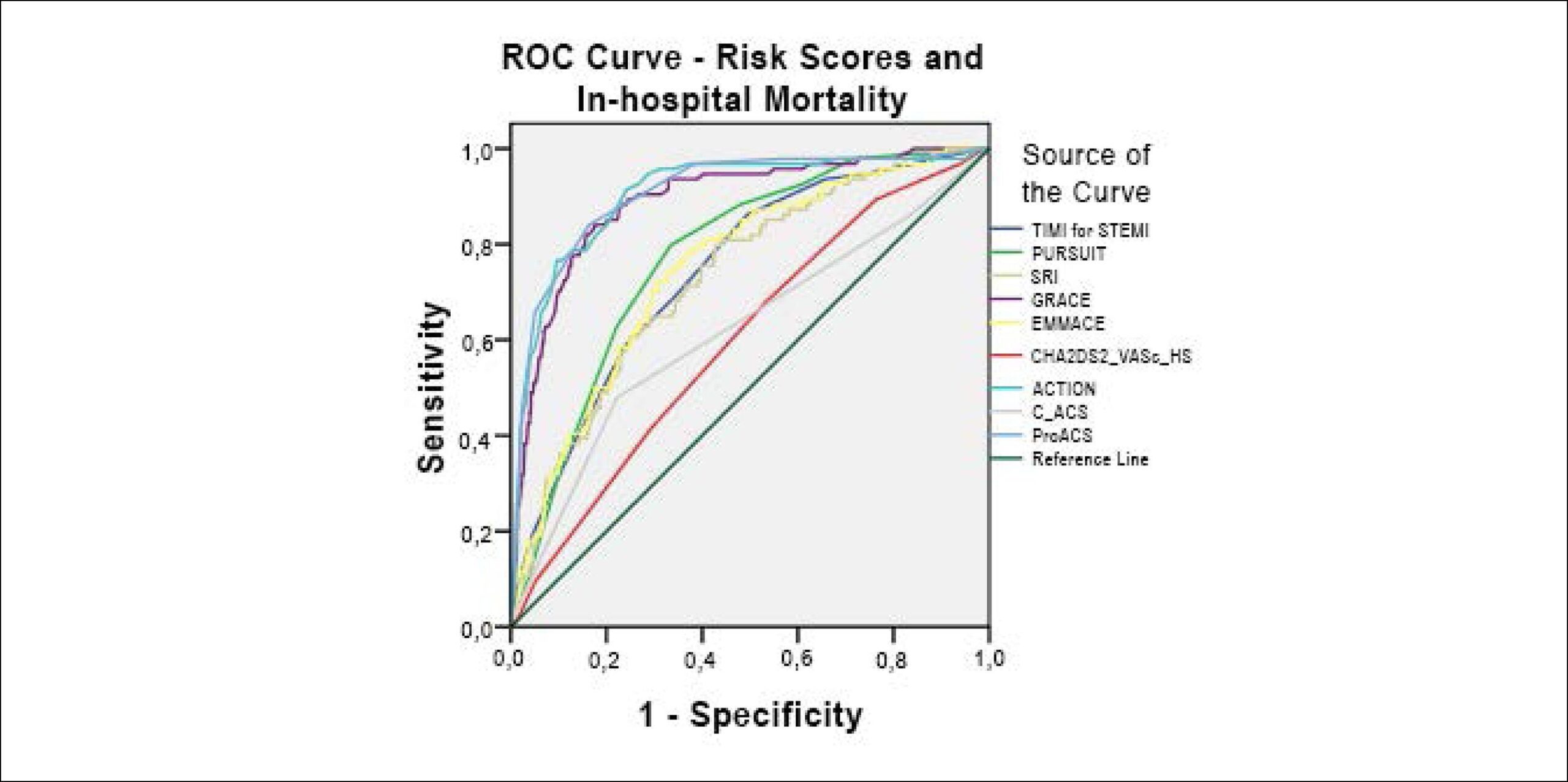
Figure 1
ABC
Original Article

Application of Risks Scores in Acute Coronary Syndromes. How Does ProACS Hold Up Against Other Risks Scores?

Júlio Gil et al. Luís Abreu Hugo Antunes Maria Luísa Gonçalves … Maria Inês Pires Luís Ferreira dos Santos Carla Henriques Ana Matos José Costa Cabral Jorge Oliveira Santos

Abstract

Background:

Multiple risk scores (RS) are approved in the prediction of worse prognosis in acute coronary syndromes (ACS). Recently, the Portuguese Journal of Cardiology has proposed the ProACS RS.

Objective:

Application of several validated RS, as well as ProACS in patients, admitted for ACS. Evaluation of each RS’s performance in predicting in-hospital mortality and the occurrence of all-cause mortality or non-fatal ACS at one-year follow-up and compare them to the ProACS RS.

Methods:

A retrospective study of ACS was performed. The following RS were applied: GRACE, ACTION Registry-GWTG, PURSUIT, TIMI, EMMACE, SRI, CHA2DS2-VASc-HS, C-ACS and ProACS. ROC Curves were created to determine the predictive power for each RS and then were directly compared to ProACS.

Results:

The ProACS, ACTION Registry-GWTG and GRACE showed a c-statistics of 0.908, 0.904 and 0.890 for predicting in-hospital mortality, respectively, performing better in ST-segment elevation myocardial infarction patients. The other RS performed satisfactorily, with c-statistics over 0.750, apart from the CHA2DS2-VASc-HS and C-ACS which underperformed. All RS underperformed in predicting worse long-term prognosis revealing c-statistics under 0.700.

Conclusion:

ProACS is an easily obtained risk score for early stratification of in-hospital mortality. When evaluating all RS, the ProACS, ACTION Registry-GWTG and GRACE RS showed the best performance, demonstrating high capability of predicting a worse prognosis. ProACS was able to demonstrate statistically significant superiority when compared to almost all RS. Thus, the ProACS has showed that it is able to combine simplicity in the calculation of the score with good performance in predicting a worse prognosis.

  • Acute Coronary Syndrome/prognosis
  • Hospital Mortality, Risk Assessment/methods
  • ST Elevation Myocardial Infarction
  • Survival Rate/methods
Read Full Article
Creative Commons Attribution (CC BY) Creative Commons license
27/06/2019 DOI: 10.5935/abc.20190109 Views 1

How to cite this article

EndNote RIS

Electronic Document Format (Vancouver)

Gil J, Abreu L, Antunes H, Gonçalves ML, Pires MI, Santos LF, Henriques C, et al. Application of Risks Scores in Acute Coronary Syndromes. How Does ProACS Hold Up Against Other Risks Scores?. Arquivos Brasileiros de Cardiologia 2019;113(1):20-3.

Electronic Document Format (ABNT)

Gil, Júlio; Abreu, Luís; Antunes, Hugo; Gonçalves, Maria Luísa; Pires, Maria Inês; Santos, Luís Ferreira dos; Henriques, Carla; Matos, Ana; Cabral, José Costa; Santos, Jorge Oliveira. Application of Risks Scores in Acute Coronary Syndromes. How Does ProACS Hold Up Against Other Risks Scores?. Arquivos Brasileiros de Cardiologia, v. 113, n. 1, p. 20-30, Jun. 2019.

Electronic Document Format (APA)

Gil, J., Abreu, L., Antunes, H., Gonçalves, M. L., Pires, M. I., Santos, L. F. , Henriques, C., Matos, A., Cabral, J. C., & Santos, J. O. (2019). Application of Risks Scores in Acute Coronary Syndromes. How Does ProACS Hold Up Against Other Risks Scores?. Arquivos Brasileiros de Cardiologia, 113(1), 20-30.

Electronic Document Format (ISO)

Gil, Júlio and Abreu, Luís and Antunes, Hugo and Gonçalves, Maria Luísa and Pires, Maria Inês and Santos, Luís Ferreira dos and Henriques, Carla and Matos, Ana and Cabral, José Costa and Santos, Jorge Oliveira. Application of Risks Scores in Acute Coronary Syndromes. How Does ProACS Hold Up Against Other Risks Scores?. Arquivos Brasileiros de Cardiologia [online]. 2019, vol. 113, n. 1, [cited 2026-10-14], pp. 20-30. Available from: <https://journals.cardiol.br/en/article/application-of-risks-scores-in-acute-coronary-syndromes-how-does-proacs-hold-up-against-other-risks-scores/>. ISSN 0066-782X

  • About ABC Family
  • Internal Regulation
  • Editorial Board
  • Brazilian Society of Cardiology (SBC)

Issues

SBC Guidelines

  • Videos
  • Podcasts
  • News