Maíra Viana Rego Souza-Silva et al. Daniella Nunes Pereira Magda Carvalho Pires Isabela Muzzi Vasconcelos … Alexandre Vargas Schwarzbold Diego Henrique de Vasconcelos Elayne Crestani Pereira Euler Roberto Fernandes Manenti Felício Roberto Costa Filipe Carrilho de Aguiar Fernando Anschau Frederico Bartolazzi Guilherme Fagundes Nascimento Heloisa Reniers Vianna Joanna d’Arc Lyra Batista Juliana Machado-Rugolo Karen Brasil Ruschel Maria Angélica Pires Ferreira Leonardo Seixas de Oliveira Luanna Silva Monteiro Menezes Patricia Klarmann Ziegelmann Marcela Gonçalves Trindade Tofani Maria Aparecida Camargos Bicalho Matheus Carvalho Alves Nogueira Milton Henriques Guimarães-Júnior Rúbia Laura Oliveira Aguiar Danyelle Romana Alves Rios Carisi Anne Polanczyk Milena Soriano Marcolino
Abstract
Background
Despite no evidence showing benefits of hydroxychloroquine and chloroquine with or without azithromycin for COVID-19 treatment, these medications have been largely prescribed in Brazil.
Objectives
To assess outcomes, including in-hospital mortality, electrocardiographic abnormalities, hospital length-of-stay, admission to the intensive care unit, and need for dialysis and mechanical ventilation, in hospitalized COVID-19 patients who received chloroquine or hydroxychloroquine, and to compare outcomes between those patients and their matched controls.
Methods
A retrospective multicenter cohort study that included consecutive laboratory-confirmed COVID-19 patients from 37 Brazilian hospitals from March to September 2020. Propensity score was used to select matching controls by age, sex, cardiovascular comorbidities, and in-hospital use of corticosteroid. A p-value <0.05 was considered statistically significant.
Results
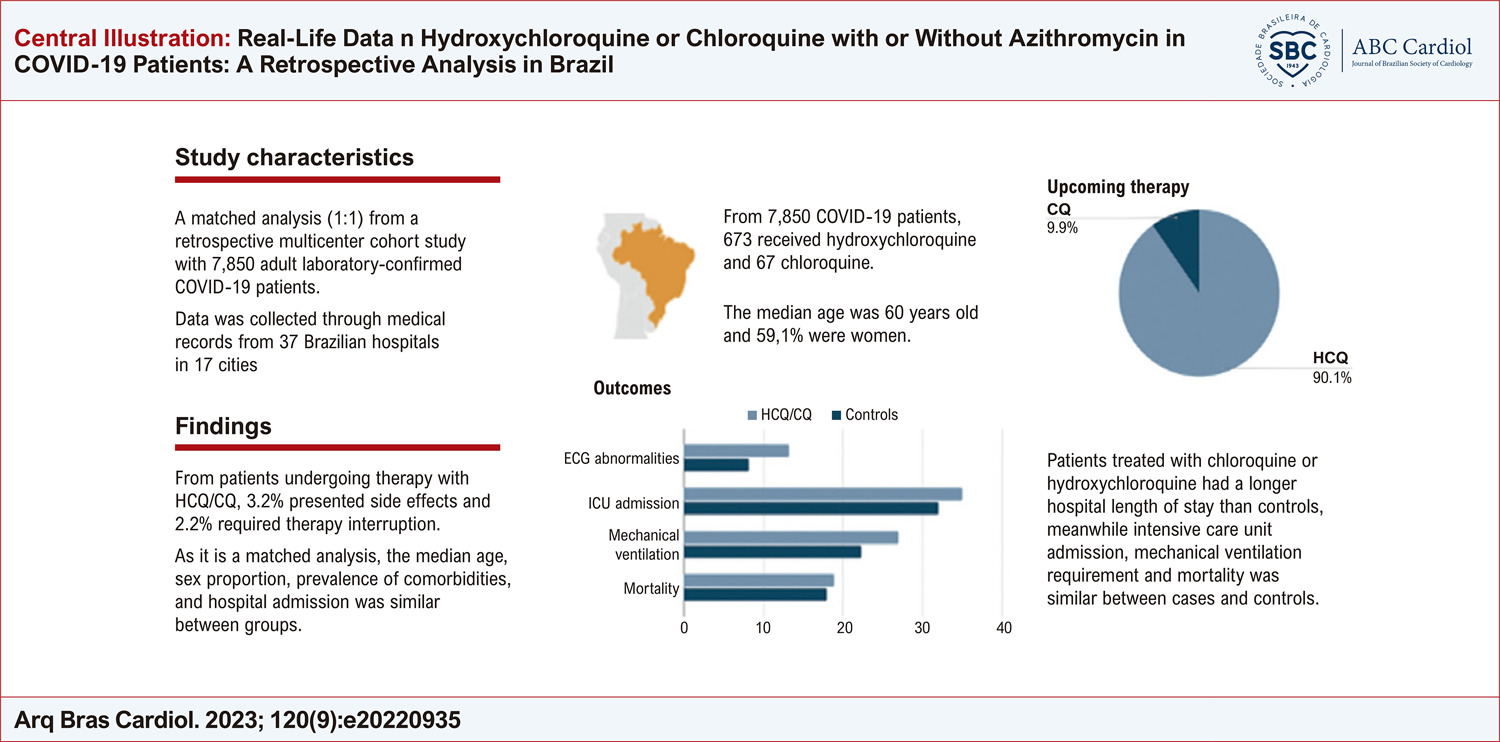
From 7,850 COVID-19 patients, 673 (8.6%) received hydroxychloroquine and 67 (0.9%) chloroquine. The median age in the study group was 60 years (46 – 71) and 59.1% were women. During hospitalization, 3.2% of patients presented side effects and 2.2% required therapy discontinuation. Electrocardiographic abnormalities were more prevalent in the chloroquine/hydroxychloroquine group (13.2% vs. 8.2%, p=0.01), and the long corrected QT interval was the main difference (3.6% vs. 0.4%, p<0.001). The median hospital length of stay was longer in the HCQ/CQ + AZT group than in controls (9.0 [5.0, 18.0] vs. 8.0 [4.0, 14.0] days). There was no statistical differences between groups in intensive care unit admission (35.1% vs. 32.0%; p=0.282), invasive mechanical ventilation support (27.0% vs. 22.3%; p=0.074) or mortality (18.9% vs. 18.0%; p=0.682).
Conclusion
COVID-19 patients treated with chloroquine or hydroxychloroquine had a longer hospital length of stay, when compared to matched controls. Intensive care unit admission, invasive mechanical ventilation, dialysis and in-hospital mortality were similar.