Relative role of left ventricular geometric remodeling and of morphological and functional myocardial remodeling in the transition from compensated hypertrophy to heart failure in rats with supravalvar aortic stenosis
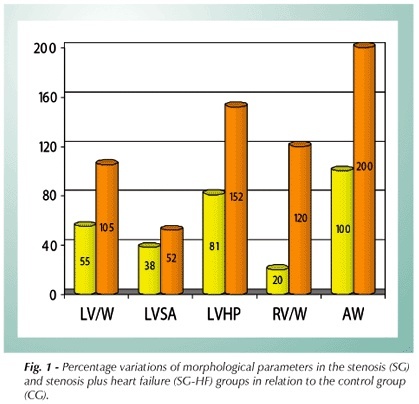
OBJECTIVE: To evaluate the relative contribution of left ventricular (LV) geometric remodeling and of morphological and functional myocardial changes in rats with induced supravalvar aortic stenosis (SAS), in the transition from compensated hypertrophy to congestive heart failure (CHF). METHODS: Twenty one weeks after induction of SAS, the rats were classified as controls (CG, n=13), without congestive heart failure (SG, n=11), or with congestive heart failure (SG-HF, n=12). All groups were evaluated with echocardiographic, hemodynamic and morphological study of the myocardium. RESULTS: Twenty one weeks after SAS: mass index (SG-HF>SG>CG, pCG, pSG>CG, pSG>CG, pSG>CG, pSG>CG, p<0.05). In the SG-HF group, LV geometric remodeling was characterized by a significant increase in dimensions and relative thickness of the normal wall (excentric remodeling), whereas the SG group presented a concentric remodeling. Indexes of LV performance in the SG-HF group were significantly lower than those of the SG group. CONCLUSION: The SG-HF and SG groups differed primarily in the LV geometric remodeling and structural myocardial remodeling process, which established a chronically compensated state in the SG group and triggered CHF in the SG-HF group in the presence of equivalent degrees of impaired contractility.
Images
Image gallery fullscreen viewer
Comments are moderated by the editorial team before publication. Discussions should be evidence-based and use scientific language. Conflicts of interest should be declared.