Does a circadian variation occur in myocardial ischemia over 48 hours in patients with unstable angina?
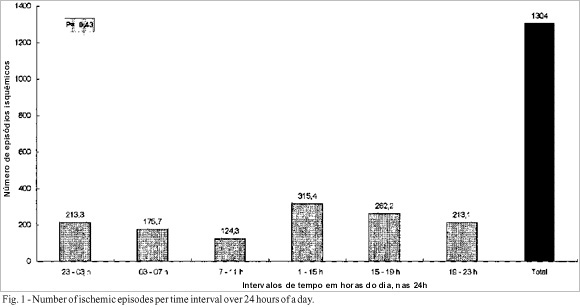
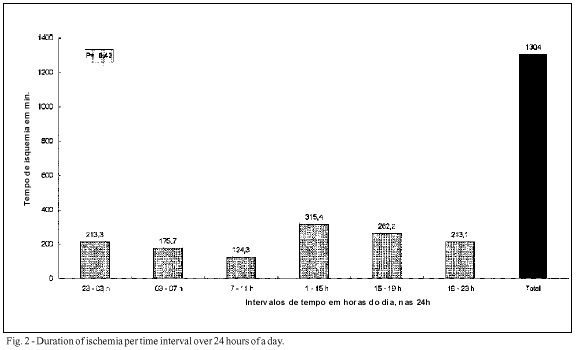
OBJECTIVE: To study the incidence of and variation in myocardial ischemia over 48 hours in patients with unstable angina. METHODS: Thirty-nine patients with unstable angina underwent long-term electrocardiography for 48 hours. The number of events and the period of time of ischemia (in minutes) were analyzed for the 48 hours, in two periods of 24 hours, and in periods of 4 hours. RESULTS: We analyzed 1755.8 hours of monitoring tapes, and ischemic episodes were detected in 18 (46.2%) patients, corresponding to 173 ischemic episodes, allowing the evaluation of 1304 minutes of ischemia.only 4 of which were (2.2%) symptomatic, Considering the entire period of time of recording and the predetermined time intervals, we observed a higher number of ischemic episodes (38) and a longer duration of ischemia (315.4 minutes) between 11:00 am and 3:00 pm. However, no significant differences occurred among the values in the different intervals. CONCLUSION: Long-term electrocardiography over 48 hours showed a high incidence (97.8%) of silent ischemic episodes in patients with unstable angina. No evidence of a circadian variation of myocardial ischemia in unstable angina was observed.
Images
Image gallery fullscreen viewer
Comments are moderated by the editorial team before publication. Discussions should be evidence-based and use scientific language. Conflicts of interest should be declared.