How can the echocardiogram be useful for predicting death in children with idiopathic dilated cardiomyopathy?
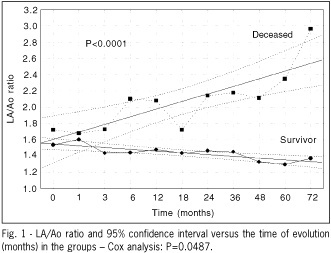
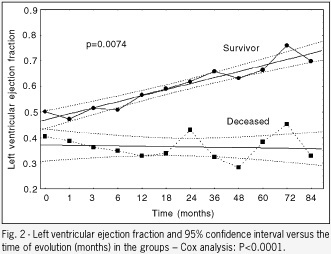
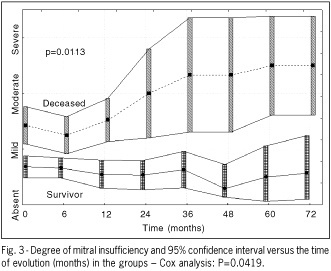
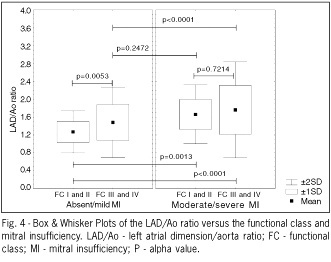
OBJECTIVE: To determine the echocardiographic predicting factors of death in children with idiopathic dilated cardiomyopathy. METHODS: A retrospective study of 148 children with idiopathic dilated cardiomyopathy diagnosed between September 1979 and March 2003 was carried out. The inclusion criteria were as follows: heart failure and a reduction in contractility on the echocardiogram in the absence of congenital or secondary heart disease. Four hundred and seventy examinations during a period of 244.8 months of evolution were analyzed. The following parameters were assessed: left atrial dimension (LAD); left atrium/aorta ratio (LAD/Ao); left ventricular systolic (LVSD) and diastolic (LVDD) dimensions; left ventricular mass (LVmass); right ventricular dimension (RVD); left ventricular ejection fraction (LVEF); left ventricular shortening fraction (% SH); severity of the insufficiency of the atrioventricular and pulmonary valves; and right ventricular systolic (RVSP) and diastolic (RVDP) pressures. The significance level adopted was alpha < 0.05. RESULTS: The mean age was 2.37 years, and 35 patients died (23.7% – 95 CI = 17.1% to 31.2%). The analysis of variance showed the following: LAD (p<0.0001); LAD/Ao (p<0.0001); LVSD (p=0.0061); LVDD (p=0.0086); LVmass (p<0.0001); LVEF (p=0.0074); %SH (p=0.0072); and RVD (p<0.0001). Worsening of mitral (MI) (p=0.0113) and tricuspid (TI) insufficiencies (p=0.0044) were markers of death, and the presence of MI, TI, and moderate/severe pulmonary insufficiency were deleterious to survival. The Cox proportional hazards regression model showed the following independent predictors of death: LAD/Ao (p=0.0487); LVEF (<0.0001); and the presence of moderate/severe MI (p=0.0419). CONCLUSION: Patients with a progressive increase in LAD/Ao, a reduction in LVEF, and progressive worsening of MI, regardless of the clinical treatment, should be considered for early heart transplantation.
Images
Image gallery fullscreen viewer
Comments are moderated by the editorial team before publication. Discussions should be evidence-based and use scientific language. Conflicts of interest should be declared.